 Think of one English sentence that introduces you by name and one simple fact. Two or three of you will share with the class. Ready?
Today you will learn to do that in German: say who you are, ask a classmate, and swap a little about where you come from.
By the end of this lesson, you will be able to:
- Introduce yourself by name in German
- Ask a classmate their name and where they come from
- Notice what people choose to say about themselves
You are about to hear seven short German introductions, one at a time. Listen to each one, then say it back together as a class. As you go, notice which lines tell people your name, which ask a question, and which talk about where you are from.
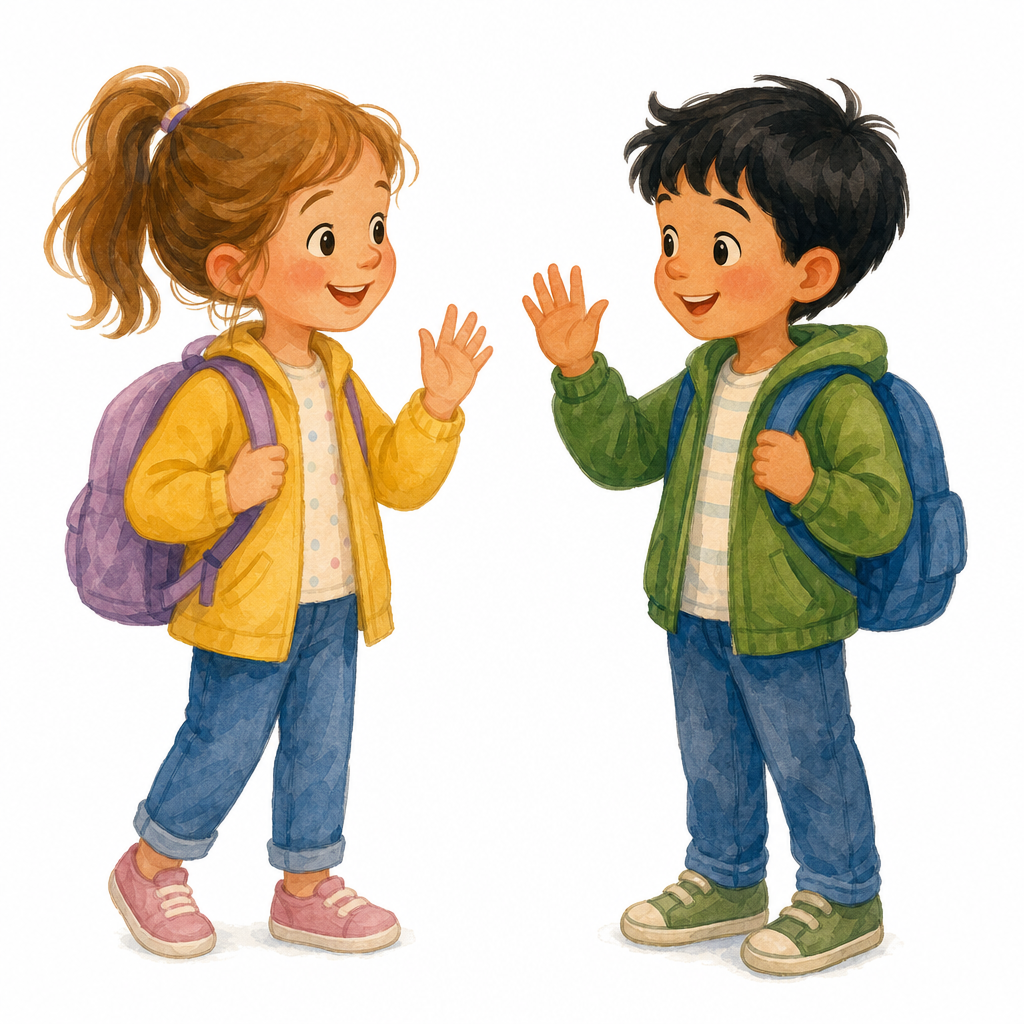
Picture two new pupils meeting on the first day at a Berlin Grundschule (primary school). First, listen to one short chat with a German name such as Lukas or Emma, then you will join in.
Polite tip: In the formal name question, Sie means polite "you" (said "zee"). It is not a girl's name here.
Volunteers will click the pairs on the board. Before each click, the whole class tries to say the German aloud together. When a match is found, everyone repeats the German phrase once more.
Keep the word list and these two model lines on the board while you write.
Ich heiße Cara.
Ich komme aus Cork.
Open your copy and write the same two sentences about you. Take care with capital Ich and the special letter ß in heiße (sharp double-s sound, not a plain B).
- Ich heiße — My name is
- Wie heißt du? — What's your name? (informal)
- Wie heißen Sie? — What's your name? (formal)
- Ich bin — I am
- Ich komme aus... — I come from...
- Und du? — And you?
- Woher kommst du? — Where do you come from?
Stand up and face a partner. Run the short name-and-home chat on the board: one of you asks, the other answers, then you swap and add where you come from. When you finish, find a new partner and try again.
After a few rounds, some of you will be asked the polite form, the way an adult would ask it. Answer with your name phrase.
Unlock the full learning experience
You're previewing this lesson. Get full access to this lesson and hundreds more — each one ready to teach, with interactive activities, printable resources and pupil progress tracking built in.
This lesson is copyright of Coding Ireland 2017 - 2026. Unauthorised use, copying or distribution is not allowed.