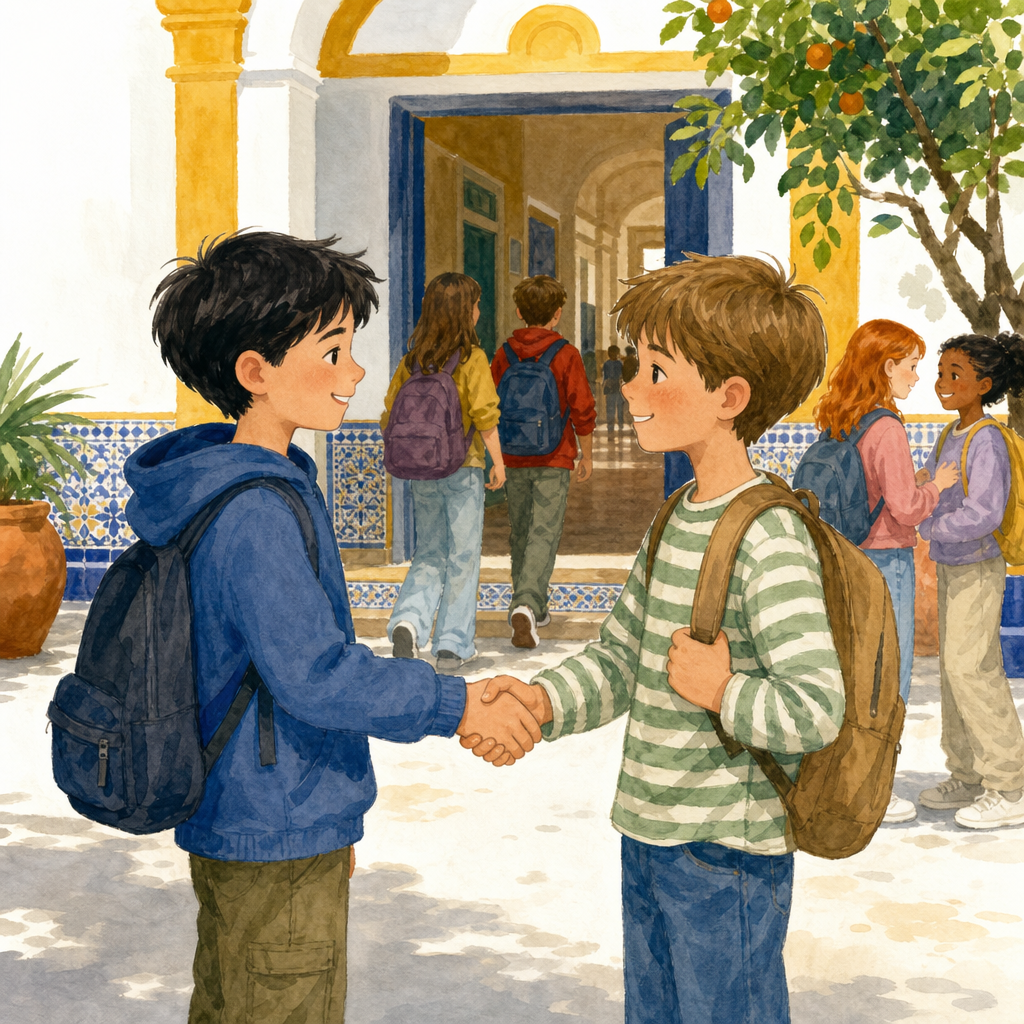
 First day at a school in Valencia. The bell is about to go and you have thirty seconds to meet someone in Spanish. What do you actually need?
You already know how to say hello. Today you learn the phrases that turn a hello into a real introduction: how to give your own name, and how to ask for someone else's.
By the end of this lesson, you will be able to:
- Say your own name in Spanish
- Ask someone else their name
- Spot that Spanish says "I call myself" rather than "my name is"
Tap each phrase on the board, listen carefully, then say it back together. Listen for the soft y sound in llamo and llamas, like the y in yes.
Core exchange to practise:
A: ¿Cómo te llamas? (What's your name?)
B: Me llamo Seán. ¿Y tú? (My name is Seán. And you?)
A: Me llamo Lucía. Soy de Valencia. (My name is Lucía. I'm from Valencia.)
Someone is introducing themselves in Spanish. Listen to the whole clip twice on the class speakers before anyone answers, then choose the answers that match what you heard.
Keep the phrases on the board. Copy Me llamo ___ (your own name) and ¿Cómo te llamas? into your copy. Watch the upside-down ¿ and the accent on Cómo: copy them exactly from the board.
- Me llamo — My name is
- ¿Cómo te llamas? — What's your name? (informal)
- ¿Cómo se llama usted? — What's your name? (formal)
- soy — I am
- ¿Y tú? — And you? (informal)
- ¿Y usted? — And you? (formal)
- Soy de... — I am from...
You are new classmates on the first day in Valencia. Use the shared script on the board.
Shared script (everyone can see both lines):
Partner A: ¿Cómo te llamas?
Partner B: Me llamo _____. ¿Y tú?
Then swap roles.
Optional stretch: add Soy de _____. (a place you choose) after your name.
Cover the other role with your hand if you want a challenge. Keep the script up as support whenever you need it.
Unlock the full learning experience
You're previewing this lesson. Get full access to this lesson and hundreds more — each one ready to teach, with interactive activities, printable resources and pupil progress tracking built in.
This lesson is copyright of Coding Ireland 2017 - 2026. Unauthorised use, copying or distribution is not allowed.