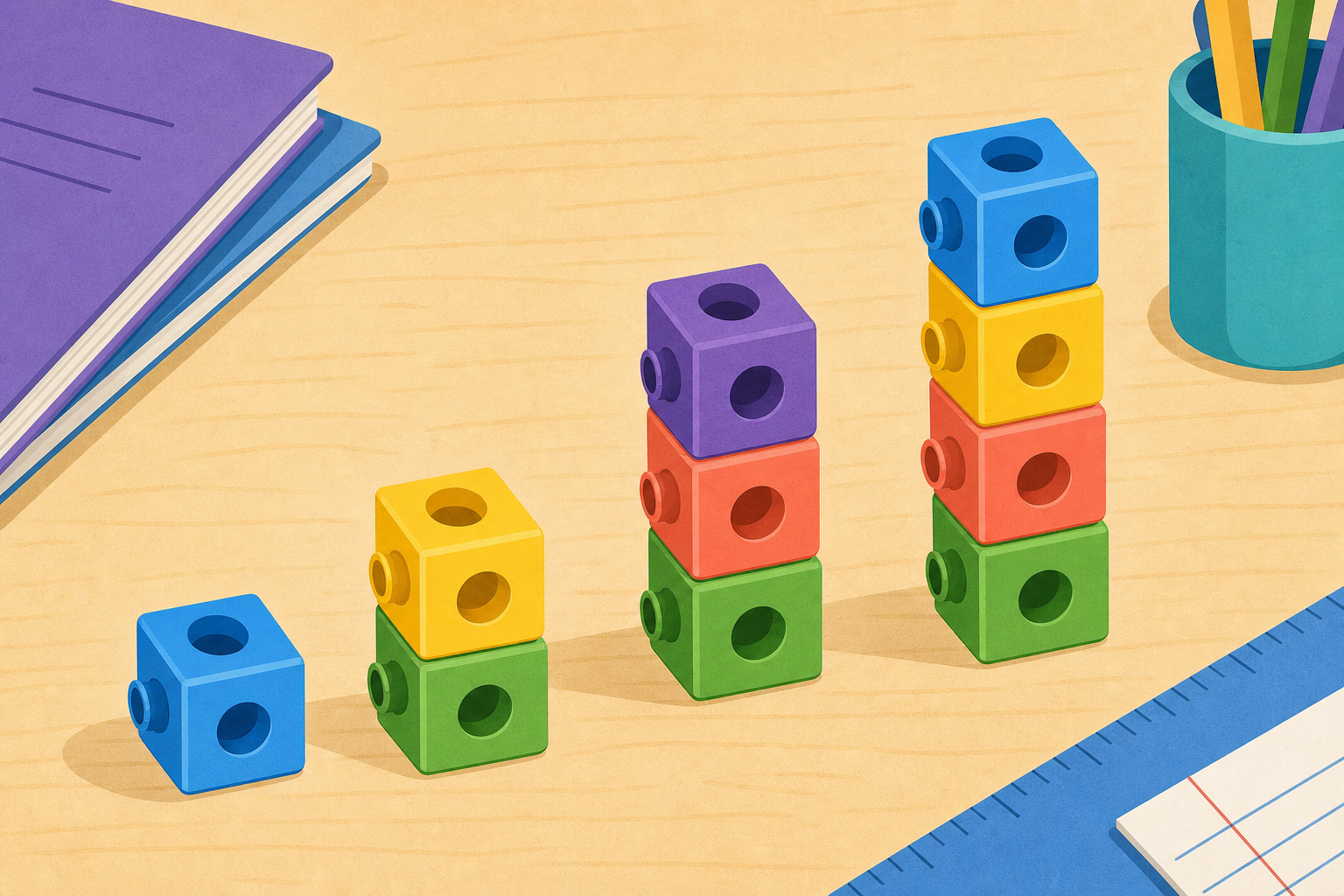
Here is a staircase built from cubes. Look at how many cubes each size needs:

Roughly how many cubes do you think the size-5 staircase needs, before we work it out?
The staircase grows in a special way. Let's look at the counts side by side and work out what gets added each time.
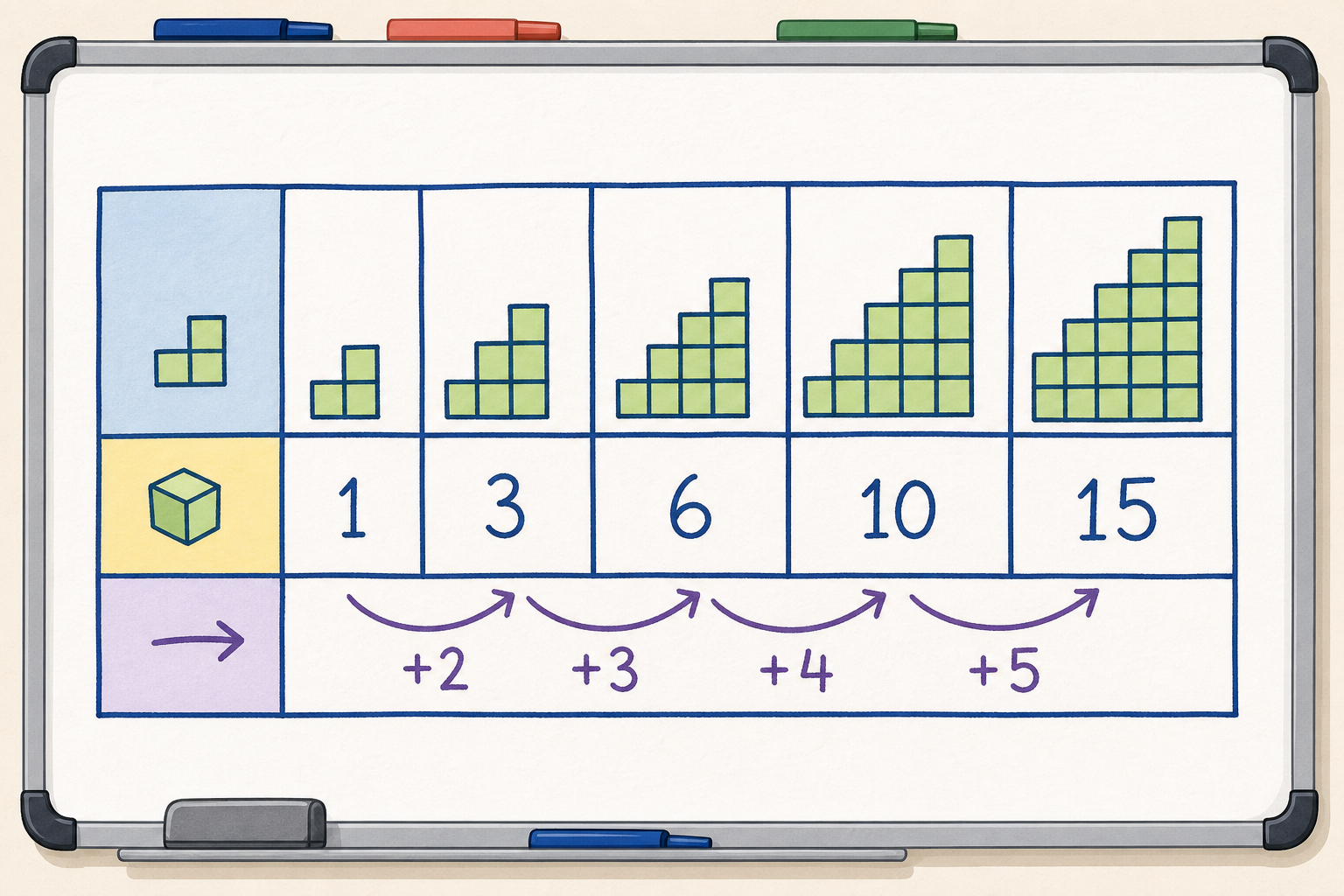
Look at the jumps between the counts. What gets added each time, and how do the jumps change? What do you think we add to a size-4 staircase to reach the next size?
In your maths copy, sketch staircases of size 1, 2, 3 and 4 and write the cube count underneath each one:
Underline the pattern you see in the four counts, then write in words the rule that gives the next staircase.
Now we extend the staircase table together on the board. We already have 1, 3, 6, 10 and 15. Predict the count for size 7, then size 8, then size 10, each time, add the next counting number and write the new total in the table before we agree on it.
Check size 7 with your hands: at your desk, build seven columns with cubes from the tub, then count. If your group has no cubes, sketch the seven columns on squared paper and count the squares.
First, predict the cube count for a staircase of size 12 using the rule, add the next counting number each time. Write out the running steps from a size you already know so size 12 is easy to reach.
Then we play a target round. We use the staircase numbers 1, 3, 6, 10, 15 and 21 as our starter chips and combine them to hit each target.
You're previewing this lesson. Get full access to this lesson and hundreds more — each one ready to teach, with interactive activities, printable resources and pupil progress tracking built in.