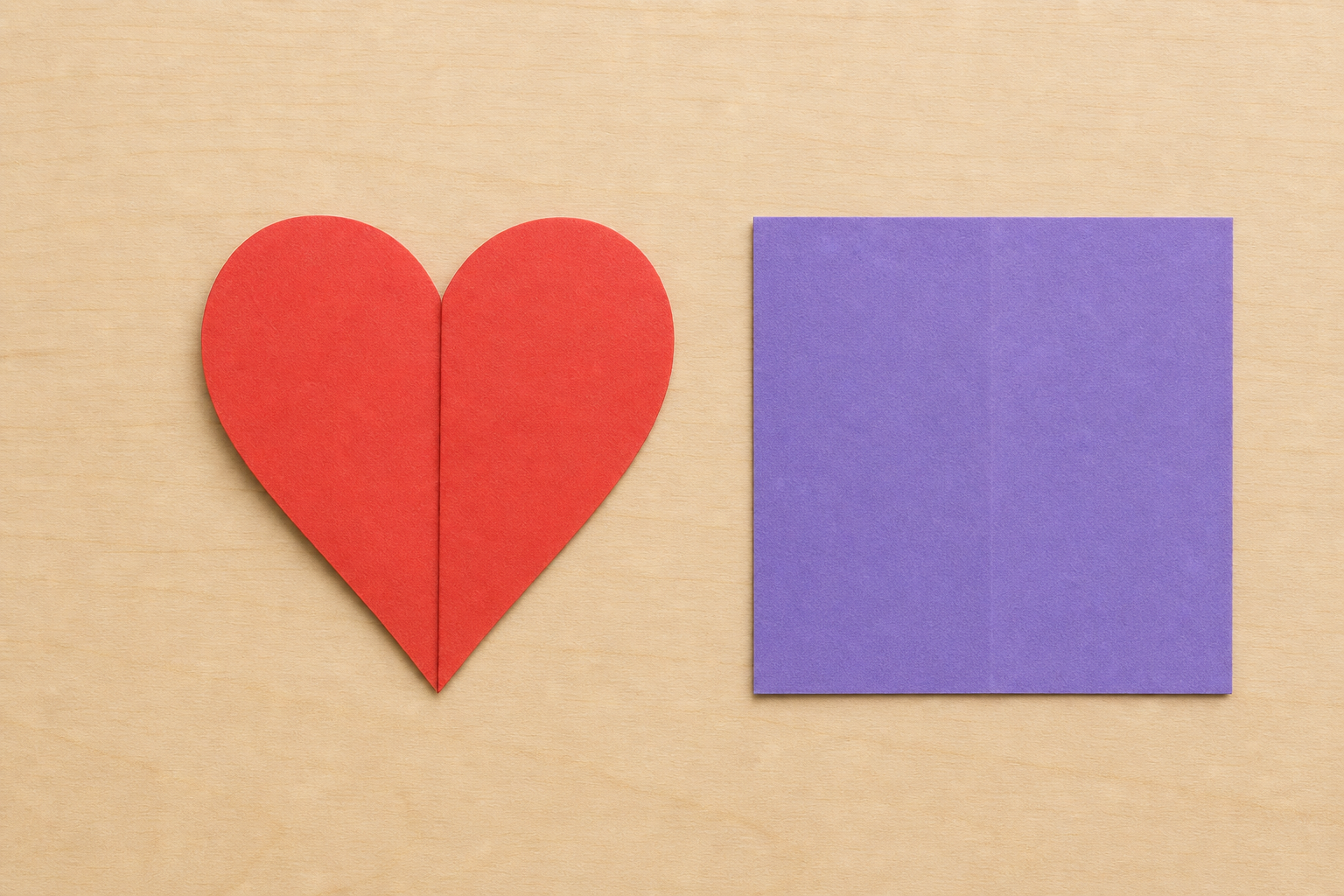
Watch as I fold this paper heart straight down the middle. The fold I make is a mirror line: the line we test to see whether the two halves match. Look closely: the two halves land exactly on top of each other, like a mirror.
A square is different. Where could you fold a square so that both halves match perfectly? Is there only one fold that works, or could there be more than one?
Fold a real or projected paper heart down the middle so the class sees the two halves land together. Then hold up a square. Take two or three hands-up answers on where a square could fold; do not confirm or correct yet, just collect predictions to test in the next step.
Watch the mirror line move across four shapes: a square, a rectangle, the letter X and the letter T. Each fold either makes two halves that match or it doesn't. Count how many folds match for each one.
Display mode: you drag the mirror line, pupils only watch. Before revealing each shape, hands-up: how many matching folds? Take two answers so the room stays with all four, not just the rectangle.
Square: side-to-side, top-to-bottom, and both diagonals all match. Four lines.
Rectangle: two straight-across folds match; pause on the diagonal and let them predict before showing the halves miss. Two lines.
Letter X: vertical matches, horizontal matches. Two lines.
Letter T: only the vertical fold matches. One line.
Keep pressing the contrast: the square's diagonals work, the rectangle's do not.
Today we explore: tap to place the mirror line, the fold line we test, on each shape and letter to see whether the two halves match. We will work through a square, a rectangle, the letter T and the letter X on the shared board.
When the fold makes both halves land exactly on top of each other, we have found a line of symmetry. When they miss, that fold does not count.
This round is for talking it through together — pupils take turns at the board and the class agrees or corrects out loud.
Name a shape, then send one pupil up to drag the mirror line and test it. Ask the class did the halves match? before confirming. Watch for the common slip on the rectangle: pupils try a diagonal fold expecting it to work like the square's. Revoice: so the diagonal works on a square but misses on a rectangle. Rotate four pupils across the four shapes.
In your maths copy, draw a square, a rectangle and the letter X. Then rule in every line of symmetry you can find on each one. Use the straight edge of your ruler to keep your lines neat.
Walk the room glancing at how many lines pupils rule on each shape — the square should have four, the rectangle two, and the letter X two (a vertical and a horizontal fold). No marking; this is whole-class copybook practice, not assessment.
Today we work through these together: the letter H, the letter X, the letter S and the letter M.
Watch out — one of them has no line of symmetry at all, so check every fold carefully before you decide.
These are the practice questions — pupils take turns at the board, check each answer, and the class confirms before moving on. Keep the board work brisk rather than over-explaining.
The letter S is the trap: it looks balanced but no fold makes its halves match, so the answer is zero lines of symmetry. Let pupils try a fold and discover the miss rather than telling them. Revoice the big idea: looking balanced is not the same as having a line of symmetry. Press the Check button after each pupil sets their lines.
You're previewing this lesson. Get full access to this lesson and hundreds more — each one ready to teach, with interactive activities, printable resources and pupil progress tracking built in.