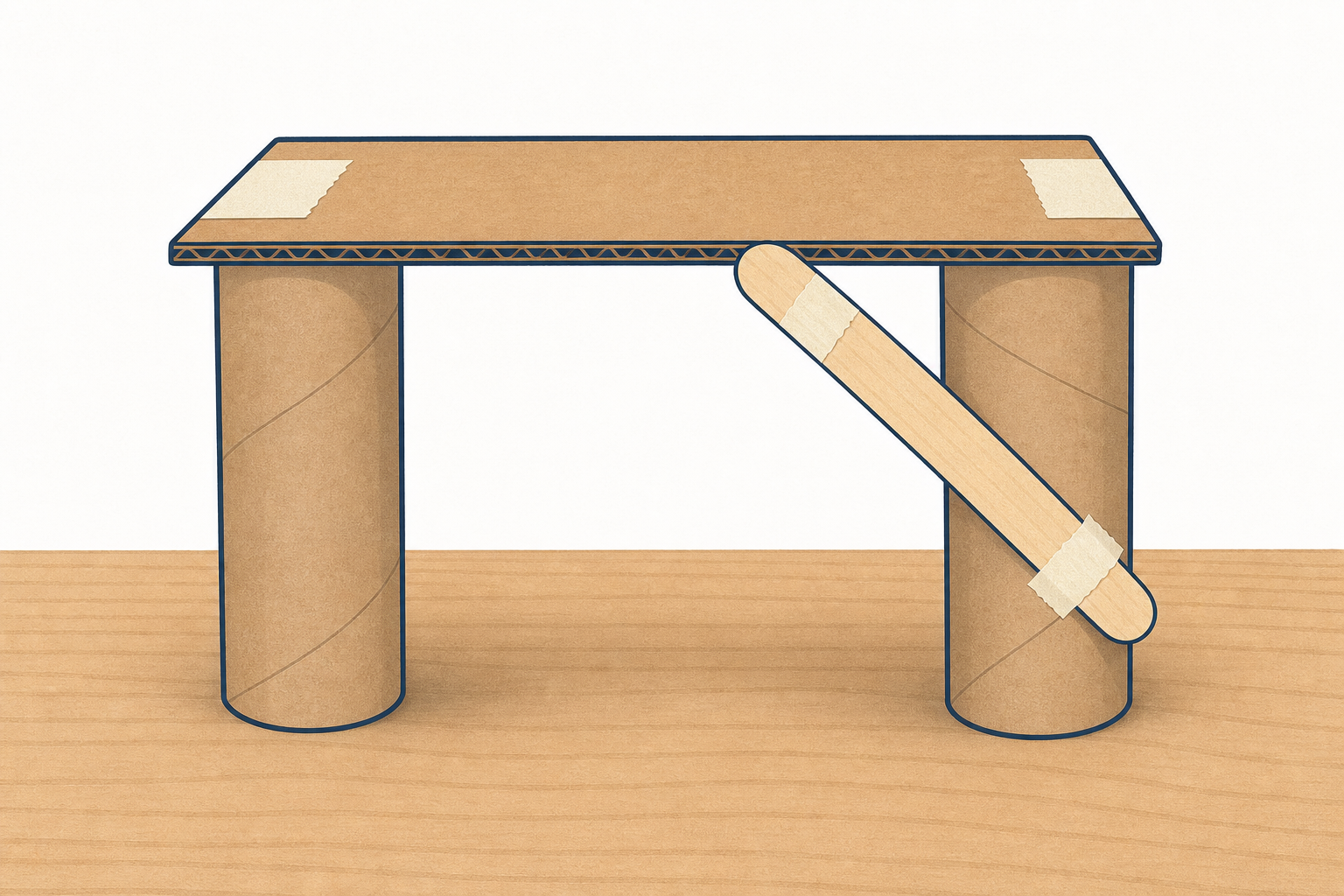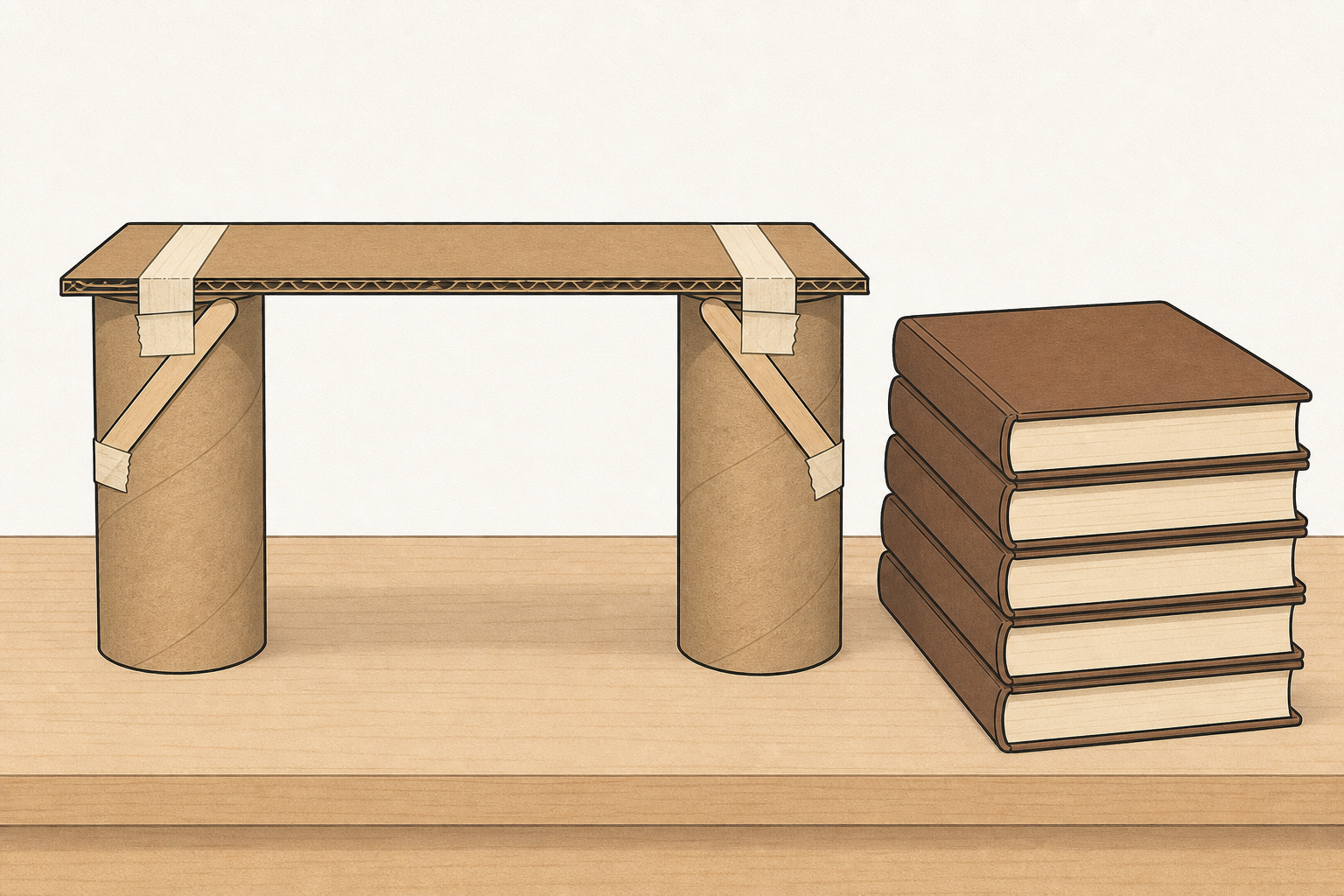
Your build is ready. Today we answer one question with numbers: how much does it hold, and does one careful change make it hold more?
Engineers do not guess that a fix worked. They load it, change one thing, load it again, and compare the two numbers.
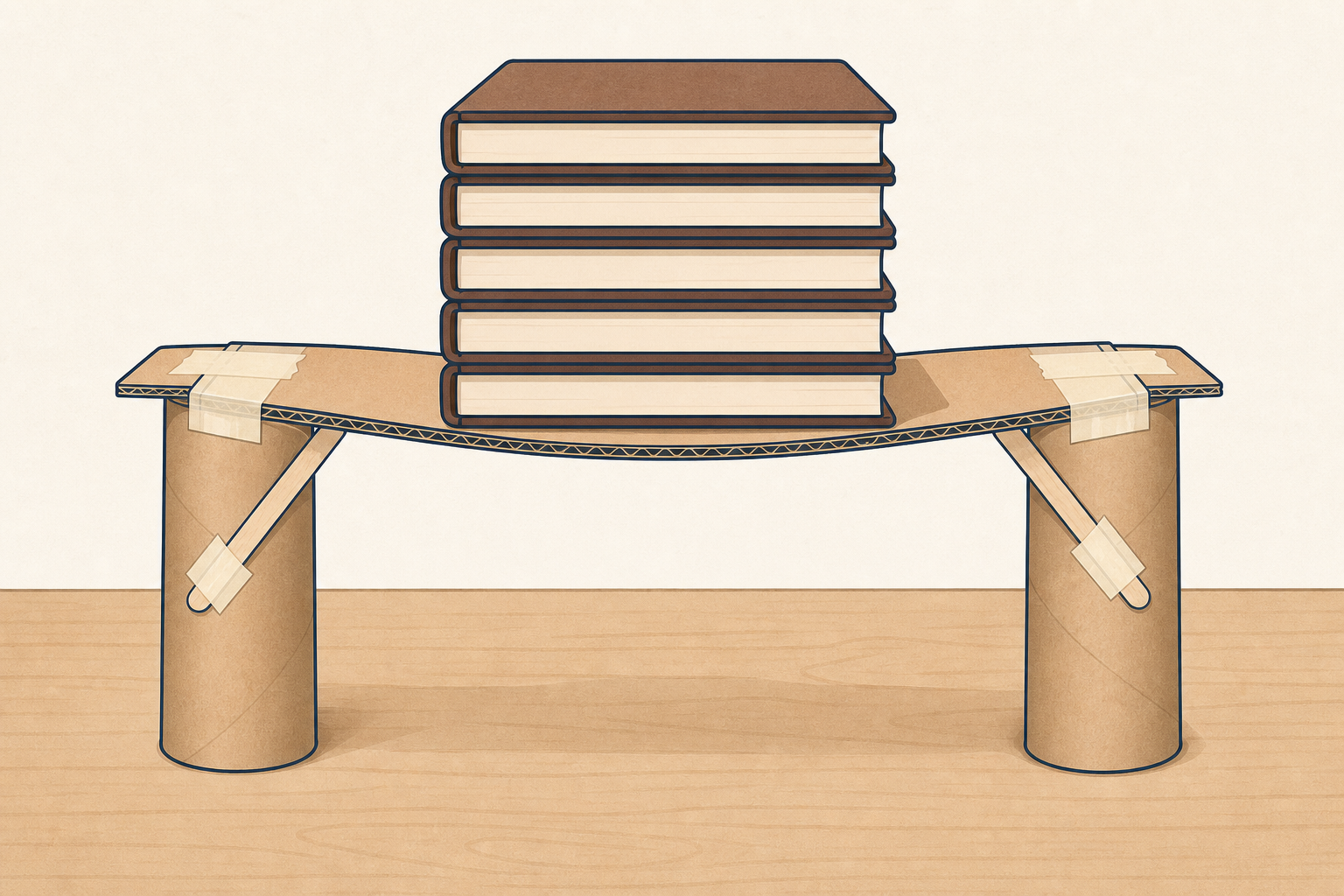
This is Part 3 of the load-bearing project. Groups need the full-size builds from earlier in this project, their Design Brief success criteria, and their Investigation Journal pages.
Before the lesson: set out weights or the real loads (books, a tablet, coats) in a shared tray; have a bucket and string ready for hanging loads; leave clear floor space so groups can stand back when a build fails. Prefer tape, split pins, slotted card and lolly-stick braces for today's timed tweak — PVA will not set in time for a fair re-test.
Key questions: What was the target load we agreed? Which shape or join do you already trust most?
Keep the hook light. Do not start loading yet.
Write your group's target load on your Investigation Journal page first. Then load your build slowly until it fails or reaches that target. Count every book, coin, or coat as you add it. Write the number held — that number is your before result.
Engineers are not disappointed when something fails on the first test: that failure shows them exactly what to fix.
Share the jobs so everyone has one: loader (adds units), counter (says the running total), spotter (watches for sag, tip, or peel), and recorder (writes the number and where it failed). In a group of three, the counter can also record.
Stand clear as it fails. Load low and slowly.
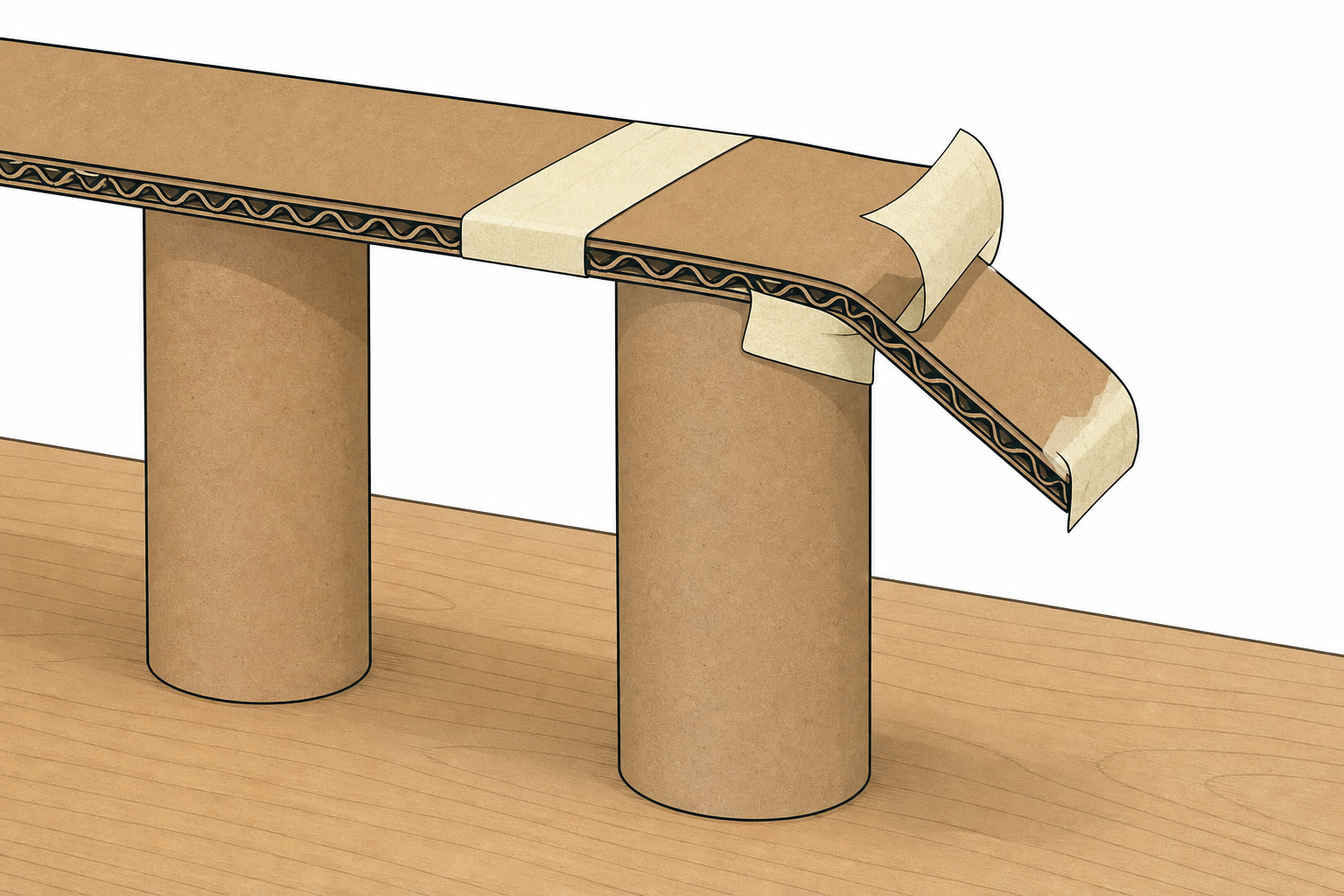
Safety: load low and slowly; stand clear as a build fails; adult supervision throughout. Stop at the agreed target if the build is still holding — failure is useful data, not the only goal.
Supervised loading order: only two groups load at a time while you stand with them. The other groups prepare their journal rows (target load, roles, prediction) and watch the active groups for the first sag, tip, or peel cue. Rotate until every group has a before number. Use a clear stop signal (hand up / "freeze") if a load looks unsafe. Watching groups stay with the science through teacher questions ("Where do you think it will go first?") — no separate desk busywork.
Before groups start, model one quick example of each failure sign on a spare scrap build or with your hands: sag (middle dips), tip (whole thing leans and topples), peel (tape or join lifts away). Match these to the modelled cycle below.
Modelled cycle (say this aloud once before groups start):
Remind groups to record where it failed (middle sag, feet spread, join peeled, tip forward) as well as the number. That detail drives the one change later.
If a build holds far past the target, stop and record the target number plus a note that it still held. Do not keep stacking until something dangerous happens.
Swap builds with another group. Look only for the weakest shape or join. Use module ideas you already know: triangle brace, arch, stronger join, or wider feet.
Tell the other group one clear piece of advice: what is weak, and which idea would strengthen it. Write that advice on their journal page.
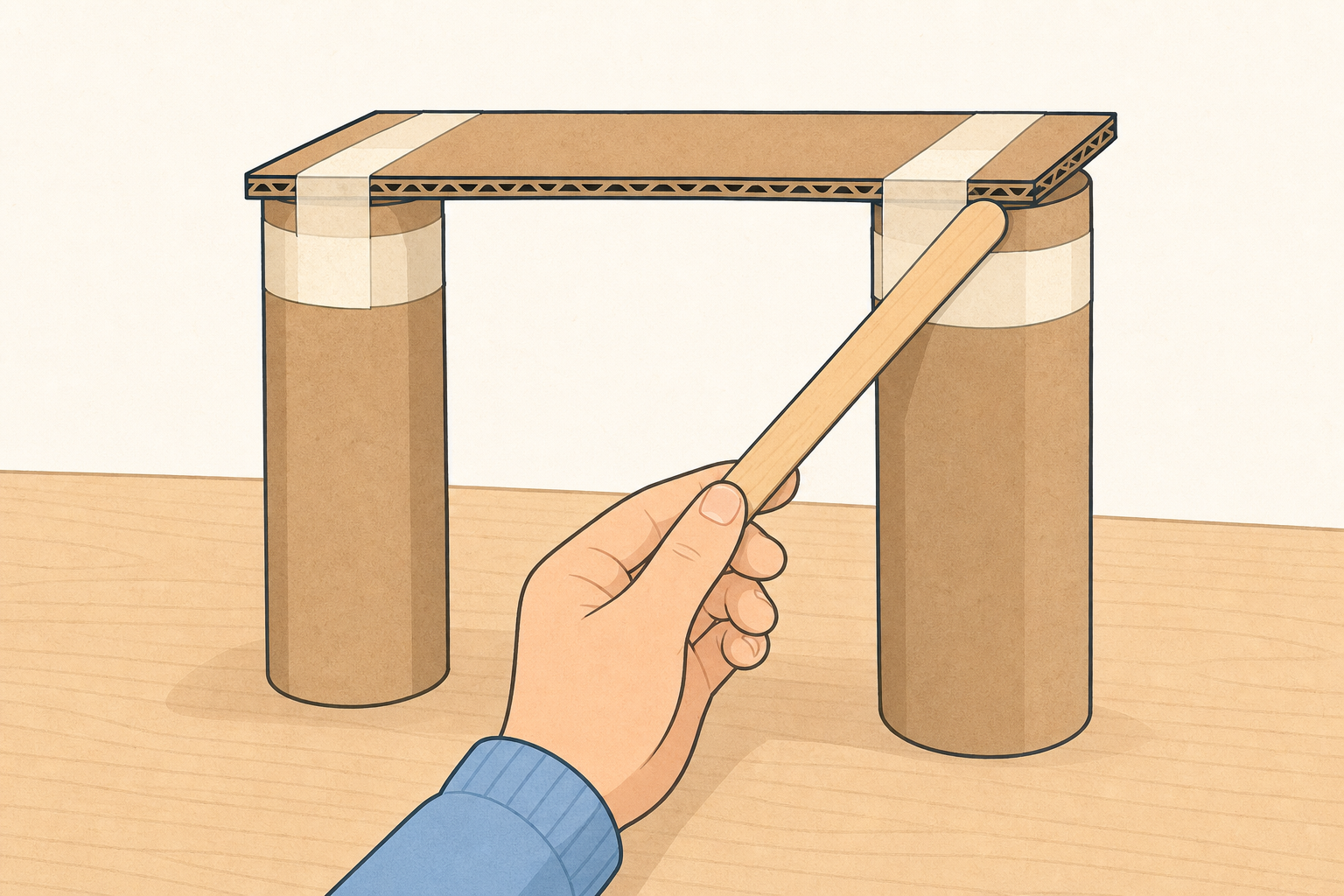
Keep feedback short and module-based. Ban vague praise such as "it's nice". Push language like: "the square frame can lean — add a diagonal", "the tape peeled — try a gusset", "the beam sags in the middle — brace underneath with triangles", "the feet are narrow — widen the base".
If a group needs the idea of a braced span, hold up a quick example (a beam with triangles under it) rather than packing the phrase into the board list.
Fold the watching class in: "Do you agree that is the weak spot? What other module idea could work?"
Each group leaves with one piece of advice. If two ideas are offered, the owners choose which single change to make next.
Ready-to-re-test rule for the next step: advice should point to a fix that can hold straight away (tape, split pin, slotted card, lolly-stick diagonal). Do not suggest a wet PVA join for today's timed tweak.
Make only one change from the other group's advice on your journal page. Brace with a triangle, swap a weak join, widen the feet, or strengthen a span — pick one.
Use a fix that holds straight away: tape, a split pin, slotted card, or a lolly-stick brace. Do not use wet glue for this tweak.
Say the module idea out loud as you fix it, then stop. The re-test comes next.
Police the one-change rule firmly. Two changes at once make the after number unreadable. If a group wants to add a brace and change the join, ask which failure mattered most and keep that one.
Immediate-hold materials only for today's re-test: tape, split pins, slotted or friction-fit card, triangular card braces, extra lolly-stick diagonals, string ties. Do not allow fresh PVA (or any wet glue) for this timed tweak — it will not set before the after test, and a soft join would give a false worse number. PVA stays in the kit only for joins that were already fully dry from an earlier lesson. If a group already started a wet join, stop them and switch to tape or a mechanical fix, or record that this build cannot be fairly re-tested today.
Adult makes any difficult cuts. Keep improvements light and quick — this is a measured tweak, not a rebuild. This step ends when the one change is made and named; do not re-load yet.
Look-fors: groups can name the idea ("diagonal brace", "triangular gusset", "rolled tube upright") rather than only saying "we made it stronger".
Re-load with the same units in the same place. Count again. Write the after number next to the before number. The difference is your evidence — not your opinion — about whether the change worked.
Only re-test if your one change is already holding (tape, pin, or brace). If a join is still soft, write not re-tested — join still setting instead of forcing a bad number.
Keep the re-test fair: same load type, same placement, same pace. Use the same supervised rotation as the before test (two groups load while you watch; others prepare journal rows and watch for failure cues).
Align with the immediate-hold rule from the Make one change step: only builds with tape, split-pin, slotted-card, or brace fixes that already hold may be loaded. If a fix is not ready, pupils record not re-tested — join still setting on the journal page rather than stacking on a soft join. Do not invent an after number.
If the improved build smashes the old target, they may go a little further to find the new number, still safely and slowly.
On the journal page pupils complete the before, one change, and after record. They do not need a second separate sheet.
Prompt: "Did the number rise? Stay flat? Fall? What does that tell you about that module idea?" Flat or falling numbers are still valid evidence.
You're previewing this lesson. Get full access to this lesson and hundreds more — each one ready to teach, with interactive activities, printable resources and pupil progress tracking built in.