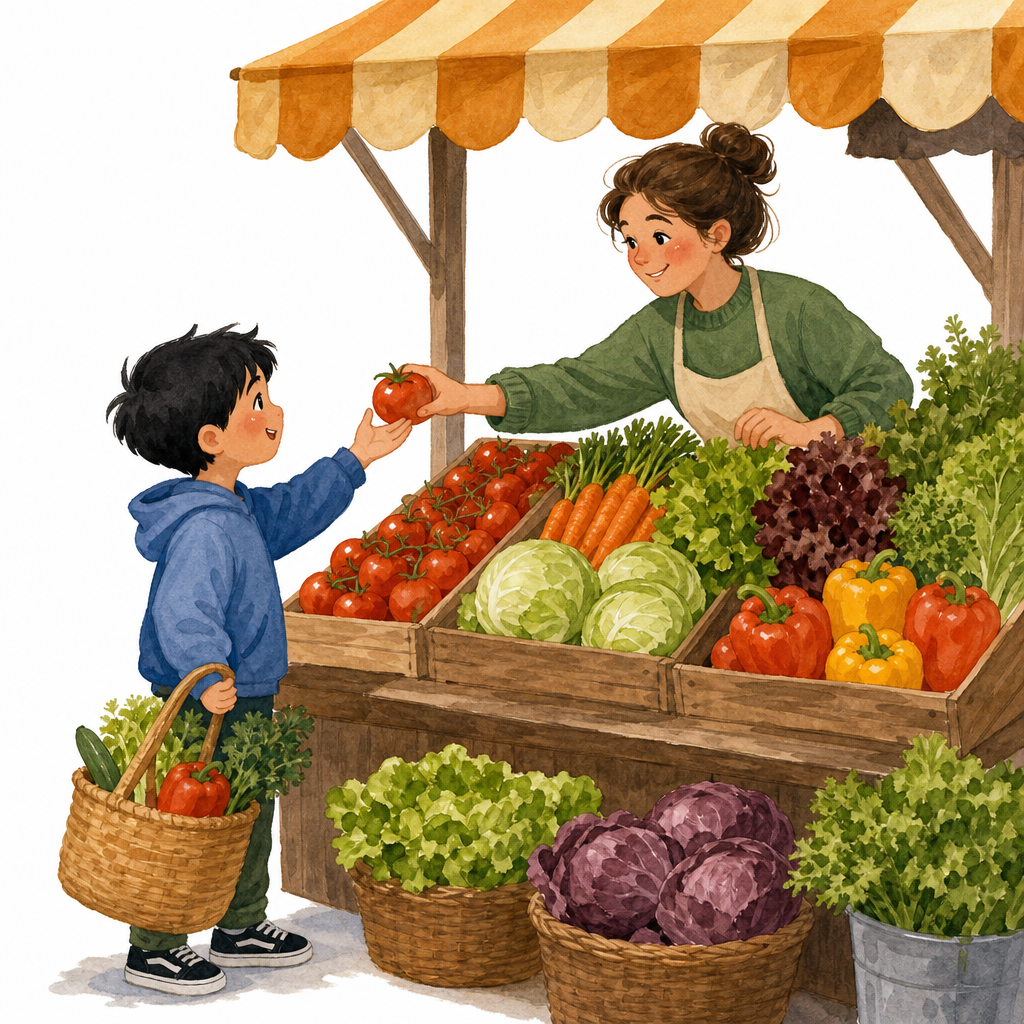
Is a tomato a fruit or a vegetable? Both answers are defensible. Scientists say fruit; most kitchens say vegetable. Today we visit a French market stall and learn eight vegetable words, including the tomato, keeping le and la with every noun.
Take two or three quick answers on the tomato question, then move on. Do not settle the debate: the point is curiosity, not a science lesson. Tell the class they already sorted fruits by gender last time, and today they will do the same with vegetables at a marché stall. Keep the energy light and curious.
You are at a summer market stall (un marché d'été). English is on the front of each card. Listen to the French first, repeat it with le, la or l', then flip to check. We meet them in two groups of four.
Work through the full set on the board in two clusters. Cluster 1 (near-cognates): la tomate, la carotte, la laitue, l'oignon. Cluster 2 (trickier): le chou, le poivron, le concombre, la pomme de terre. For each card: play the audio, class repeats twice (all together, then by table), then flip to confirm. Insist on the article every time: carotte alone is not enough; la carotte (lah kah-ROT) is the answer. Point out that l'oignon (loh-NYOH(n)) uses l' because the noun starts with a vowel, but it is still masculine. Celebrate cognates out loud: "la tomate looks like tomato, easy win!" Note: le poivron is the vegetable (bell pepper), not the spice le poivre; if a child offers the spice word, point back to the picture. After the full set, spend about two minutes on a 'hard four' choral pass only: le chou, le poivron, le concombre, la pomme de terre. That recycle stops the harder words dropping out before matching.
Still at the market stall: volunteers flip two cards on the board to find each French vegetable with its English meaning. When a match is found, the volunteer says the French with le, la or l', then the whole class repeats once. Everyone else whispers the French as each French card turns.
Run this as a whole-class game on the board with volunteers taking turns. Make the pupil roles clear before you start: volunteers flip; everyone else whispers along and joins the choral echo after each match so row 3 speaks every time. If a pair is missed twice, pause and say the French word together before continuing. Keep listening for bare nouns without articles and gently correct them. Praise a clean match with the article included. This consolidates meaning after the first meeting with the words.
Open your copy. From today's eight market vegetables still on the board, write four you would put in a ratatouille (or would eat), each with le, la or l'. Take care with l' on l'oignon and with the three words in la pomme de terre.
Today's list: la carotte, la tomate, la pomme de terre, l'oignon, le chou, la laitue, le poivron, le concombre.
Pause the board but keep the eight French forms with articles clearly visible (pin the flashcard deck or leave the list on screen). Everyone writes: this is the only three minutes where every pupil's pen is moving. The task is copy-from-the-board of four chosen items, not unaided spelling of uneaten or unlisted vegetables. Walk the room and check that each word carries le, la or l'. Optional: allow a quick sketch beside one label. Do not collect these.
We sort the market haul together on the board into masculine and feminine. When a word is sorted, everyone says it aloud with its article (le chou / la carotte). Trust the article you learnt: le and l'oignon go one way, la the other.
Model the first two yourself so the class sees the drag action. Say the full phrase as each word is sorted: le chou (luh SHOO) into masculine, la carotte (lah kah-ROT) into feminine. Then take volunteers for the rest. Between drags, do a quick whole-class thumbs-up/thumbs-down or a 'masculin / féminin' call so every pupil responds, not only the volunteer at the board. Remind them there is no spelling rule that always works: they learn the article with the noun. If someone stalls on l'oignon, ask whether they heard le or la behind the l' (it is masculine). When the class lands l'oignon in masculine correctly, make a big deal of it, that one trips adults up too.
You're previewing this lesson. Get full access to this lesson and hundreds more — each one ready to teach, with interactive activities, printable resources and pupil progress tracking built in.