Mathematics
Intermediate
50 mins
Teacher/Student led
+80 XP
What you need:
IWB/Projector/Large Screen
Kitchen scale

Mass: Weighing in Grams and Kilograms

Learn to read mass on a weighing scale in grams and kilograms, and discover when each unit makes sense for different objects.
Teacher Class Feed

Load previous activity

    1 - Getting Started ~4 mins

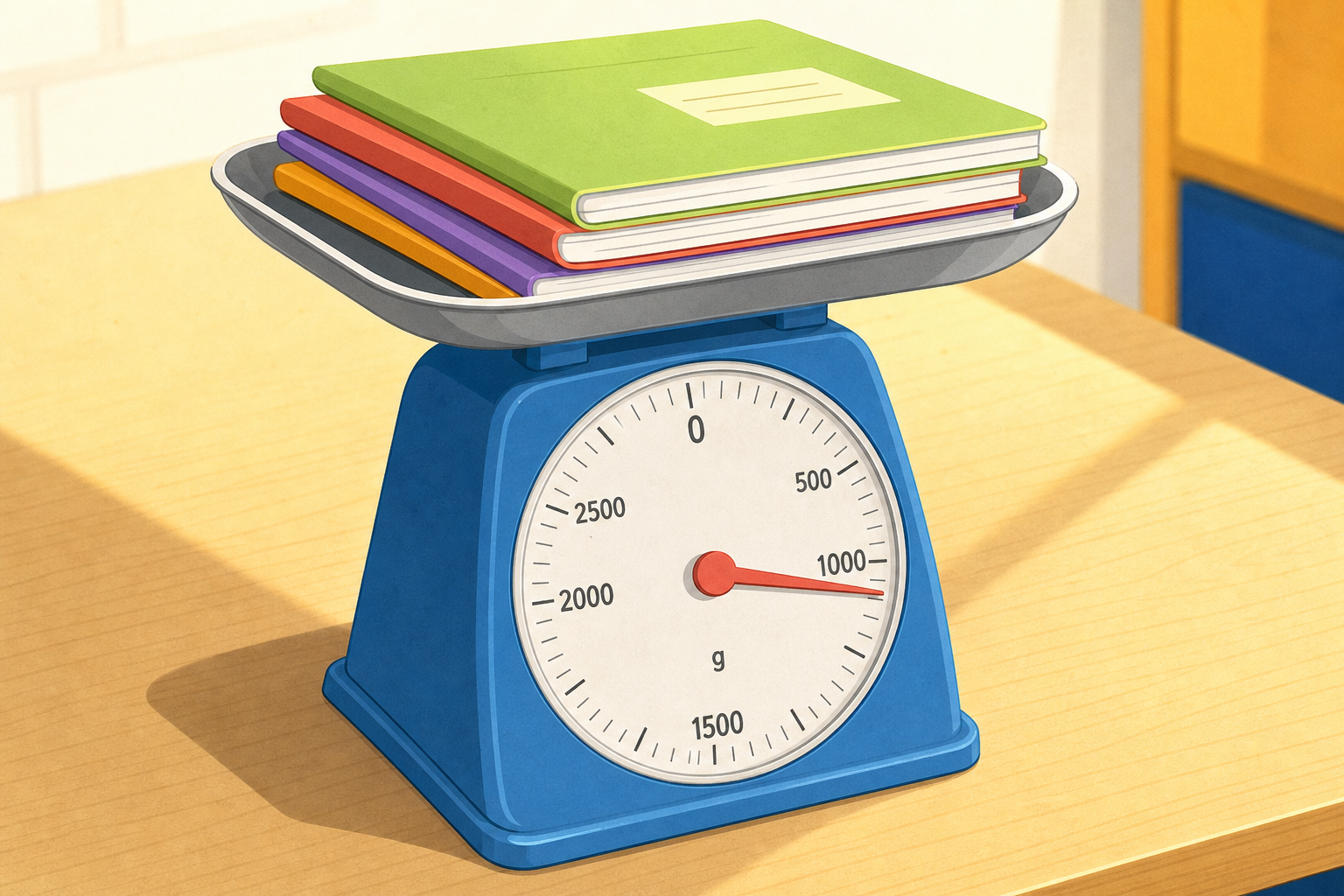
    Illustration for Getting StartedLook at the real scale on the front desk. There is a stack of copybooks sitting on it. Is that heavy or light? What does the scale say?

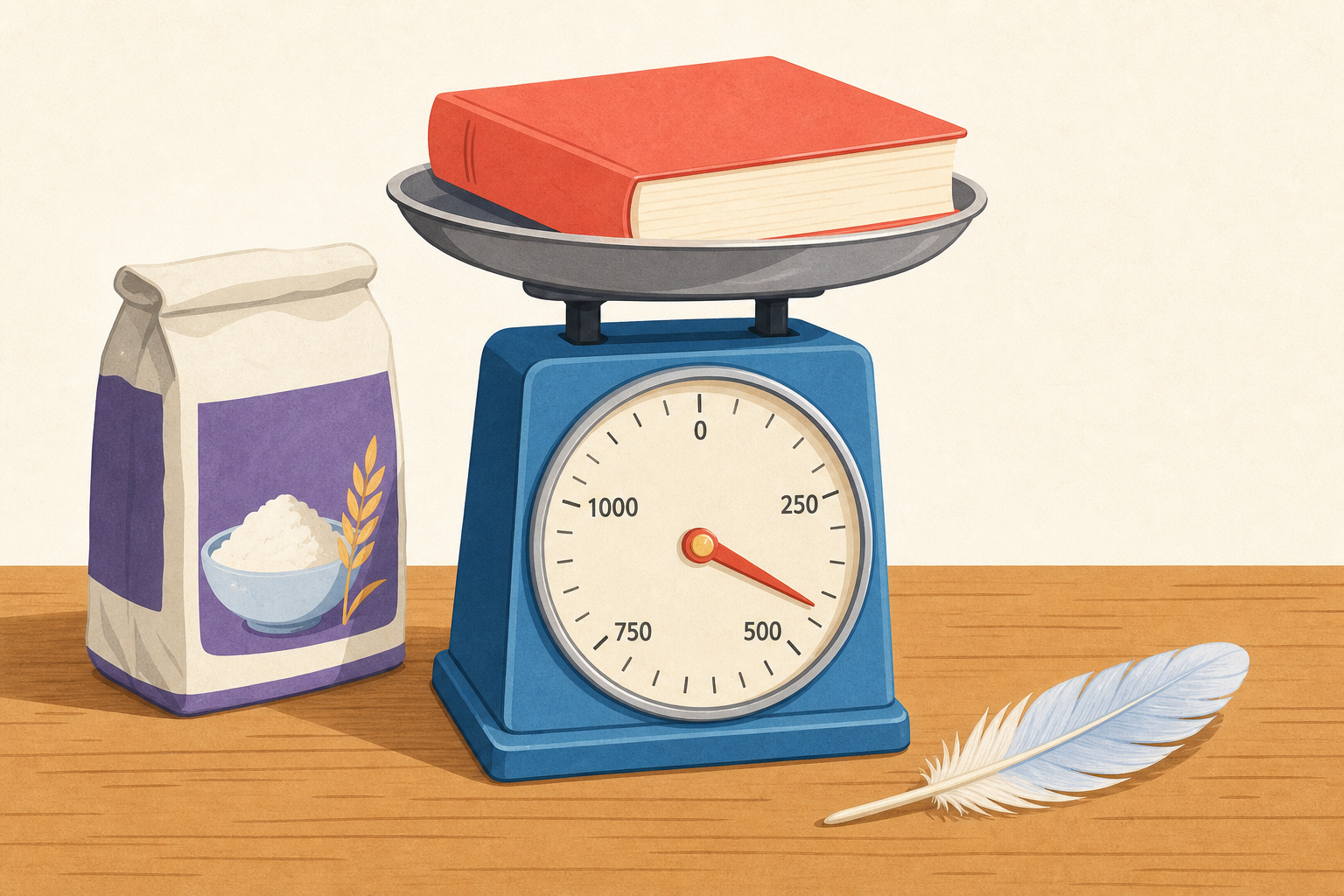
    Hands up: which of these do you think is heaviest — a feather, your Maths book, or a bag of flour?

    2 - Watch and Notice ~8 mins

    Illustration for Watch and NoticeWatch as four real objects are weighed at the front, one at a time. Notice the number on the scale for each one, and notice which unit fits best.

    • A Maths book
    • The class register
    • A bag of flour
    • A feather
    Key point

    Keep an eye out: once an object reaches 1,000 g, that is the same as 1 kg. So 2 kg is the same as 2,000 g.

    3 - Try It Together ~11 mins

    We will predict, then weigh. First we weigh a lunchbox. Then a pencil case. Then a stack of three Maths books. Before each one goes on the scale, we say our guess out loud.

    Key point

    For each object: write down your prediction first, then read the actual mass off the scale, then see how close you were.

    How close can we predict the mass of everyday classroom objects before we weigh them?

    ['Look at the object and write your prediction in grams.', 'One pupil places it on the front scale and reads the mass aloud.', 'The class agrees the reading and records the actual mass.', 'Work out how far off the prediction was.']

    Record: three-column table: object, prediction (g), actual (g)

    Share back: class reads each actual mass aloud and reconciles any disagreement

    4 - Write Each Mass and Its Unit in Your Copy ~3 mins

    COPYBOOK MOMENT

    In your maths copy, write each object we weighed on its own line, with its mass and the unit the scale showed.

    • Maths book
    • Register
    • Flour

    Then underline the unit you would choose for each object if you could only use one, and be ready to say why.

    5 - Class Challenge ~8 mins

    Key point

    Five real objects will pass around the room: a lunchbox, a pencil case, a glue-stick tub, a stapler, and a full water bottle. Weigh each one on your group's scale and write its mass in grams. If an object reaches 1,000 g or more, write it in kilograms too — the water bottle might.

    Stretch: stack three Maths books, estimate the whole stack first, then weigh it and check how close you were.

    Hands-on Task

    Pupil practice
    Module 4 · Measures: Length, Mass, Capacity, Area, Volume Measures
    Lesson 51 · Mass: Weighing in Grams and Kilograms
    Download Activity Book page (PDF)
    123learn · Online learning platform

    Unlock the full learning experience

    You're previewing this lesson. Get full access to this lesson and hundreds more — each one ready to teach, with interactive activities, printable resources and pupil progress tracking built in.

    Hundreds of curriculum-aligned lessons
    Interactive activities in every lesson
    Printable resources & progress tracking
    Copyright Notice
    This lesson is copyright of Coding Ireland 2017 - 2025. Unauthorised use, copying or distribution is not allowed.
    🍪 Our website uses cookies to make your browsing experience better. By using our website you agree to our use of cookies. Learn more