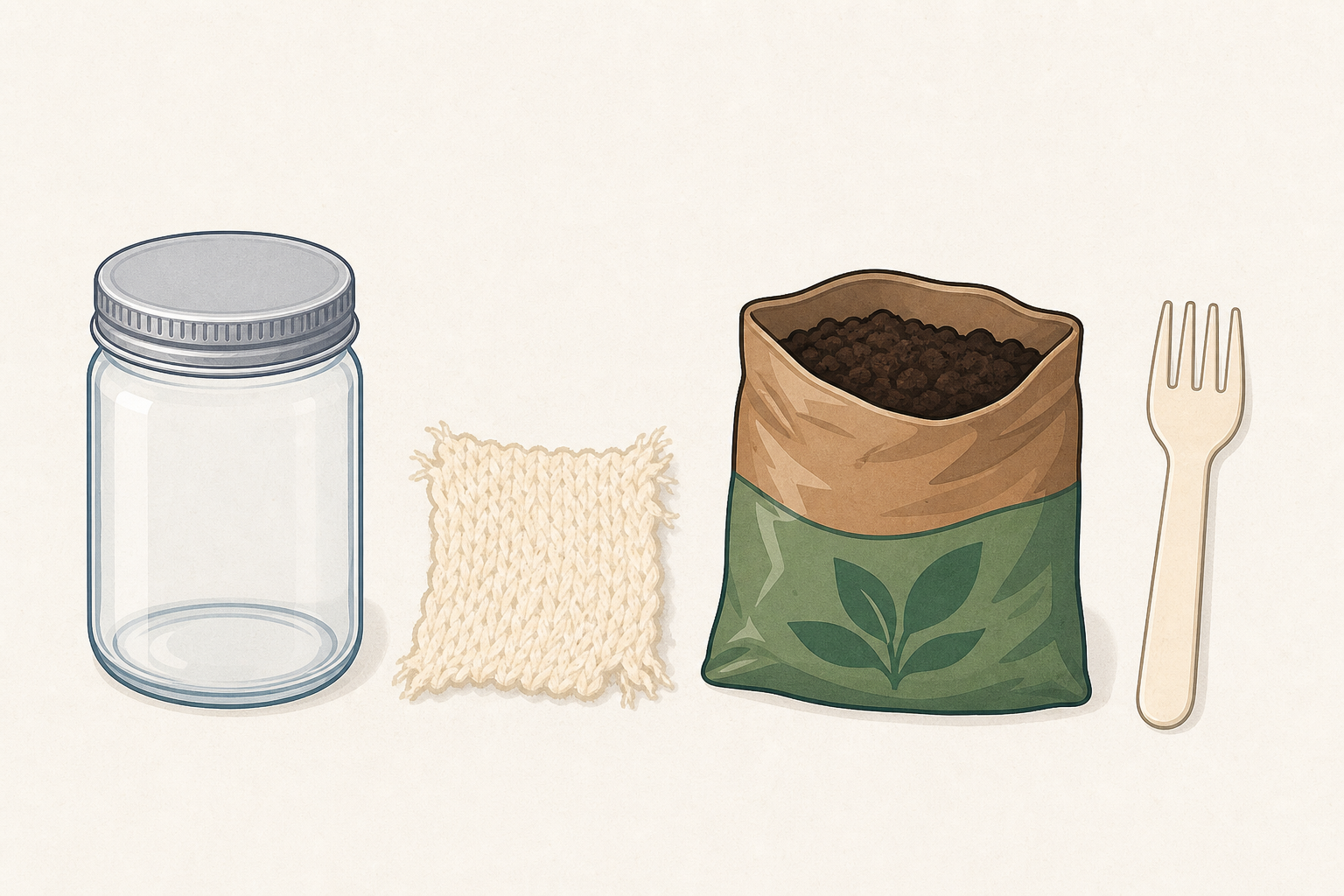
Look at these four everyday things: a glass jar, a scrap of wool, a bag of peat-free compost, and a plant-based fork. Where did each one come from, and what should happen when we finish with it?
Hands up one idea for any of them.
Hold up (or point to photos of) four familiar items only: a clean glass jar or bottle, a scrap of wool or a wool jumper, a bag labelled peat-free compost, and a plant-based or compostable fork or bag. Keep the hook light: one curiosity question, no research yet. Group sample trays stay closed until the research step.
Key question: Where did this come from, and where should it go next?
Take three or four quick ideas. Do not correct them yet. Say that today the class will handle real samples, then research materials the way materials scientists and engineers do: source, use, end of life, then a reasoned swap.
Have ready: one sample tray per group (intact glass jar, wool scrap, sealed peat-free compost pinch, plant-based fork); printed research-card sets for groups (full card texts are in the research step); highlighters and three-box sticky notes ready as the default scaffold.
Look at the jar again. Source asks: where did this material begin before people shaped it? Glass begins as sand, soda ash (a white powder used in glass-making) and limestone, melted together.
Now the plant-based fork. End of life asks: what should happen when we finish with it?
Engineers in Ireland use those two questions before they pick a material. When you choose packaging for school lunches, how do both questions help, and which one would you check first, and why?
Lead with only two ideas on the board: source and end of life. Keep sustainable swap and trade-off for the weigh-and-pitch steps so the class is not holding four new labels before any handling or research.
| Concept | Why it matters | Example |
|---|---|---|
| Source — where a material comes from before people shape it into something useful | Knowing the source helps us see the land, energy and living things involved in making it | Wool comes from sheep on Irish farms; glass starts as sand, soda ash (a white powder used in glass-making) and limestone melted together |
| End of life — what happens when we have finished using a material | A clever design is wasted if the material has nowhere sensible to go next | Clean glass jars go in recycling or bottle banks; peat dug from bogs is gone for thousands of years once burned or used up |
| Sustainable swap — choosing a different material for the same job because it is kinder across its life (name later, at pitch time) | This is how engineers and product designers cut harm without giving up the job the material must do | Peat-free compost in the school garden instead of peat from a bog; a reusable bottle instead of a single-use one when it fits the job |
| Trade-off — a balance between the good and less good sides of a choice (name later, at pitch time) | Almost no material is perfect; scientists weigh evidence rather than chase a magic answer | Glass is heavy to transport (uses energy) but can be recycled again and again without losing quality |
Board beat (about 6 minutes): link each term to a hook object (point at the real jar and fork, or their photos). Take two or three lunch-packaging answers. Make it clear either lens can be strong if the reason is solid: the class is weighing, not hunting a single winner. Then move straight into research. Do not run the full modelled research cycle here; model one Glass row at the start of the research step.
Misconception to head off later: "Natural always means harmless" and "plant-based always means it vanishes outdoors." Bioplastics and wool both need the right end-of-life path. Peat is natural but taking it harms bogs that store carbon.
Nature of STEM: Materials choices are science and engineering decisions with real Irish stakes: bog protection, farming, recycling systems, and what factories make next.
First, open your group tray. Compare the four samples: which feels heaviest, which bends or flexes, and which feels softest? Agree one quick property for each sample.
Next, each person takes one research card: glass, wool, peat-free compost, or bioplastics (like the plant-based fork). Read only your card. Use your sticky note boxes for short phrases: source, use, end of life.
Then teach your group those three ideas in short phrases you can say aloud. Underline one line on your card that felt surprising or less good: a watch-out the card wants you to notice.
Stay with the evidence on the cards. You will put the facts on your Comparison Table next.
Before the lesson: print one full set of the four research cards per group (card texts below). Prepare one sample tray per group: intact clean jar, wool scrap, sealed pinch of peat-free compost, plant-based fork. Give every pupil a highlighter and a three-box sticky note (source / use / end of life) as the default scaffold, not an optional extra. No teacher-made props.
Grouping: groups of three to four. Every group gets the full set of four cards and one tray so each can complete a full comparison later.
When cards open (one line only): the card heading Trade-off means the less-good side or watch-out. We name the engineer word trade-off properly in the weigh step; for now pupils underline that watch-out line.
Model first (2 minutes, whole class): read the Glass card headings aloud. On the board, model one short row only: material = glass; source = sand, soda ash (white glass-making powder), limestone melted; use = bottles and jars; end of life = recycle again and again if clean. Point to the watch-out line on the card (labelled Trade-off): heavy to transport. Groups then copy that pattern in their own words for all four.
How to run (about 20 minutes total):
Look-fors: pupils handle samples before reading; they point at card lines rather than guessing; they separate fact from preference; they notice that bioplastics are not automatic magic; phrases are short enough to explain aloud; sticky-note boxes are used.
Card A — Glass
Source: Mainly sand, soda ash (a white powder used in glass-making) and limestone, heated until they melt, then cooled into a hard, clear solid. Ireland has a long history of glass-making (think famous crystal and bottle works).
Use: Bottles, jars, windows and packaging that keeps food fresh; often washed and reused.
End of life: Can be recycled again and again without losing quality if it is clean. Bottles and jars go in recycling collections or bottle banks. Broken glass is sharp and must be handled carefully. In landfill it lasts a very long time.
Trade-off: Glass is heavy to transport, which uses energy, but it is excellent for recycling when people put it in the right place.
Card B — Wool
Source: Comes from sheep. Sheep farming is part of rural life in many parts of Ireland. When sheep are shorn properly, the fleece grows back and the animal is not harmed.
Use: Jumpers, socks, blankets, carpets and sometimes building insulation because it is warm, breathable and natural.
End of life: Biodegradable: it can break down in soil over time. Good wool clothes last for years if mended and washed with care. Unwanted items can often be reused, donated, or composted in the right conditions.
Trade-off: Wool is renewable and natural, but sheep need land and care, and washing wool uses water and energy.
Card C — Peat-free compost
Source: Made from materials such as green waste from gardens and kitchens, wood fibre, or coconut fibre (coir), instead of peat dug from bogs. Peat bogs store large amounts of carbon and are homes for special plants and animals; they take a very long time to form. Choosing peat-free means more peat can stay in the bog, storing carbon and supporting wildlife.
Use: Helps plants grow in pots, school gardens and allotments.
End of life: Becomes part of the soil and helps new plants grow.
Trade-off: Peat-free bags can cost a little more or feel different at first. Some ingredients such as coir travel a long way, so transport is a cost, but bog protection remains a clear Irish win because bogs cannot be replaced quickly.
Card D — Bioplastics (like the plant-based fork)
Source: Plastics made partly or fully from plant materials such as corn starch or sugar cane, instead of only oil and gas (fossil fuels). Used in Ireland for some everyday packaging and cutlery even when the plants are grown elsewhere.
Use: Some food packaging, cutlery, bags and similar items; can look and feel like ordinary plastic.
End of life: Depends on the type. Some need industrial composting facilities (hot, specialised plants) and will not break down properly in a home compost heap or if left outdoors. Others may be recyclable only with care. Always check the label. In the wrong bin they can spoil a recycling load.
Trade-off: Bioplastics can reduce reliance on fossil oil, but "plant-based" does not automatically mean the item disappears harmlessly in nature. The disposal system matters.
Differentiation: the highlighter and three-box sticky note are already default for every pupil. Extra support: pair for teach-back if reading load still bites. Challenge groups: which claim on a card is a fact, and which is a value judgement about what we "should" do?
Safety: keep compost sealed or on a tray; no tasting; wash hands after handling. Glass samples must be intact jars only, not broken glass. Property compare is dry only (weight, flex, feel); no soaking or tearing samples.
This table is your evidence bank for the pitch. Keep each cell short enough to say aloud without reading a paragraph.
Open your Investigation Journal Comparison Table page. For each material, record the source, a main use and the end of life from the cards, using short phrases you could explain aloud.
Write what the evidence says, not what you wish were true. You will decide your recommended swap in the next talk.
Pupils record on the paper Comparison Table page only. Tell them to record source, use and end of life for each of the four materials. Do not invent extra board columns or dictate a layout the journal page does not show. The swap recommendation is decided and spoken in the next steps; if the page has a notes space they may jot a draft phrase there after they choose, not before.
Expected pattern (short phrases):
Common mistake: copying whole paragraphs. Push for short phrases they could explain aloud.
If a group finishes early, they draft one spoken sentence stem only: We would swap X for Y because… using two facts from the table.
Now we name two engineer words. A sustainable swap is choosing a kinder material for the same job. A trade-off is the less good side you still admit. The watch-out line you underlined on a card is often that trade-off.
Choose from pairings tied to today's cards, for example: peat compost to peat-free compost; single-use oil-based cutlery or packaging to reusable glass, or to a carefully chosen bioplastic; a synthetic warm layer to wool.
Discuss in your group: which one sustainable swap would you recommend for our school or homes, and why? Name what you would move away from, what you would move toward, and at least two reasons from your table.
Be ready to hear a challenge: what is the trade-off you must admit?
Whole-class then group talk. Display-only: no typing into the platform. This is the moment to pin the labels sustainable swap and trade-off onto the decision the groups are making. Link trade-off back to the watch-out lines pupils already underlined.
Focus question: Which single swap is most worth making here, and what evidence backs it?
Agreed from→to pairings (surface these on the board so groups do not invent unresearched materials):
Groups pick one pairing (or a close variant still anchored in the four cards). The "move toward" half must use table evidence; the "move away from" half is the everyday baseline the cards contrast with.
Prompts:
Draw out: peat-free compost is a strong Irish biodiversity and climate angle; glass shines on recycling but is heavy; wool is renewable but not impact-free; bioplastics need honest end-of-life talk.
Misconception: the "winner" material must beat every other on every measure. Real engineering chooses the best fit for a job, with eyes open to trade-offs.
You're previewing this lesson. Get full access to this lesson and hundreds more — each one ready to teach, with interactive activities, printable resources and pupil progress tracking built in.