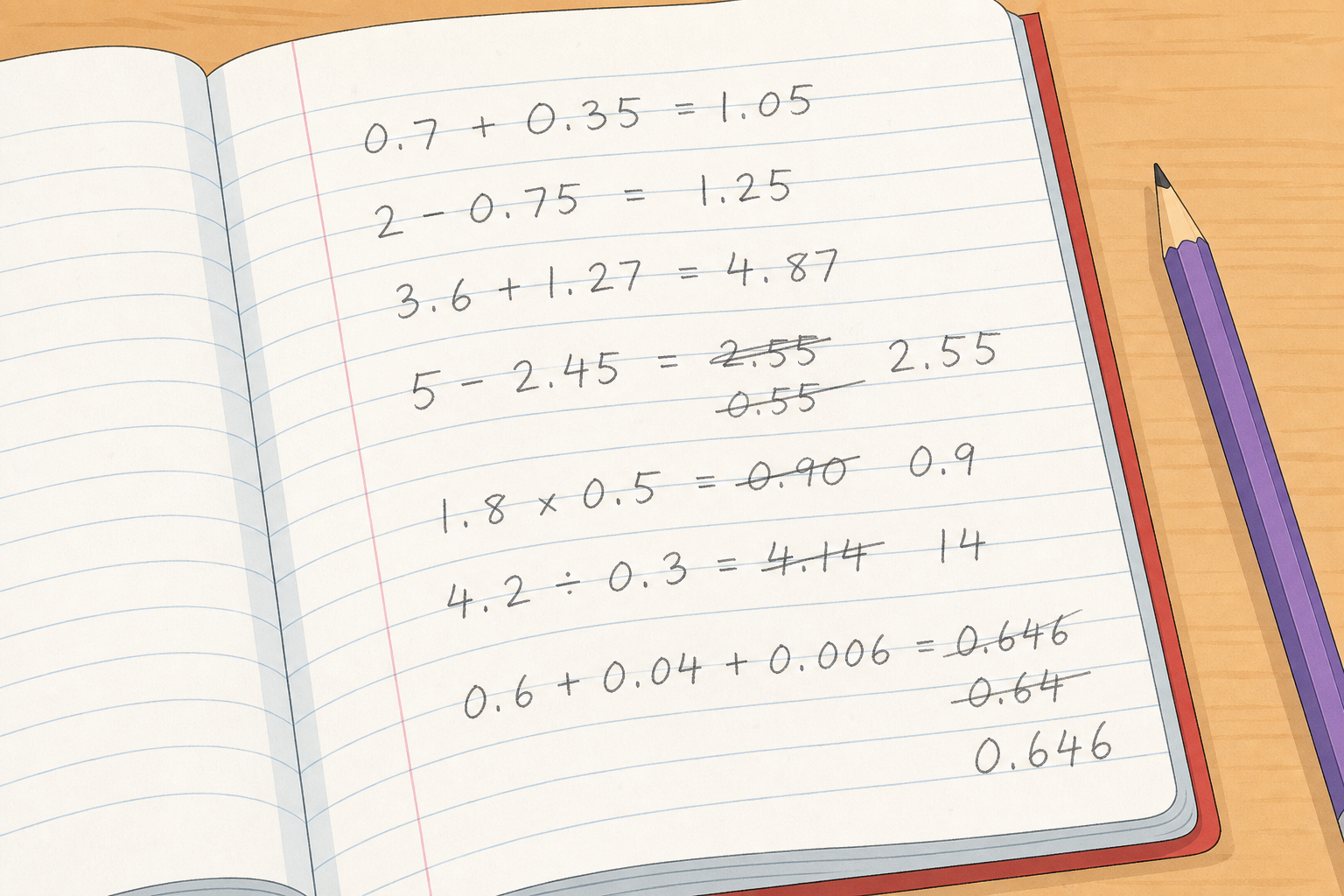
Open your maths journal at one of the very first pages from back in September. Look at how you worked a problem then.
If that early version of you could sit in this classroom today, what would you do differently now?
Give the class thirty seconds of quiet page-turning before any hands go up, then take two or three honest answers. You are warming up the idea that their thinking has moved, not fishing for a right answer.
Your teacher will show two pieces from a journal like yours, side by side: one from September, one from May. Look closely at what is different between them before you open your own journal. Be ready to say what changed and why.
Left, September: place 0.25, 0.4 and 0.7 on a line from 0 to 1 — three marks only, no note of how 0.25 was fixed between 0.2 and 0.3.
Right, May: share €36 between Aoife and Ben in ratio 5:4 — every step shown: 5 + 4 = 9 parts, 36 ÷ 9 = €4 one part, Aoife 5 × 4 = €20, Ben 4 × 4 = €16, check €20 + €16 = €36.
Point, don't narrate — let them compare and name the difference themselves before you do: the later piece shows each step, not just the answer.
Hold out for it; revoice a strong answer — the later piece lets someone else follow how you got there.
Then settle and write up the three criteria for choosing proudest pieces: a clear method, it taught you something, you'd be proud to show it. Leave these up for the rest of the lesson.
Together we will agree what makes a journal piece worth choosing. Look at the three criteria on the board:
We will test one journal piece against all three, out loud, so everyone knows how to judge their own.
Talk this one through together. Ask a pupil to read out the key working lines from a piece they are happy to share, and copy those two or three lines straight onto the IWB as they say them. The class then agrees or corrects out loud whether the piece meets each of the three criteria. (If your room happens to have a visualiser or document camera, holding the page under it works too, but it is not needed.)
Work through exactly one piece against all three marks, naming each as you go. Do not let it drift into a critique session; the point is to model the judging so every pupil can then do it silently at their own desk. If a piece fails one criterion, that is fine and worth saying so, it shows the criteria have teeth.
Fallback if no pupil volunteers (or if a pupil would rather not have their work judged publicly): reuse the later-year ratio example from Watch and Notice, which is already on the board, and judge that against all three criteria instead. The modelling works just as well on the shared example, and no pupil is put on the spot.
Now go through your own journal on your own. Choose three pieces from across the year that you are proudest of. For each one, write a single sentence saying why you chose it.
Then find one piece you would improve, and write exactly what you would change about it.
Stretch: for the piece you would improve, rewrite one line of it the better way, right there in your journal.
Choose three pieces you are proudest of and write one sentence of why for each; then name one piece you would improve and exactly what you would change.
Record: written reflection in the paper maths journal
This is the practice round, pupils work quietly in their own journals. Keep the room calm; this is a reflection beat, not a race. Circulate and prompt with the three criteria on the board when a pupil is stuck choosing.
The four learning-objective checkpoints are: three pieces chosen, a reason per piece, a change-my-thinking sentence, and one improvement named. Every pupil should reach at least the first three.
Think of one mistake from early in the year that you would not make now.
What changed in your thinking to fix it?
Listen for pupils naming a specific change in method, not just "I got better". Revoice a strong answer: so it wasn't that you tried harder, it was that you found a rule that works every time.
If a pupil offers a vague answer, press gently: what were you doing before, and what do you do instead now? Take three or four contributions, no typing.
You're previewing this lesson. Get full access to this lesson and hundreds more — each one ready to teach, with interactive activities, printable resources and pupil progress tracking built in.