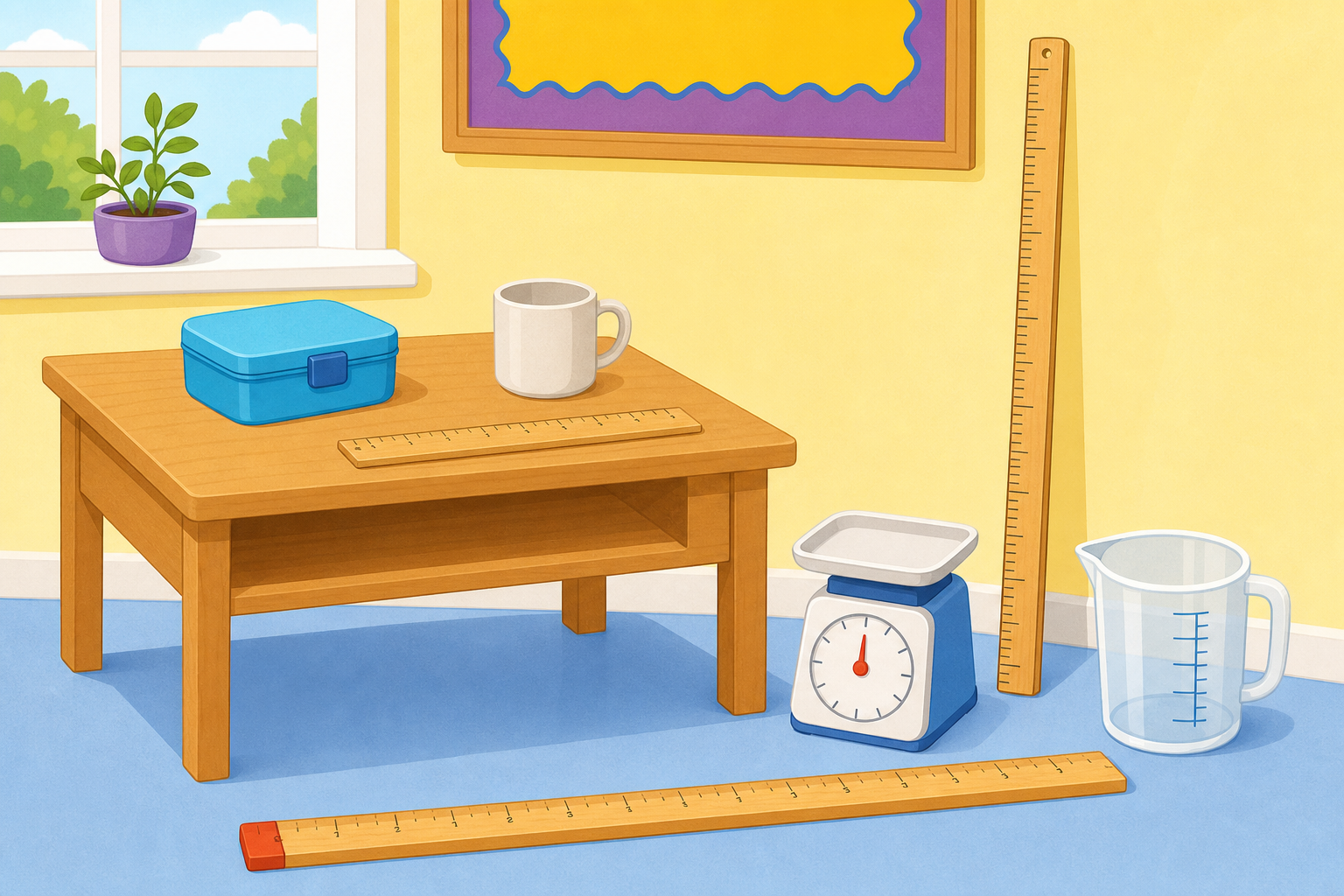
Look around our classroom. How long, how heavy and how full are the things all around us?
Think about three things: the length of a desk, the weight of a lunchbox, and how much a mug holds. For each one, which tool would you reach for — a ruler, a metre stick, a weighing scale, or a measuring jug?
Take three hands-up answers, matching each object to a tool. Keep it brisk — the point is to surface that different measures need different instruments before the investigation starts.
Watch as I estimate first, then read the scale.
Here is a metre stick reading a desk length, and a ruler reading a small object. Notice how the marker lands right on a line, and that I say a guess out loud before I read the number.
Model the two-step rhythm the class will use: say your estimate out loud, then read the instrument. On the desk-length reading, point out lining the zero up with one end. On the small-object reading, point out where the marker lands on the ruler.
Say the estimate before every reading — that habit is the whole lesson.
Set three measuring stations around the room — a length station (ruler and metre stick), a weight station (weighing scales), and a capacity station (measuring jug and water tray); groups of four rotate around them with one copybook and pencil each.
Run all three stations at desks rather than moving about the room — pass the objects and instruments between groups, keeping the same estimate-then-measure rhythm at each.
This is a small-group station rotation, not a board beat. Groups of four move around the three stations in turn.
Circulate between groups and catch alignment slips on the spot: not lining the zero up on the ruler, and reading a jug from above instead of at eye level. Listen for each pupil saying their estimate aloud before they measure.
If a station's real kit is not available, pass the objects and instruments between groups, keeping the same estimate-then-measure rhythm.
In your maths copy, rule a three-column table headed item, my estimate and measured. Fill in one length, one weight and one capacity that you measured yourself, writing your estimate before the measured value in each row.
Walk the room glancing at column headings and that the estimate column is filled before the measured column — this is whole-class copybook practice, not marking.
Before our next round, let's look together at how to read and write a small length as centimetres and millimetres. Watch where the pencil's edge meets the ruler, then read it as __ cm __ mm.
Drive this interactive on the IWB. Point to how each little line is 1 mm, and read the length as 14 cm and 5 mm together. This is the format pupils will write in the round that follows, so make the cm-and-mm way of writing it clear now.
You're previewing this lesson. Get full access to this lesson and hundreds more — each one ready to teach, with interactive activities, printable resources and pupil progress tracking built in.