Mathematics
Advanced
50 mins
Teacher/Student led
+95 XP
What you need:
IWB/Projector/Large Screen
Measuring jug
Weighing scales

Measuring Precisely and Ranking by Length

Estimate measurements first, then read length, mass and capacity precisely using the correct instrument and scale divisions. Rank real edges by length and explore where measurement error occurs.
Teacher Class Feed

Load previous activity

    1 - Getting Started ~5 mins

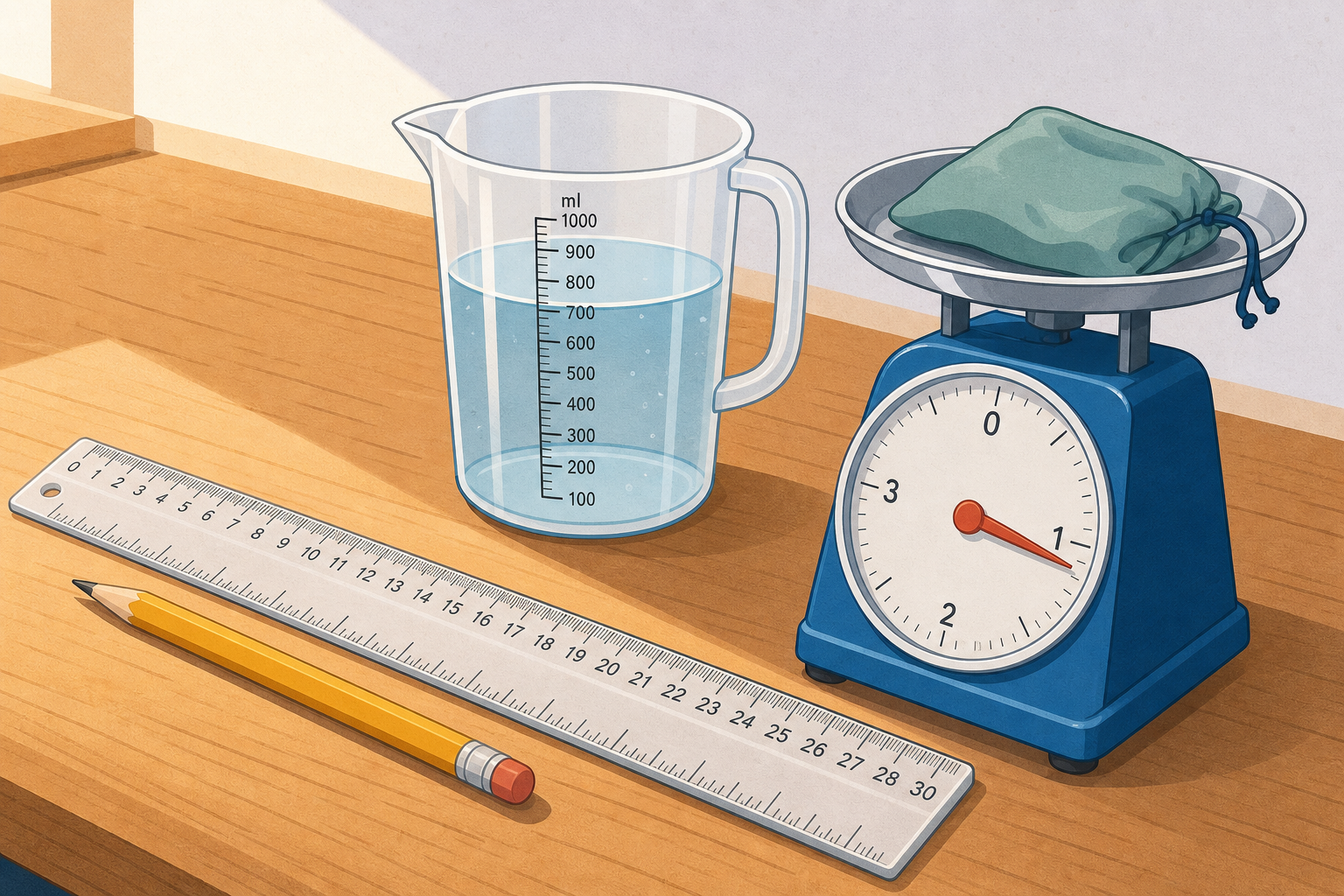
    Illustration for Getting StartedHere are three instruments, and on each one the pointer has stopped between two marks: a ruler measuring a pencil, a jug of water, and a weighing scale with a bag on it. What is each one reading? And how did you decide about the marks that have no number written on them?
    2 - Watch and Notice ~9 mins

    The interactive shows a pencil measured against a ruler. Watch where the pencil's right edge lands and how we work out what one small mark is worth before reading it off. Then we will read a real scale and a real jug the same way — always check what one mark is worth before you compare.

    3 - Try It Together ~10 mins

    Now you measure with your own instruments. First, on your own at your desk, estimate then measure a pencil or copybook edge on your ruler to the nearest millimetre. Read it square-on. Say what one small mark is worth.

    Key point

    Next, take turns on the shared group instruments. Estimate then weigh a small object on the group scales to the nearest 50 g. Estimate then pour water into the group jug and read the level to the nearest 100 ml, with your eye level with the mark. Each time, estimate first, work out what one small mark is worth before you give your answer.

    Hands-on Task

    4 - Record Your Three Readings in Your Copy ~3 mins

    COPYBOOK MOMENT

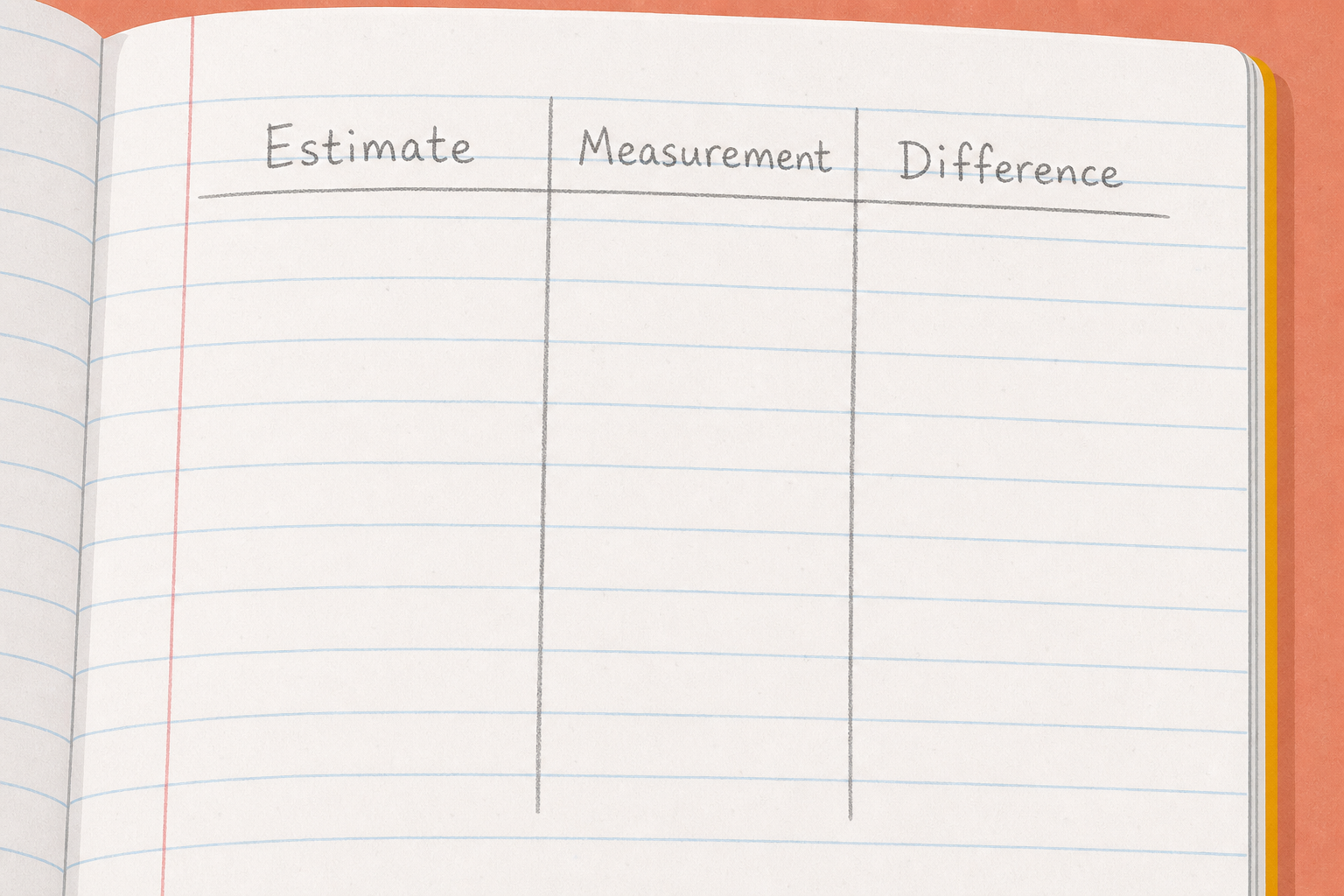
    Illustration for Record Your Three Readings in Your CopyIn your maths copy, make three columns: your estimate, your precise measurement, and the difference between them. Record each of your three items — the length, the mass and the capacity — one to a row. Write the unit beside every number.

    5 - Class Challenge ~13 mins

    Key point

    Time to measure the long edge of three things in the room and rank them by length. In your groups, you will measure three edges. First measure the long edge of your desk top. Then measure the long edge of a book cover. Then measure the long edge of a notice board or wall display. For each edge, estimate first, then measure the length precisely and record it. When all three are done, put them in order from shortest to longest.

    Which is the longest edge — the desk edge, the book edge or the notice board edge — and by how much?

    Estimate each edge first. Measure the long edge of each surface to the nearest millimetre with a ruler or tape, reading square-on. Record all three, then rank them shortest to longest by length and work out the gap between the shortest and longest.

    Ways to start:

    • Estimate the desk edge in centimetres before you measure — is it closer to the length of one book cover or three?
    • Measure the book cover's long edge to the nearest mm, then check against your estimate.

    Stretch:

    • Give one place in your measuring where a small error could have crept in, and say how much it would change the length.
    • Express your longest measurement in both cm and mm.

    Record: A table with one row per surface and columns for surface, estimate and precise length, plus a shortest-to-longest ranking line underneath.

    Share back: Each group reads out its shortest-to-longest ranking and one measurement it was least sure of.

    Pupil practice
    Module 5 · Measures: Length, Area, Volume, Mass and Capacity Measures
    Lesson 58 · Measuring Precisely and Ranking by Length
    Download Activity Book page (PDF)
    123learn · Online learning platform

    Unlock the full learning experience

    You're previewing this lesson. Get full access to this lesson and hundreds more — each one ready to teach, with interactive activities, printable resources and pupil progress tracking built in.

    Hundreds of curriculum-aligned lessons
    Interactive activities in every lesson
    Printable resources & progress tracking
    Copyright Notice
    This lesson is copyright of Coding Ireland 2017 - 2025. Unauthorised use, copying or distribution is not allowed.
    🍪 Our website uses cookies to make your browsing experience better. By using our website you agree to our use of cookies. Learn more
