 Describe your pet in English in five words. No pet at home? Invent one: size, colour, name, noise, favourite food.
Today we put that idea into Spanish, joining a pet and a colour in one short sentence.
By the end of this lesson, you will be able to:
- Name common pets in Spanish
- Join a pet to a colour in one sentence
- Share a short pet description with the class
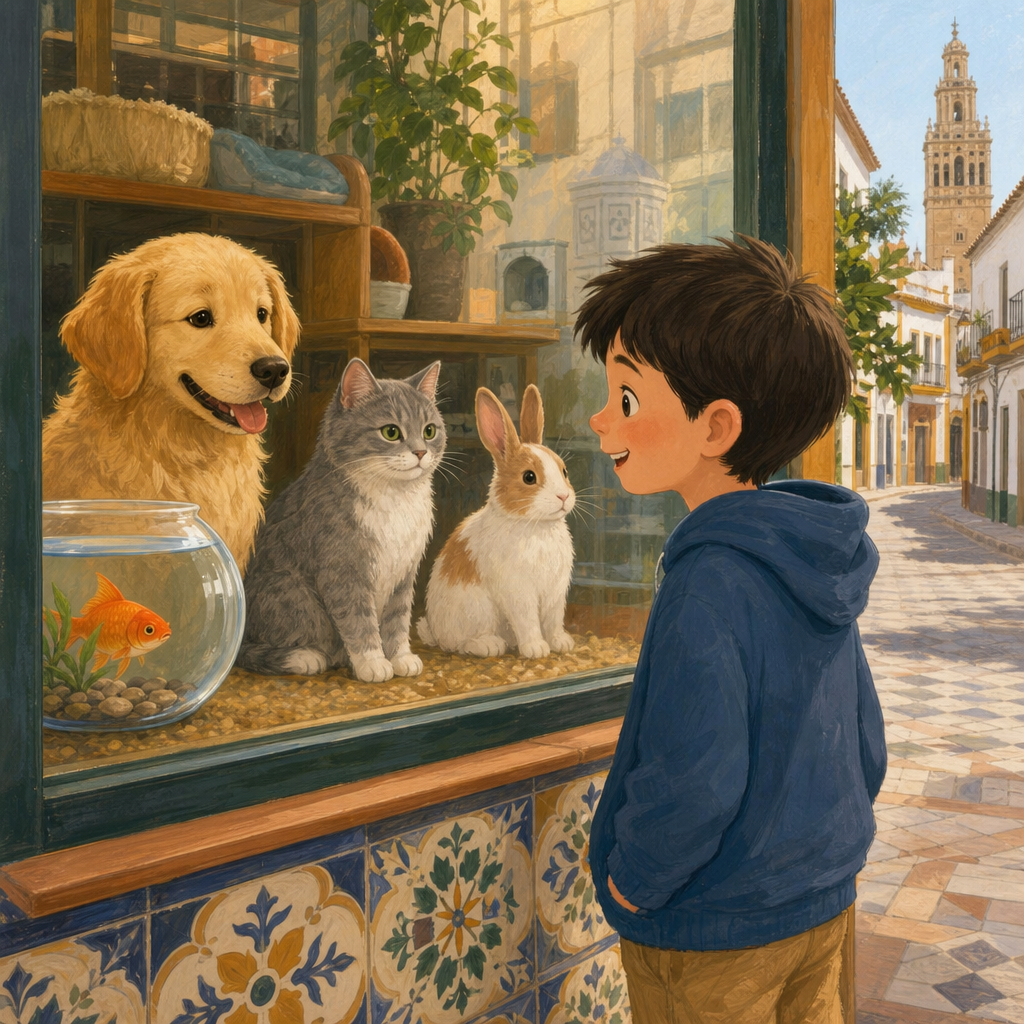
Imagine the shop window of a tienda de animales in Seville. Today's eight pets appear in the table on the board. Listen to each one, then say it back together with the class. We will meet them in two groups: four first, full chorus, then four more.
Learn each pet with el or la first. In full sentences we often switch to un / una (a / an):
El perro → Tengo un perro negro (I have a black dog).
La tortuga → Tengo una tortuga verde (I have a green tortoise).
The colour sits after the pet. Colour bank on the board: negro (NEH-groh), blanco (BLAHN-koh), verde (BEHR-deh).
el / la vs un / una. When you name a pet in general you use el or la; after Tengo (I have) you switch to un with the el-pets and una with the la-pets. Mixing them up sounds odd to a Spanish speaker, a bit like saying "the a dog" in English, so matching the article to the pet keeps your sentence clear: el perro → Tengo un perro (I have a dog); la tortuga → Tengo una tortuga (I have a tortoise).
Colour after the pet. In Spanish the colour usually follows the pet. English says "black dog"; Spanish says "dog black". Getting that order right makes your sentence sound Spanish rather than translated word for word: Tengo un perro negro (I have a black dog).
The shop window of a tienda de animales in Seville is full of animals. Volunteers drag each Spanish label onto the right pet on the board. Everyone else says the word with el or la when the label moves.
Open your copy and write one sentence about a pet and its colour.
Use only this pattern: Tengo un perro negro or Tengo una tortuga verde.
Keep the article (un / una), put the colour after the pet, and mind the accents.
Colour bank: negro (NEH-groh), blanco (BLAHN-koh), verde (BEHR-deh).
- el perro — Dog
- el gato — Cat
- el pez dorado — Goldfish
- el loro — Parrot
- el conejo — Rabbit
- el hámster — Hamster
- la tortuga — Tortoise
- el ratón — Mouse
Still in the Seville pet shop. On the board, match each Spanish pet to its English meaning (or picture). When a pair is found, the whole class says the Spanish with el or la.
Keep the articles: el perro, la tortuga, and the rest of today's list.
Unlock the full learning experience
You're previewing this lesson. Get full access to this lesson and hundreds more — each one ready to teach, with interactive activities, printable resources and pupil progress tracking built in.
This lesson is copyright of Coding Ireland 2017 - 2026. Unauthorised use, copying or distribution is not allowed.