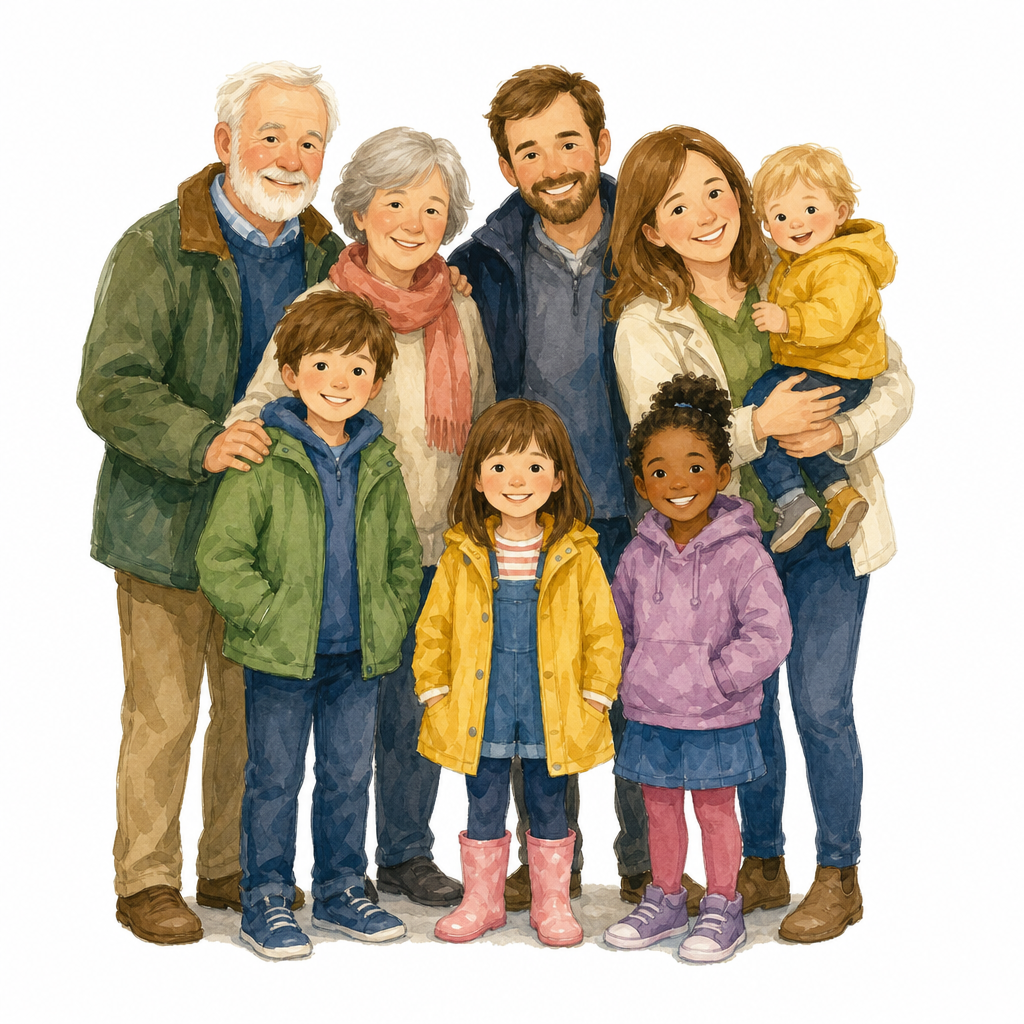
How many people live in your house? Use the number strip on the board and say the number in German first.
Numbers refresh: 1 eins · 2 zwei · 3 drei · 4 vier · 5 fünf · 6 sechs · 7 sieben · 8 acht · 9 neun · 10 zehn
Meet Lea from Vienna: Das ist Lea aus Wien. Today you will name family members in German, say how many people are in a family, and say how old someone is.
Keep the number strip (1–10 with German words) visible for the whole opener. Take a quick round of house numbers in German only. Grin when the German numbers come out fast: make it a tiny win before new words. Do not teach the family words yet; the word-table does that next. Quiet prompts if needed: vier (feer), fünf (fuenf), sechs (zex). Anchor the lesson with Lea from Vienna so numbers and ages sit in a real place: Das ist Lea aus Wien (dahs ist LAY-ah ows VEEN).
First: Tap each card, listen, then chorus the full phrase. Keep der, die or das with every noun and notice each capital letter in writing.
Next: Build each frame one chunk at a time. Spot known numbers, then volunteers swap in their own number or age.
How many: In meiner Familie sind wir vier. (There are four of us in my family.)
Age: Mein Bruder ist zehn Jahre alt. (My brother is ten years old.)
Lea: In Leas Familie sind sie fünf. Ihre Schwester ist acht Jahre alt.
Phase 1 (words only): Tap each word and have the class repeat twice, once all together and once by table. Point at der/die/das every time so the pair sticks. German nouns are always capitalised: keep that visible. Sound hook: Schwester's schw is the same lip shape as English sh; exaggerate it once for fun, then normal speed. Short u in Mutter and Großmutter: keep it clipped (like English put), not a long “oo”.
Phase 2 (frames): Only after the seven pairs feel secure, build the frames one chunk at a time with phonetics: In meiner Familie (in MY-ner fah-MEE-lee-uh) → sind wir vier (zint veer feer); then Mein Bruder ist (mine BROO-der ist) → zehn Jahre alt (tsayn YAH-ruh alt). Chorus each full frame twice. Flag possessives briefly: mein with Bruder/Vater/Baby, meine with Schwester/Mutter. Invite two volunteers to swap in their own number or age before the listening activity. Lea model age stays inside the 1–10 strip (acht), matching the listen scene. Leave both frames large on the board (pinned beside the word-table) for the rest of the lesson; they must stay visible for copy time.
Read the three questions first. Then listen to the short family scene twice and answer out loud as a class (one-word or short answers are fine).
Listen for family words, a number, and an age.
Before play: Read the three on-screen questions aloud. Response mode is whole-class oral (or thumbs for number options if you offer 3 / 4 / 5). Books closed on the first play.
Teacher preview: Play the platform clip (describing-families) once yourself before the lesson. Use the support below so you can run answers without translating the whole scene into English.
Line-by-line listening summary (typical scene content for this scenario):
Model transcript you can follow or read aloud if audio is unclear (matches today's frames and vocab):
Hallo! Ich bin Lea. In meiner Familie sind wir fünf. Das ist mein Vater. Das ist meine Mutter. Das ist mein Bruder. Das ist meine Schwester. Meine Schwester ist acht Jahre alt.
Gloss: Hello! I am Lea. There are five people in my family. That is my father, mother, brother, sister. My sister is eight years old.
Questions and target answers (accept German or English at this stage; celebrate German words):
Play once for gist, once for detail. If a pupil is stuck, replay only the how-many or age stretch rather than translating everything. Useful phrases: Noch einmal (nokh EYE-nmahl); Hört zu (hert tsoo).
First, say it: Several volunteers use the big frames on the board. Swap the number or the age out loud: In meiner Familie sind wir … and Mein/Meine … ist … Jahre alt.
Then write: Open your copy and write two sentences about your family (how many people, and one person's age). You may copy and adapt the frames; keep every der/die/das and every capital letter.
Oral substitution first (about 2 minutes): With both frames still large beside the word-table, run a quick whole-class round. At least four pupils speak: two on how-many, two on age. Chorus a strong example once more before anyone writes.
Then copy (about 3 minutes): Re-display or pin both frames from step 2 for the whole slot: In meiner Familie sind wir vier. and Mein Bruder ist zehn Jahre alt. Number words 1–10 should still be visible. Remind pupils: mein before masculine/neuter nouns (Bruder, Vater, Baby) and meine before feminine ones (Schwester, Mutter). Pupils may copy and adapt rather than write from memory. Walk the room and check articles and capital letters. Do not collect the copies. Pupils who live between two homes can choose one household; the task is the language, not a census. Support: point at the starter on the board. Extension: add a second family member with age.
Drag each family noun into the correct column: der, die or das. Say the full phrase quietly as you drop it (for example der Vater, not bare Vater).
Today's one das word is das Baby. The others are der or die.
Whole-class on the IWB with volunteers only (no devices). This is quick practice of pairs already chorused, not a new grammar lecture. When a card is wrong, say the full pair together before the next drag. Pattern pupils often notice: many male family words take der, many female ones take die; das Baby is the neuter one in this set. Still stress that gender is learned with the noun, not guessed from English meaning alone.
You're previewing this lesson. Get full access to this lesson and hundreds more — each one ready to teach, with interactive activities, printable resources and pupil progress tracking built in.