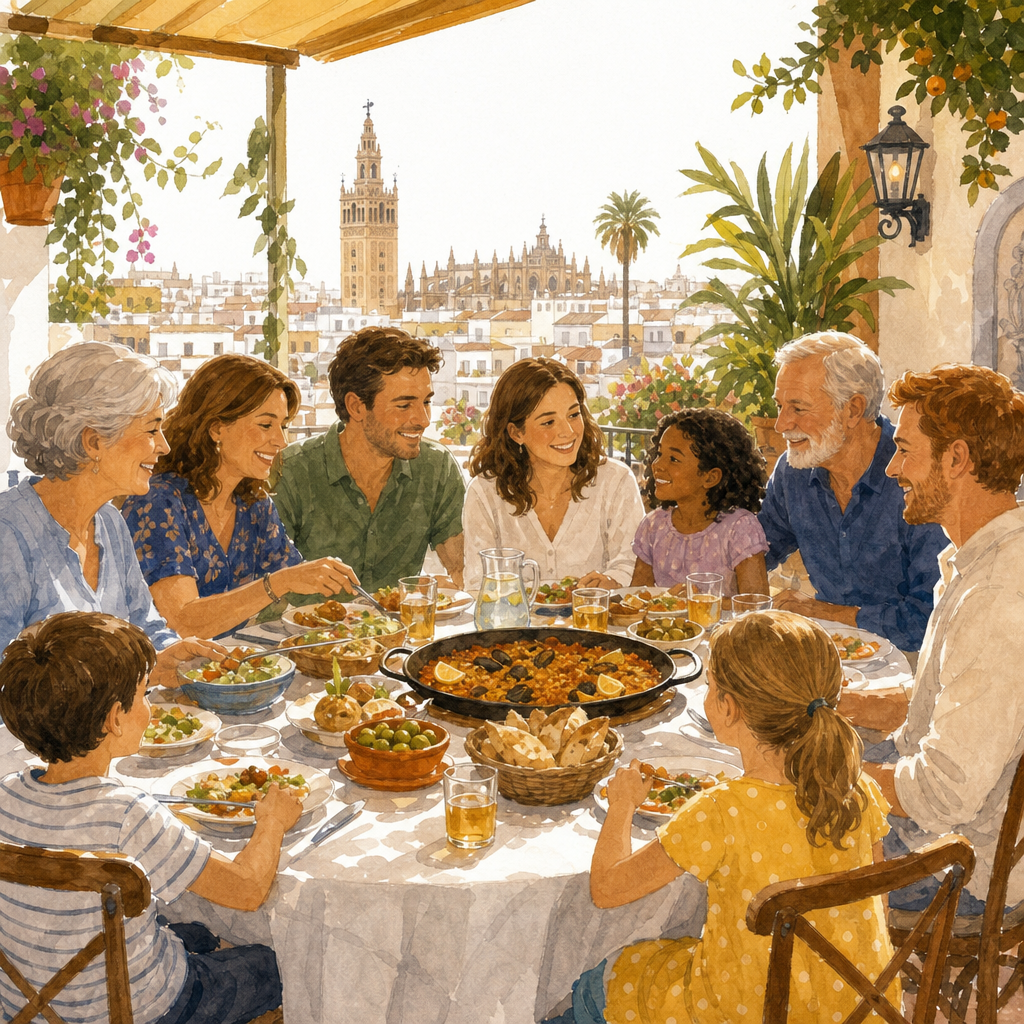
We're visiting the García house in Seville before Sunday lunch. How many people do you think live there? Say a number in Spanish if you can. Today we name the people in a family, and we say how old someone is.
Take a quick round of house numbers in Spanish (real homes or a guess for the Garcías). Pupils already met numbers earlier in the course, so even a hesitant cuatro (KWAH-troh) or cinco (THEEN-koh / SEEN-koh) is a win. Do not introduce the family list yet; the next step does that. Keep the Seville Sunday-lunch hook light and welcoming.
These seven words unlock almost every family chat in Spanish. We will tap each word on the board: listen, then say it back together. Keep el or la with the word every time.
Beat 1: the seven phrases only (listen-repeat).
Beat 2: two sentence frames from the García house. Echo each line together before anyone invents their own.
Frame A (how many):
Somos cuatro en mi familia. (There are four of us in my family.)
Frame B (age):
Mi hermana tiene diez años. (My sister is ten years old.)
Then your teacher will call a number or a family word. The class speaks one full frame back together.
Beat 1 (words): Tap each word on the IWB word-table. Class repeats twice: once all together, once by table. Point at the article every time so the pair is what they hear. All seven words are for recognition and sorting.
Beat 2 (frames): Uncover the two model sentences. Model each slowly, pointing chunk by chunk, then class choral echo. Full pronunciation guides:
Stress that Spanish says age with tener (to have): tiene ... años, literally "has ... years", not es.
Beat 3 (oral substitution, whole class): You supply a prompt; class speaks one frame. Examples: hold up 5 fingers → Somos cinco en mi familia; point at el padre and say "40" → Mi padre tiene cuarenta años (support the number if needed). Do 4–6 rapid rounds. For speaking and later writing, lean on high-frequency members: el padre, la madre, el hermano, la hermana, and optionally la abuela. Keep el abuelo and la tía in the listen-repeat and sorting set so all seven stay visible.
Spy mission: catch the number of people and at least one age. Your teacher will share a short family scene twice. Books closed the first time. Then answer the three questions on the board: how many people, which family words you heard, and any age with tiene ... años.
Primary delivery (use this every time): You are the audio. Read the script below aloud twice, clearly and not too fast. Books closed on the first reading. On the second reading, pupils may glance at the still-visible word-table. Do not rely on remembering an unseen platform clip for your plenary.
Script to read aloud (Spanish):
Hola. Me llamo Lucía. Somos cinco en mi familia: mi padre, mi madre, mi hermano, mi hermana y yo. Mi hermana tiene diez años. Los fines de semana visitamos a la abuela.
Pronunciation support for the script:
Exact plenary answers (locked to this script):
Board questions to display after the second reading:
If a pupil freezes: re-read only the matching sentence, point at the word on the word-table, and ask that micro-question again.
Optional extra only: if the listen-answer interactive (describing-families) loads cleanly, pupils may try it afterwards as ear practice. Platform numbers or names may differ from Lucía's script; your assessed class check is always the script answers above, not the platform keys.
Open your copy. First we say each frame together once more. Then write two sentences about your family (or a family you invent).
Keep these gapped frames on the board:
Somos _____ en mi familia.
Mi _____ tiene _____ años.
Word bank: el padre, la madre, el hermano, la hermana, el abuelo, la abuela, la tía · Somos · tiene · años
Tip: choose family words you can say confidently. Numbers you already know are fine.
Pause other board clutter but keep the word-table and the two gapped frames visible. Before pencils move, run one slow whole-class oral pass of each full model:
Then pupils write. Accept honest answers about any household, including shared or blended families; invented families are fine too. The language goal is one number sentence and one age sentence. Look for Somos... and tiene... años. Productive targets can stay on the high-frequency five (padre / madre / hermano / hermana / abuela); the other words may stay in the bank for recognition. Do not collect these.
Article challenge: can your table clear the board without a single mix-up? Volunteers drag each family word into the el column or the la column on the board. Everyone else whispers the full phrase (el or la plus the word) before it drops. Tables can agree the column first.
Whole class on the IWB with volunteers taking turns, or tables calling the column before the drag. Non-volunteers stay active by whispering the full phrase. If a word is sorted wrong, say the pair together (el padre, la madre) and try again. Notice the pattern: many masculine family words end in -o and many feminine ones in -a, but treat that as a helpful clue, not a rigid rule (and la tía still takes la).
You're previewing this lesson. Get full access to this lesson and hundreds more — each one ready to teach, with interactive activities, printable resources and pupil progress tracking built in.