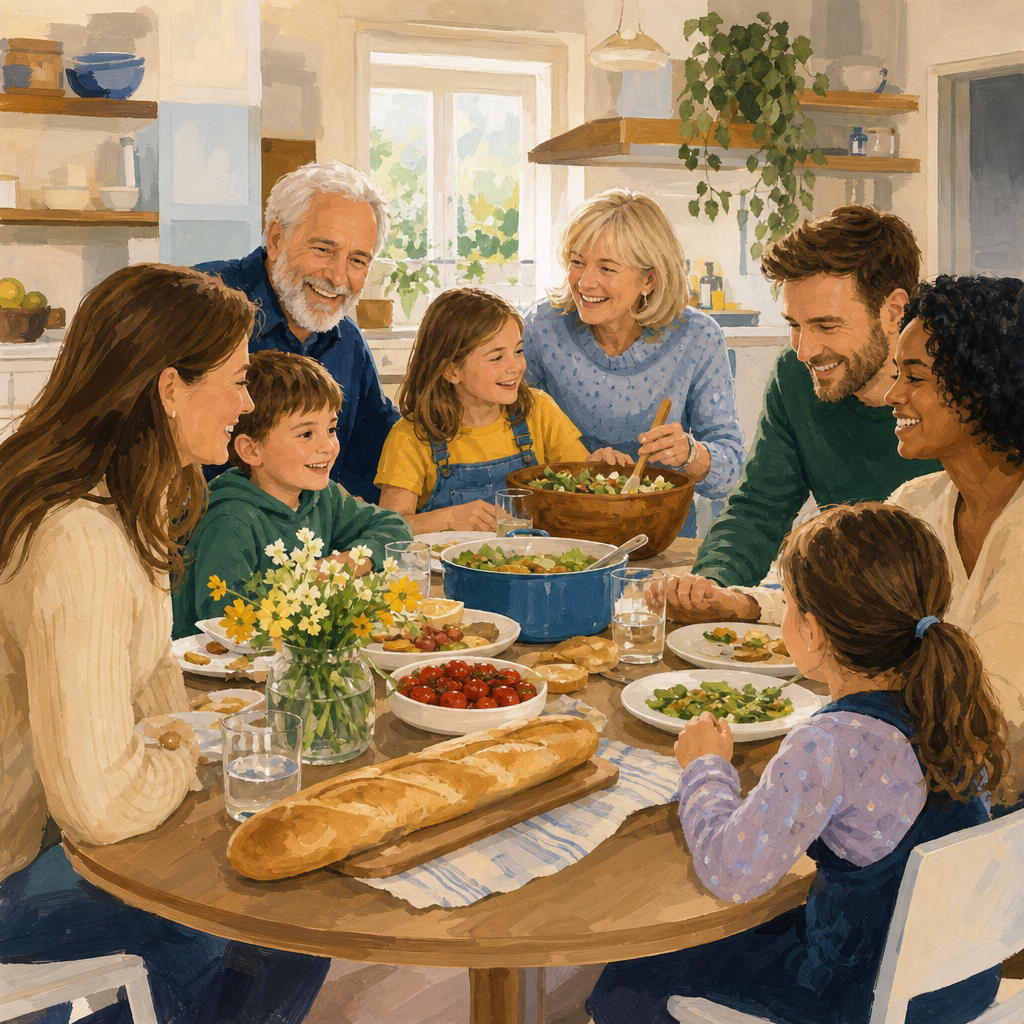
If you drew your family on a page right now, how many people would you name? Keep that number in your head.
In France you might hear children say papa and maman at home, and papy and mamie for grandparents. Today we learn the full words you will see in books: le père, la mère, le grand-père, la grand-mère, and three more.
We will learn seven French family words, listen to someone describe theirs, and sort the words by le and la.
Take a few answers on how many people pupils would name, then move on. Do not teach any French yet; the flashcards in the next step introduce every word. If anyone volunteers with please or thank you in French, smile and accept it as a nice manners link, not a requirement.
Here are today's seven family words. English shows first: try the French before you flip, then listen and say it back together. Watch which ones take le and which take la.
Work through all seven cards on the IWB. English appears first, so invite a guess, flip, then play the audio. Class repeats twice: once all together, once by table. Point at the article every time so the pair is what they hear. Pronunciation guides if you need them: le père (luh PAIR), la mère (lah MAIR), le frère (luh FRAIR), la sœur (lah SUR), le grand-père (luh grahn-PAIR), la grand-mère (lah grahn-MAIR), le bébé (luh bay-BAY). Notice the accents on père, mère, frère and bébé. Sœur has that special French sound: purse your lips like a tiny kiss and say SUR; celebrate the first clean try from the class.
Léa is telling her new classmate who lives in her house in Lyon. Listen all the way through once without answering, then listen again and choose the best answers. Listen for which family people she names.
Play the full clip twice on the class speakers, pens down and eyes on the board the first time. After the second play, take answers with fingers or a partner whisper, then check together and ask what clue gave each one away. The written text is shown on screen as well as spoken.
What the clip actually says.
Claire: Bonjour! Tu as des frères ou des sœurs? (Hello! Do you have any brothers or sisters?)
Luc: Oui, j'ai deux frères. (Yes, I have two brothers.)
Luc: Et toi? (And you?)
Claire: J'ai une sœur. (I have one sister.)
Claire: Nous avons aussi un bébé à la maison! (We also have a baby at home!)
Luc: C'est super! J'adore les bébés! (That's great! I love babies!)
The questions the class will be asked, and the answers.
Before you start: today's words in this clip are le frère, la sœur, le bébé.
If the speakers or the interactive fail, read the lines above aloud yourself, twice, then ask the same questions.
Open your copy and write three or four family words, each with its article. Use the full list on the board. You can choose people from your own home, from Léa's family, or from the stick-family on the board: pick whichever list feels right for you. Take care with the accents on père, mère, frère and bébé, and with the oe in sœur.
Pause the board. Project the full seven-item list with articles and accents for the whole three minutes so nobody is writing from memory alone. Also leave a simple stick-family (or Léa's named people) visible as a neutral source. Choral-spell the tricky ones once before pens move: p-è-r-e and s-o-e-u-r. Show that oe in sœur is the French joined sound sometimes written as the single letter œ; pupils may write oe if they cannot form a ligature, as long as the article and the rest of the spelling are correct. Keep the model spellings visible the whole time. Everyone writes: this is the only three minutes where every pupil's pen is moving. Walk the room and check the article is going in front of every word; a list of bare nouns will not carry the gender pairing. Three quiet minutes, every pen moving. Lists of different lengths are all fine. Never press a pupil to write about their own household: the stick-family and Léa's family are equal, valid choices for anyone who prefers them (sensitive home situations, foster care, recent change, or simply not wanting to share). Do not collect these.
We sort each family word into the masculine (le) or feminine (la) column on the board. When it is your turn, say the word with its article and tell us which column. Everyone else says it quietly with us as it is placed. You have already met gender with fruits and vegetables: use that same ear here.
Then, with a partner: Partner A names someone in English (or points at a stick-person on the board); Partner B answers with le or la and the French word. Swap roles.
Whole-class IWB is the default (no pupil devices needed). Model the first two on the board, thinking aloud: le père goes under masculine because of le, la mère under feminine because of la. Invite volunteers for the rest, or drag as a class decision. If a word lands in the wrong column, say the full phrase with the article and let the class correct it together. Watch for le bébé: pupils sometimes guess feminine because babies are small, but the article decides. Well spotted if anyone nearly puts bébé with la, loads of learners do; the article is the boss.
After the sort (about six minutes), put a simple stick-family or the word list on the board and model one exchange: you point and say "mother", class answers la mère. Then pairs for about three to four minutes: Partner A prompts in English or by pointing; Partner B says the French with the article; swap. Circulate and listen for the article stuck to the noun. Partners may use the stick-family so nobody has to name their own household aloud.
You're previewing this lesson. Get full access to this lesson and hundreds more — each one ready to teach, with interactive activities, printable resources and pupil progress tracking built in.