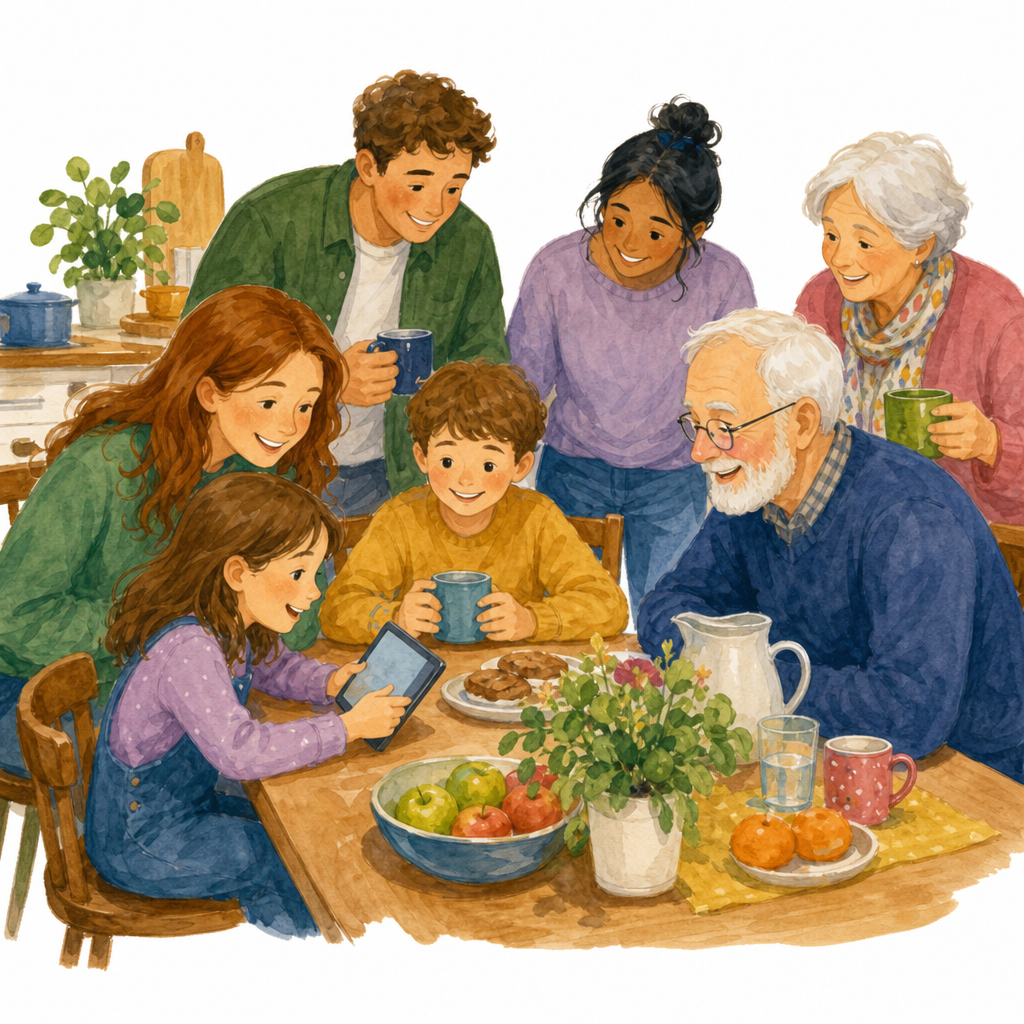
How many people are in your house right now? Hold up that many fingers, then say the number in French. You already know the numbers; today we put them with family words.
If you held up more than six, your house is déjà une grande famille: we will need every word today!
Take a quick finger count around the room, then invite three or four pupils to say their number in French (e.g. quatre = kat-ruh, cinq = sank, six = seess). Enjoy the grande famille joke if anyone holds up a high number. Do not introduce the family words yet; the word-table does that next. Keep the energy light: the point is to wake up last year's numbers before they meet the new nouns.
Meet the Dupont-Martin family from Lyon. Listen to each family word, then say it back together. Watch which take le and which take la, and listen for the soft r at the end of mère, père and frère.
Then we build full sentences about how many people are in a family and how old someone is, using mon and ma.
Word pass (IWB-led): You tap each word on the board. Class repeats twice: once all together, once by table. Point at the article every time so the pair is what they hear. Pronunciation guides: la mère (lah mehr), le père (luh pehr), le frère (luh frehr), la sœur (lah sur), le grand-père (luh grahn-pehr), la grand-mère (lah grahn-mehr), la tante (lah tahnt).
Quick re-run: In a mixed order, say the English or point at the image; class calls back the French with the article (e.g. you say "aunt" → class: la tante).
Possessives on the board before the frames: Write one clear line: mon with le words / ma with la words. Examples: mon frère, ma sœur, ma tante.
One fixed Dupont-Martin story (keep these facts identical in step 3): Narrator is Léa Dupont-Martin in Lyon. Five people in her household: father, mother, brother, sister and Léa. Her brother is eight. Her sister is eleven. Aunt lives in Lyon too (not counted in the five).
Sentence frames (keep large and visible for the rest of the lesson — ages must match the story above):
Choral substitution (whole class, 3–4 rounds): Class repeats each model, then you change one piece (number, name, or family member) and they chorus the new sentence. Keep Dupont-Martin ages fixed when you stay on that family: brother = huit, sister = onze. For free practice, swap to other numbers or other relatives: Il y a quatre personnes dans ma famille / Ma tante a trente ans / Mon grand-père a soixante ans. Leave a small number bank (quatre, cinq, six…) and age bank (huit, dix, onze…) on the board.
Pair speak (about 2 minutes): In pairs, pupil A says a how-many sentence; pupil B says one age sentence; then swap. Stay on the two frames; no new grammar.
We will hear a short family scene twice. Listen for how many people there are and who is how old. Then answer the questions on the board together.
Play the full clip twice on the class speakers, pens down and eyes on the board the first time. After the second play, take answers with fingers or a partner whisper, then check together and ask what clue gave each one away. The written text is shown on screen as well as spoken.
What the clip actually says.
Claire: Bonjour! Tu as des frères ou des sœurs? (Hello! Do you have any brothers or sisters?)
Luc: Oui, j'ai deux frères. (Yes, I have two brothers.)
Luc: Et toi? (And you?)
Claire: J'ai une sœur. (I have one sister.)
Claire: Nous avons aussi un bébé à la maison! (We also have a baby at home!)
Luc: C'est super! J'adore les bébés! (That's great! I love babies!)
The questions the class will be asked, and the answers.
Before you start: the only word from today's list that is in this clip is le frère, la sœur. The rest of it is other vocabulary, so tell the class to catch what they can rather than hunt for today's words.
If the speakers or the interactive fail, read the lines above aloud yourself, twice, then ask the same questions.
First whisper your two sentences to yourself or a neighbour, using the patterns on the board. Then open your copy and write them: how many people in the family, and one person's age. You may write about your own family or about the Dupont-Martin family. Take care with accents and with mon / ma.
Keep the model sentences large on the board, plus the mon/ma line. If pupils choose Dupont-Martin, keep the fixed facts: five people, brother eight, sister eleven. Oral first (about 1 minute): point at each frame; class repeats; then everyone whispers their own version (number and one age phrase swapped in) to themselves or a neighbour. Only then open copies.
Write (about 4 minutes): two sentences each. Allowed scaffolds: copy the frame and change the number, family word, and age. Walk the room and check (1) the article or mon/ma matches the noun (ma sœur, not mon sœur), (2) age uses a … ans, not an English-style "is", (3) accents on mère, père, frère, sœur. Do not collect these.
Drag each family word into the le column or the la column. Say the word quietly as you place it, article first.
Whole class on the IWB with volunteers taking turns, or tables calling out before the drag. All seven words in this lesson are singular and take le or la only (no plural les card): le père, le frère, le grand-père vs la mère, la sœur, la grand-mère, la tante.
Label the board columns clearly as le and la (binary gender sort). If a word is dropped in the wrong column, say the correct pair together before moving on: la mère, not bare mère. After the sort, ask which column is fuller and whether any pattern jumped out (there often is not a tidy spelling rule, and that is worth naming).
You're previewing this lesson. Get full access to this lesson and hundreds more — each one ready to teach, with interactive activities, printable resources and pupil progress tracking built in.