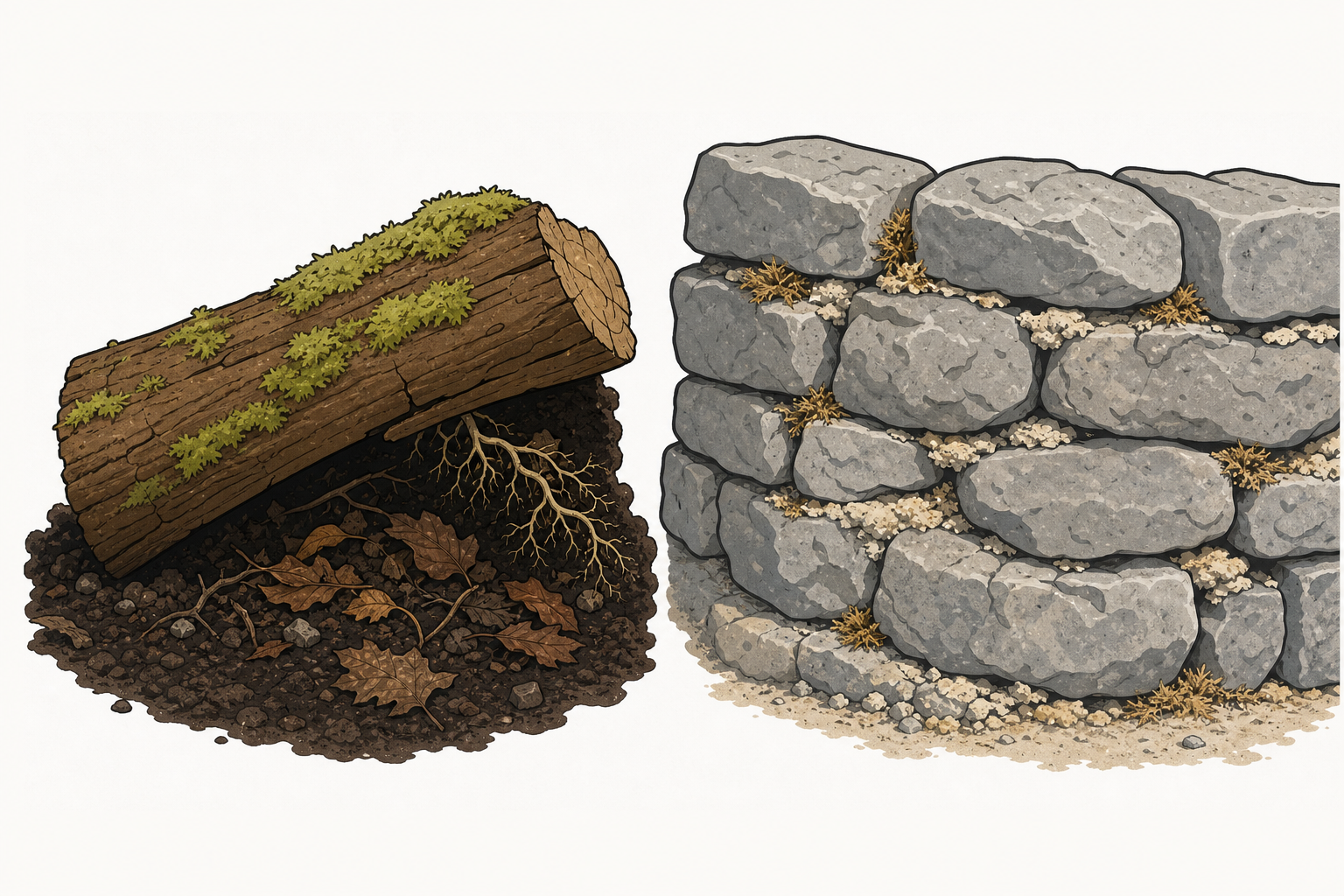
Look at these two places in a school garden: the dark space under a log, and the sunny face of a stone wall. Do you think the same living things would live in both? Hands up if you think they would be different, and be ready to say why.
Show the two contrast photos on the IWB (or point out a real log and wall if you can see them from the classroom). Keep this as a curiosity beat only: do not hand out pots or explain the full hunt yet.
Key question: Why might different creatures choose different small places to live?
Take three or four quick ideas. Do not correct wrong guesses; they feed the prediction step. Have outdoor coats and the hunt kit ready by the door for later.
If outdoor grounds cannot be used today, still run this hook, then use the indoor evidence route described in the hunt step.
Under a log is cool, damp and dark; a sunny wall is dry and bright.
Microhabitat means a small place like that, with its own conditions.
Adaptation means a body feature or behaviour that helps a creature survive there.
Suited means the creature’s features match the conditions of the place.
If a creature needs to stay damp and hidden, which microhabitat would suit it better: under a log, or on a sunny wall?
Teach the three ideas with the table below before you go outside. Keep the live board to the log-versus-wall anchor, the three short term lines, and the one check question. Use the table yourself; do not read it aloud in full.
| Concept | Why it matters | Example |
|---|---|---|
| Microhabitat — a small place inside a bigger habitat that has its own light, moisture and shelter | Two spots only a few metres apart can hold completely different living things | Under a damp log is cool and dark; the sunny face of the school wall is dry and bright |
| Adaptation — a body feature or behaviour that helps a living thing survive in its place | Adaptations explain why we find one creature under a log and another on a wall | A snail’s shell and slime trail help it climb hard surfaces without drying out too fast |
| Suited to a habitat — the living thing’s features match the conditions of the place it lives | We use evidence from the hunt (where we found it, what it looks like) to explain the match | An earthworm’s soft moist body suits damp soil under logs, not a dry wall |
Misconception to head off (one line only): steer “it likes it” toward conditions: damp or dry, dark or light, hidden or open, and the feature that matches.
Optional one-breath model (skip if time is tight; the full wonder–predict–check language sits in the next step): I predict woodlice under the log because they need damp and dark.
Do not hand out the ID sheet yet; groups meet it as a working tool at the start of the hunt.
We are going to hunt in three microhabitats: under a log or stone, in grass, and on a wall. In your group, predict which creatures you think you will find in each place, and one reason why. We will test those ideas with real evidence outside.

Agree the three microhabitats the class will visit (use what your grounds actually have: log pile or large stone, a patch of grass or hedge base, a wall or tarmac edge). Groups of three or four work well.
Model the inquiry language once as you set predictions: I wonder if woodlice and snails live in the same places. I predict woodlice will be under the log because they need damp and dark. I will check by looking carefully under one log and on one wall stretch. After the hunt we will say what we observed and what we think the evidence shows.
Prediction prompts:
Predictions are never wrong; they are the start of the science. Pupils may jot a quick “I think…” line on their Investigation Journal page before going out, or hold the prediction orally if time is tight.
Safety brief (say clearly): stay inside the boundary; lift logs gently from the edge and put them back the same way; use the soft brush or pot to move creatures, never pinch; no collecting stinging insects; do not taste anything; mind nettles and brambles; wash hands when we return. Living things go back where they were found.
If you are using the indoor evidence route instead, keep the same three microhabitat labels and prediction prompts, then move straight to the tray or photo stations described in the next step.
In your group, visit each of the three microhabitats. Use the magnifier and the ID sheet to name what you find. On your Investigation Journal page, note the microhabitat, what lives there, and one feature that might help it live in that place. Handle living things gently with the soft brush or pot, and put everything back.
The outdoor 25-minute budget only holds if the three microhabitats are pre-marked and close together (short walks between stations). Budget roughly: coats and line-up (2–3 min), walk to the first station (1–2 min), about five minutes per microhabitat, short moves between stations, return and hand-wash (3–4 min). You move between groups with spare pots, brushes and the spare ID sheet.
Hand out the ID sheets at the door or first station so groups use them as a working tool, not a pre-hunt glossary. Look-fors: careful lifting and replacing of logs; brush or pot handling, not pinching; using the ID sheet before guessing; recording habitat and creature, not just “bug”; one adaptation note (hard shell, many legs, slime, lives in soil, and so on).
If the grounds are quiet: still record absences (“none seen on wall”) and signs of life (webs, snail trails, worm casts). Empty findings are still data.
Do not drop the evidence objectives. Run the same three microhabitat labels indoors with one of these routes (apparatus listed in materials_needed):
Predictions, matching and journal outcomes stay the same. Reschedule a true outdoor hunt when weather allows if you want a follow-up comparison.
Print these eight entries as the group ID sheet. Each entry is what the group reads.
Card 1 — Woodlouse: Grey body with armour-like plates and many short legs. Often curls or runs when lifted. Needs damp, dark shelter. Common under logs and stones.
Card 2 — Earthworm: Long, soft, pink or brown body with no legs. Moves by stretching and squeezing. Needs moist soil and cannot survive long on dry open surfaces. Found in soil and under logs.
Card 3 — Garden spider: Eight legs and silk for webs or hunting perches; often on walls, hedges and grass. Eight legs help it climb walls, hedges and grass; silk is used for webs or hunting perches to catch small prey in open or edge spots.
Card 4 — Snail: Hard spiral shell and a soft slimy foot. The shell protects the soft body; slime helps it move on hard surfaces. Often on walls, plants and in damp corners.
Card 5 — Ant: Six legs and strong jaws; nests under stones or in soil; travels in ground-level trails looking for food. Often seen in groups on grass, paths and under stones.
Card 6 — Centipede: Long brown body with many legs; moves fast. A hunter of other minibeasts. Prefers dark damp places under logs and stones.
Card 7 — Ground beetle: Hard shiny wing cases and six legs; runs rather than flies when disturbed. Often under stones or in grass at the soil surface.
Card 8 — Slug: Soft slimy body with no shell. Dries out easily, so it stays in damp sheltered places under logs, stones and leaves.
Differentiation: less confident groups tick name + habitat only and add one word for a feature; confident groups add a second creature per habitat and a fuller “why suited” note.
Safety in the field: fixed boundary; adult eyes on log lifting; soft brushes and pots only; no bees or wasps in pots; wash hands on return; return every living thing.
Back inside, we share finds as a class first. Then, in your group, draft two matches on your Investigation Journal page. Each draft needs three parts: the living thing, one adaptation, and one evidence phrase from the hunt (for example damp, dark, shell or slime). Aim for a clear draft, not perfect wording — we tighten that next.
Pupil action this beat: (1) whole-class oral share of finds, then (2) groups draft two adaptation–habitat matches with one evidence phrase each on the Investigation Journal page. This is draft only; the next step is a short quality check, not a second full write-up.
Whole-class share first: take one find from each microhabitat on the board (habitat | creature | feature). Then give groups about four minutes to agree and draft two matches.
Strong matches to draw out if groups stall:
Nature of STEM weave: this is how ecologists work a site: sample different spots, record who lives where, then link features to conditions before anyone plans a change.
Key questions: What evidence from the hunt supports your match? What would happen to a woodlouse left on a dry wall in full sun?
Misconception: “Bigger creatures live in bigger places.” Size is not the rule here; moisture, shelter and food matter more.
You're previewing this lesson. Get full access to this lesson and hundreds more — each one ready to teach, with interactive activities, printable resources and pupil progress tracking built in.