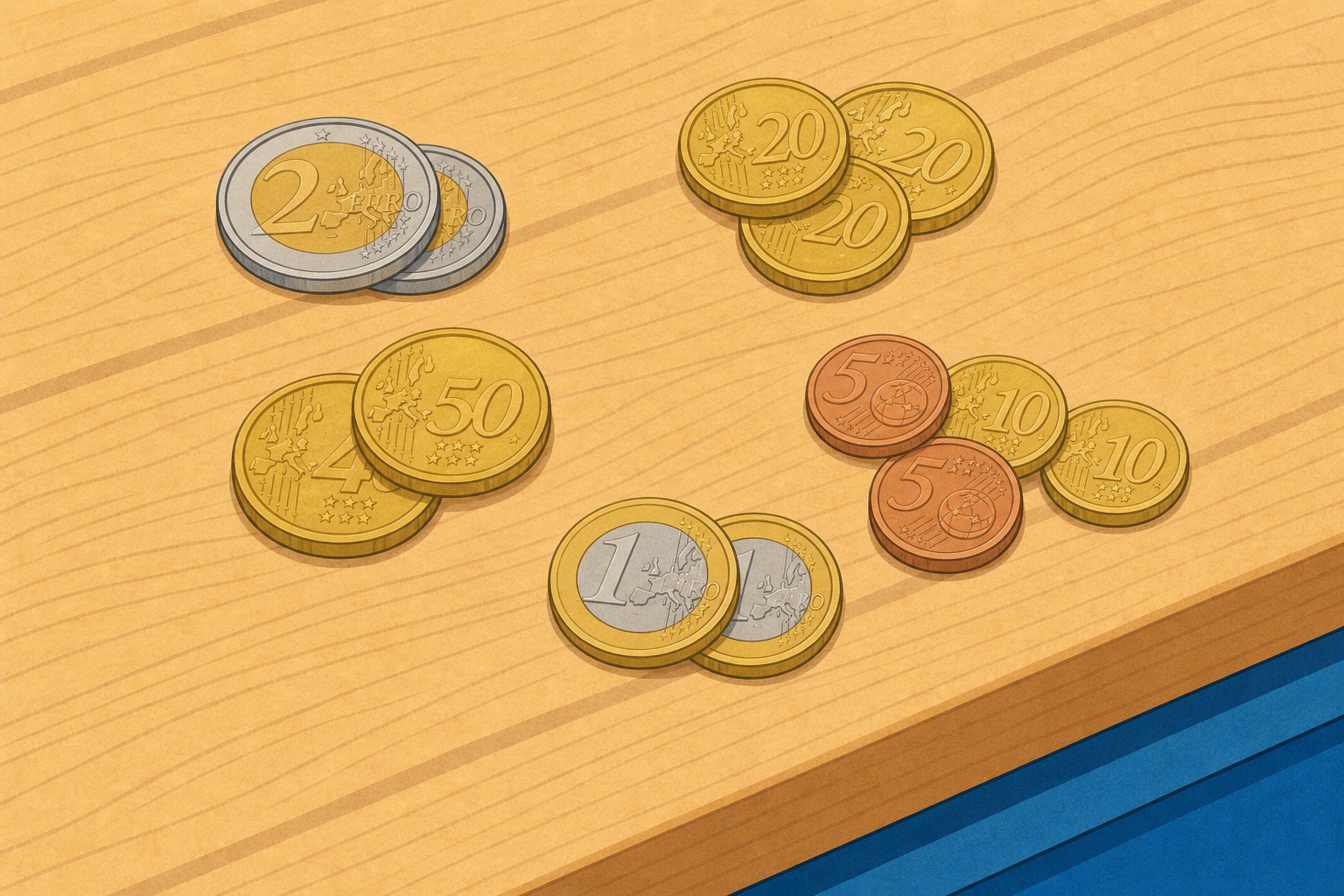
Hands up: how many different ways can you think of to make exactly 80c using coins? Is there just one way, or more than one?
Take three hands-up answers, not open call-outs. Write two or three of the pupils' coin sets on the board side by side so the class can see the same total made different ways. Do not settle on a 'best' way yet — that is the point of the lesson.
Here are four amounts. Read each total and think which coins and notes could make them.
The last one hides a trap. Look at €3.05: the number straight after the point is a zero, so say it as three euro and five cent. The zero is in how the amount is written; you can still use 10c, 20c or other coins as long as the total is right.
Read each total in euro and cent as a class.
Point at each coin as the class tallies aloud; these are static snapshots, nothing to drag.
Now we build these amounts on the coin tray, in this order: 55c, then €1.15, then €2.40, then €3.08. One pupil taps the coins at the board while everyone else watches the running total and agrees or corrects out loud. The last one, €3.08, has a zero straight after the point, so say it as three euro and eight cent before we check it.
Talk this one through together — one pupil builds at the board and the class agrees or corrects out loud.
An individual pupil drags coins to build the called amount while the class watches the running total. After each build, ask if a larger coin would have used fewer pieces. On €3.08, hold out for the eight single cent and the zero straight after the point — this is the same trap as €3.05 in the model.
In your maths copy, write two different ways to make €1.55. List the coins and notes in each way, one under the other, then add each list up to check both come to €1.55. If you have the printable coins-and-notes worksheet, use it to lay out each set before you write it down.
Walk the room, glance for two genuinely different sets that both total €1.55 — no individual marking, this is whole-class copybook practice, not assessment.
Hand out the printable coins-and-notes worksheet to pupils who prefer to lay out physical or paper coins before writing; the printable mirrors the on-board tray so no pupil is left out if the IWB is unavailable.
A bigger coin swallows up several smaller ones, so reaching for the biggest first means fewer pieces to count.
Now we make these amounts, each a little harder than the last: 65c, then €1.20, then €2.85, then €3.70. For each one, aim for the fewest coins and notes you can.
This is the practice round — pupils take turns at the board, check each answer, and the class confirms before moving on. Keep the board work brisk rather than over-explaining.
For each target ask the class to predict the largest coin or note to reach for first. €3.70 rewards the largest-first idea neatly — the fewest way is a €2, a €1, a 50c and a 20c; take predictions before the reveal.
You're previewing this lesson. Get full access to this lesson and hundreds more — each one ready to teach, with interactive activities, printable resources and pupil progress tracking built in.