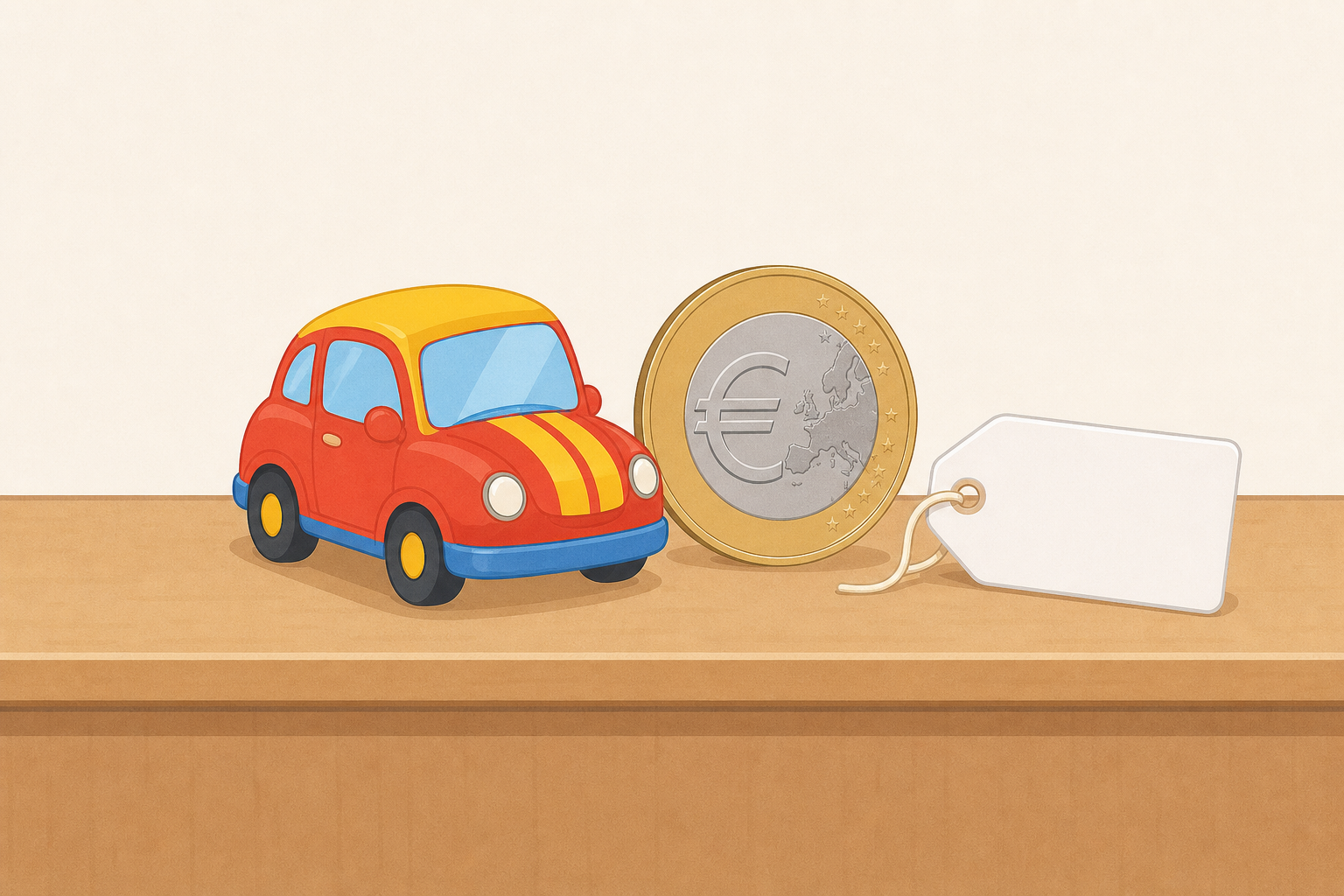
A small toy costs 70c. You hand the shopkeeper €1. How much money should you get back?
That money you get back has a special name. What do we call it?
Here are two purchases. For each one we count coins up from the price to the money handed over. Those coins are the change.
First: a sticker costs 80c and is paid for with €1. The display counts on as 90, then 100.
Next: a pencil costs €1.50 and is paid for with €2. The display counts up from €1.50 to €2.
Notice that we never take anything away. We only count up from the price.
Each time we say the price. Then we count coins up to the money handed over. The coins we add are the change.
Today we work these out together on the board by counting up from the price. First we do a 90c sticker paid with €1. Then a 60c apple paid with €1. Last a €1.20 juice paid with €2.
In your maths copy, write three "cost — paid — change" lines for the examples on the board, filling in the change on each line.
Count up from the cost to the money paid to find each change.
Today we work through four fresh change questions together, each a little harder than the last. Read each story. Decide the money paid. Then count up from the price to find the change.
We start with a 70c pencil paid with €1. Then a €1.40 comic paid with €2. Then a €3 sandwich paid with €5. Finally a €2.40 book paid with €5.
You're previewing this lesson. Get full access to this lesson and hundreds more — each one ready to teach, with interactive activities, printable resources and pupil progress tracking built in.