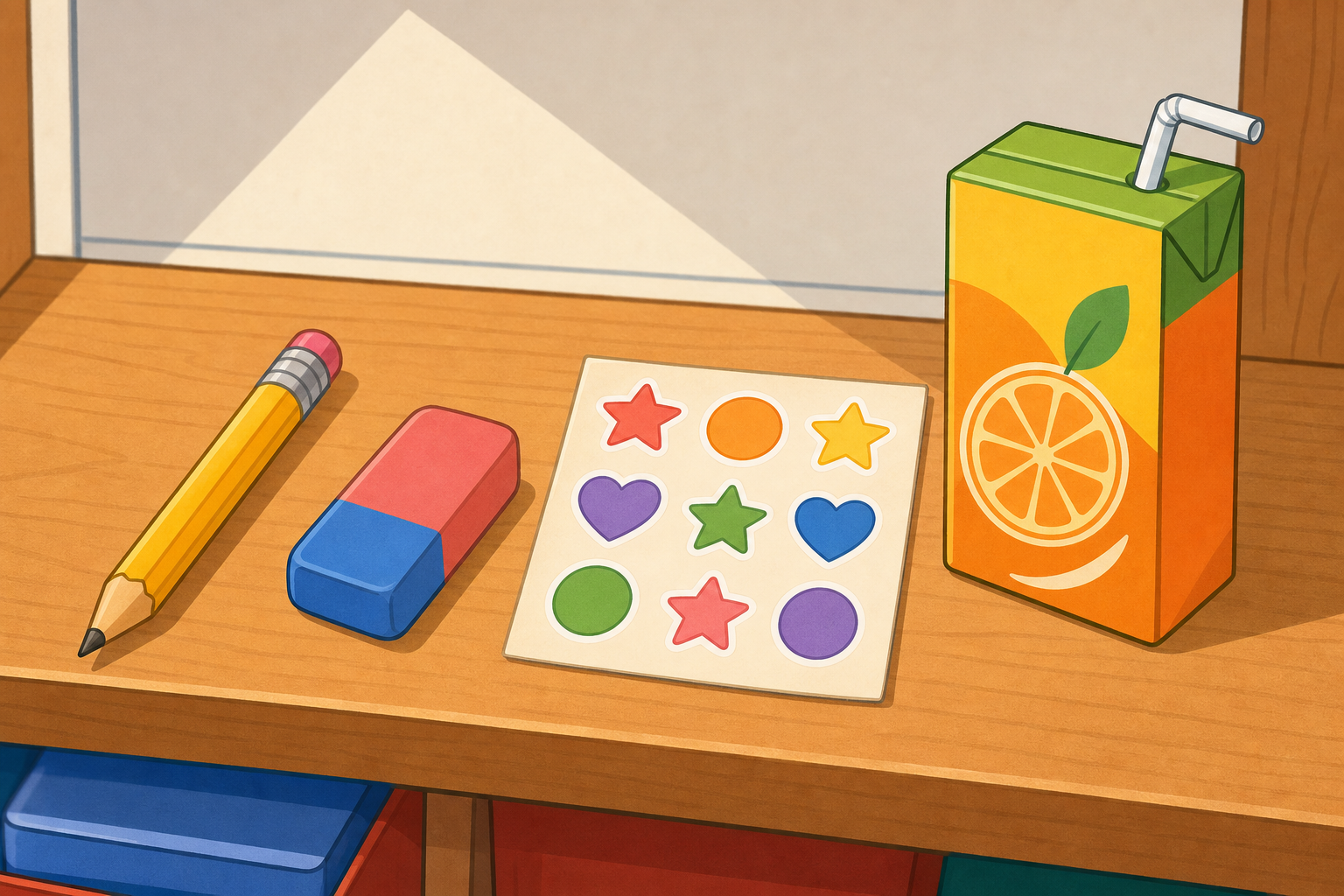
Here is our tuck-shop price list:
If you had €1 or less to spend, which two things could you buy? Have a think, then share your idea.
Show the tuck-shop price list on the board as pupils settle. Take three hands-up answers, not open call-outs. This is a think-and-share opener, so there is no wrong answer yet — hold the question open so the class works it in the next steps.
Here are three shopping choices on the coin-counter. Look at the coins for each total, then check: does the total fit inside the money we have? On the last one, look at the change found by counting on.
Tray 1 — pencil (30c) and rubber (20c). Tally aloud 20, 30, 50: the 20c and 10c make the 30c pencil, second 20c is the rubber. Ask does 50c fit inside €1 before telling them — yes, room to spare.
Tray 2 — sticker (50c) and juice (€1), totals €1.50. Hold out for the moment it passes €1. Point is the check, not the adding: get one pupil to say why €1 is not enough, so €2 is needed.
Tray 3 — pay €1.50 with €2, count on together in 10c steps: €1.50, €1.60, €1.70, €1.80, €1.90, €2. Change left over is one 50c. Ask one pupil to name the change.
Today we build each total on the coin-counter. After each total we check: does it fit €1, or would we need €2?
Talk this one through together — pupils take turns at the board and the class agrees or corrects out loud.
For each pair, get the coins into the tray first, read the total, then ask the whole class the budget question: fits €1, or need €2? Between turns, revoice a pupil's answer so the watching class hears the reasoning. Remember the pencil has no single coin — pupils build the 30c from a 20c and a 10c. The last pair (€1.50) is the one that tips over €1 — hold the class on it and ask what note pays for it.
In your maths copy, choose two items from the price list. Write their total, then count on from the total to €2 to find your change.
Walk the room glancing at whether the total is added correctly before the change is worked out — this is whole-class copybook practice, not marking. Watch for pupils counting on in 10c steps the way it was modelled on the board.
Today we work through these spending questions together, using the price list. Add first, then check it fits.
This is the practice round — pupils take turns at the board, check each answer, and the class confirms before moving on. Keep the board work brisk rather than over-explaining.
Question 3 is the make-or-break: €1 juice plus 20c rubber is €1.20, so €1 is not enough. Let the class predict before you check the total on the tray. For question 4, get the total on the tray, then count on from the total up to €2 for the change, the same way it was modelled earlier.
You're previewing this lesson. Get full access to this lesson and hundreds more — each one ready to teach, with interactive activities, printable resources and pupil progress tracking built in.