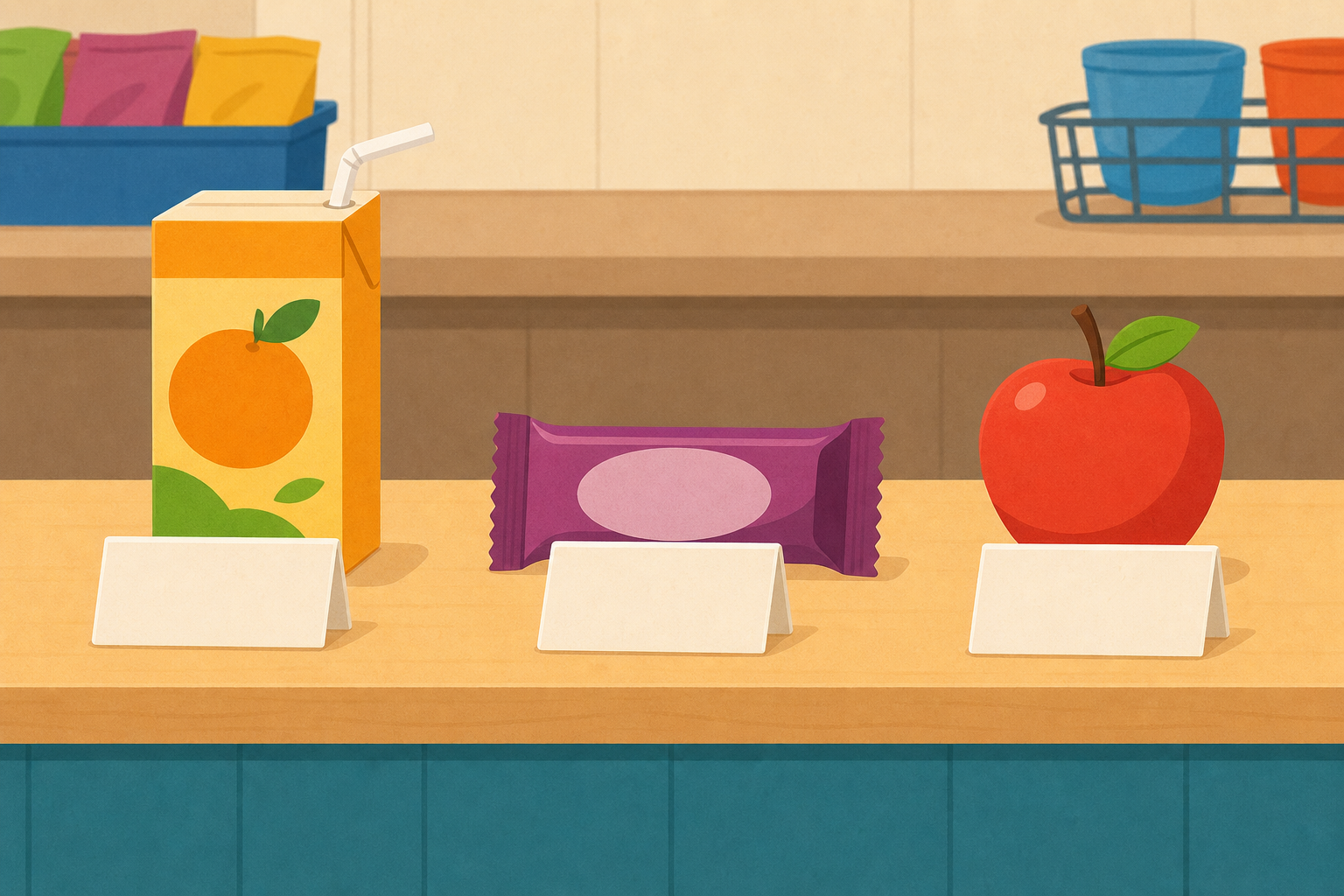
You walk up to the tuck shop with a €5 note in your hand. There is a drink for €1.50, a snack for €1.20 and a piece of fruit for €0.85.
Which two things could you buy and still have change left over? How much change would you have?
Display the three prices as pupils settle. Take three hands-up answers, not open call-outs. Hold out for pupils to name the two items and say roughly how much they'd spend, before anyone confirms the exact totals and the change from €5.
Here is our tuck-shop price list for today. We will shop from this all lesson:
Watch as we lay out €5 and spend from it, checking what is left each time:
Which spend leaves you the most, and which leaves you the least?
Read the price list aloud first so pupils have a fixed set of named items and prices to shop from all lesson. Then work through the three panels in order as subtractions from €5: point to each coin, don't drag.
Panel one buys the snack and fruit (€1.20 + €0.85 = €2.05), leaving €2.95. Panel two buys the drink and snack (€1.50 + €1.20 = €2.70), leaving €2.30. Panel three buys the dearest pair on the list, the drink and treat (€1.50 + €1.60 = €3.10), leaving only €1.90. Before revealing each remainder, ask the class to predict it. Draw out that the dearer the pair, the less is left.
Now let us fill a whole €5 budget together, using the price list. We add each cost one at a time and check what is left after each. First a €1.50 drink. Then a €1.20 snack. Then a €0.85 fruit. Last of all, a €1.60 treat. Watch closely on the treat and check whether it still fits inside the €5 budget.
Then think about value for money. Two snacks are on sale: one at €1.20 and one at €0.90. If both are the same size, which one is better value, and why?
This round is for talking it through together: pupils take turns at the board and the class agrees or corrects out loud before you move on.
Keep a running total on the board beside the tray: after the drink, €1.50; after the snack, €2.70; after the fruit, €3.55. Before the €1.60 treat, ask the class to predict whether it fits (€3.55 + €1.60 = €5.15, so it does not). Revoice a good answer: so we'd be over by fifteen cent. On the value-for-money pair, draw out that the €0.90 snack is better value only if it is the same size and just as good — cheaper is not always better if you get less. Rotate four pupils to lay out and read each price.
In your maths copy, use the price list on the board. This time your budget is smaller: €4, not €5. Write one shopping list of items you could afford, one under the other. Then add up the cost of your list.
Point back to the on-screen price list and flag the smaller €4 budget out loud before pupils start. Ask for the list and the total only — the change from €4 is worked as a class in the next discussion. Walk the room glancing at whether totals stay at or under €4; no individual marking, this is whole-class copybook practice.
Today we work through four shop tasks using the price list and coins:
This is the practice round — pupils take turns at the board, check each answer, and the class confirms before moving on. Keep the board work brisk rather than over-explaining.
The tasks rise in difficulty: the first is one subtraction from €2 (€2 − €1.20 = €0.80), the last asks pupils to compare prices on the list for best value before adding. On the third task, note that buying all four items (drink + snack + treat + fruit) would total €5.15 and so go over — dropping the fruit leaves the three-item drink + snack + treat basket at €4.30, the closest fit under €5. Fast finishers watch the board. Watch for pupils who tip over the budget and don't notice — get the class to spot it.
You're previewing this lesson. Get full access to this lesson and hundreds more — each one ready to teach, with interactive activities, printable resources and pupil progress tracking built in.