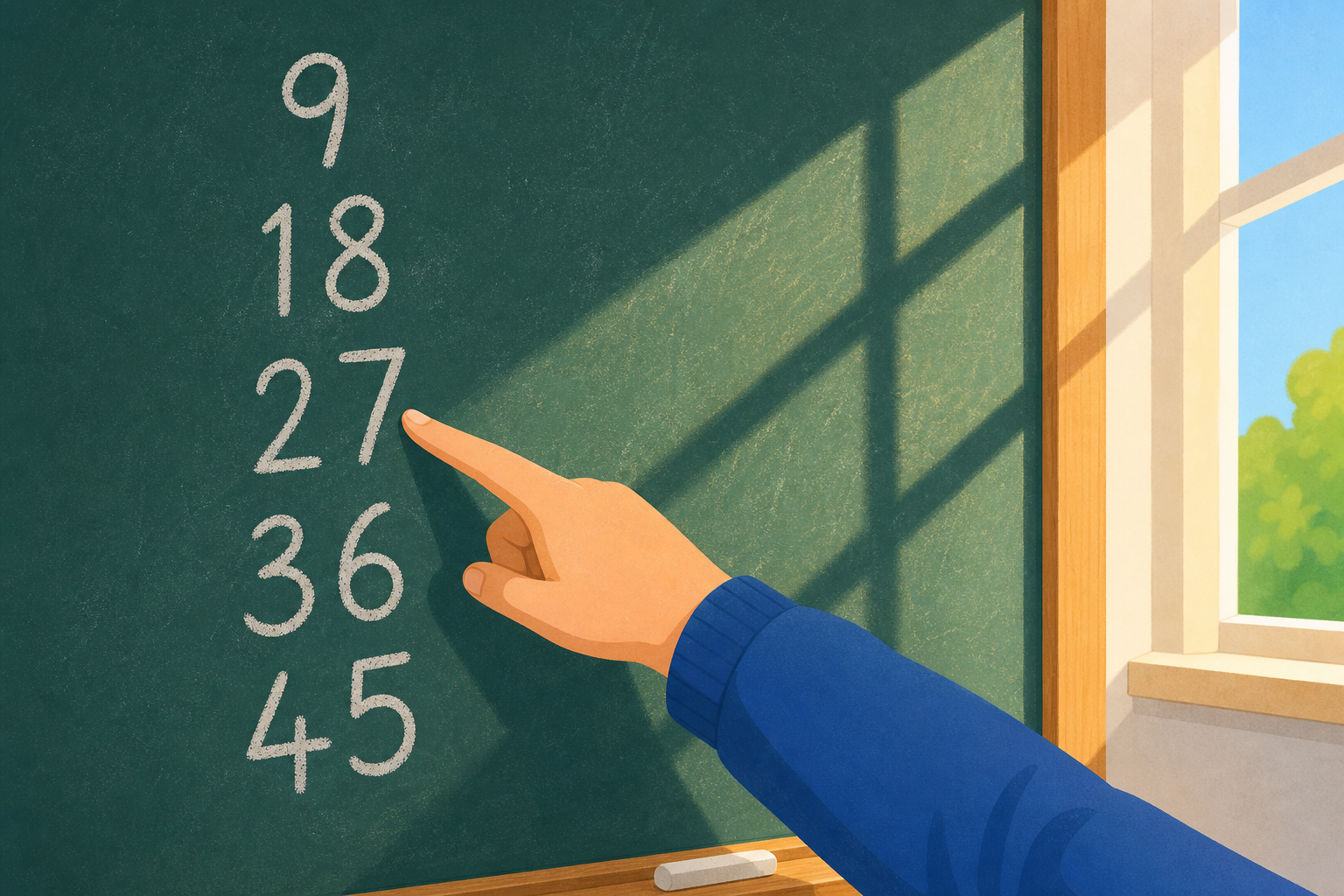
Here is a quick secret about the 9 times table. Look at the answers: 9, 18, 27, 36, 45. Add the two digits of any one of them together. What do you get every single time? Try 45: add its two digits, 4 and 5. Try 27: add 2 and 7. Have a look and be ready to tell me the pattern you spot.
Write the multiples 9, 18, 27, 36, 45 up on the board by hand as you speak (there is no interactive in this opening hook). Give five seconds of quiet think-time, then take two or three hands-up answers. You are steering them toward the digits always add up to nine. Don't confirm it as a rule yet — that lands in Watch and Notice.
The hundred square shades one times table at a time: threes, then sixes, then nines. Watch where each set of multiples lands and see what pattern shows up. Say the numbers aloud as they light up.
3s: multiples 3, 6, 9, 12, 15 on. Trace the slanting stripe with a finger so they see the shape, not just the numbers.
6s after the 3s: the load-bearing idea. Compare the separate 3s and 6s squares, every multiple of six is also a multiple of three, because six is three doubled. Write 3 x 4 = 12 and 6 x 4 = 24 side by side on the board.
9s: 9, 18, 27, 36, 45, 54, 63, 72, 81, 90. Read the two digits of each and add: always nine. Pause before the last reveal, let them predict the digits of 9 x 8 (seven and two, add to nine), then reveal 72.
Today we work through these facts together on the board. Each time, say how you knew it:
This round is for talking it through together — pupils take turns at the board and the class agrees or corrects out loud.
The interactive shows one fact at a time and confirms the answer when the correct button is tapped. After each pupil answers, ask how did you know that? before moving on.
In your maths copy, write the 6 times table down to 6 × 10. Beside each answer, write the matching 3 times fact that it is double of. For example, write 6 × 4 = 24, and beside it 3 × 4 = 12, because 24 is double 12.
Walk the room glancing at whether the doubling pairs line up correctly — this is whole-class copybook practice, not marking. If a pupil writes an answer that is not double its 3s partner, point at the partner rather than giving the answer.
Time for tables bingo. You each have one printed card that you keep for the whole game. I'll call the facts from the board in four rounds: a 3 times round, then a 6 times round, then a 9 times round, and finally a mixed 7s and 8s round. Every answer you hear stays marked, so a winning line can build up across the rounds. Mark the answer on your card each time. First to a line of four calls it out, and we check the facts together.
These are the practice questions — pupils play on paper with printed bingo cards, marking answers with a pencil as you call each prompt from the board. There is no on-screen tapping and no automatic grading in class; the class confirms each called answer aloud. Keep the calling brisk.
How the cards map to the rounds: each pupil uses one 4×4 card (16 answers) across all four rounds. There are 24 called prompts in total, so a card cannot be fully filled and a line of four is comfortably reachable, especially as marks carry over between rounds. Do not hand out a fresh card per round.
Before the lesson: print one bingo card per pupil from the generated cards PDF, and keep the call-sheet for your eyes only while you call the questions.
You're previewing this lesson. Get full access to this lesson and hundreds more — each one ready to teach, with interactive activities, printable resources and pupil progress tracking built in.