A shop stacks its shelves in rows. One shelf holds 23 tins of beans, and there are 4 shelves the very same. Roughly how many tins is that on the wall altogether? Hands up: is it closer to 80, or closer to 100?
We could count every tin one by one, but that would take an age. Today we will find a quick, tidy way to work out 23 × 4 and sums like it.
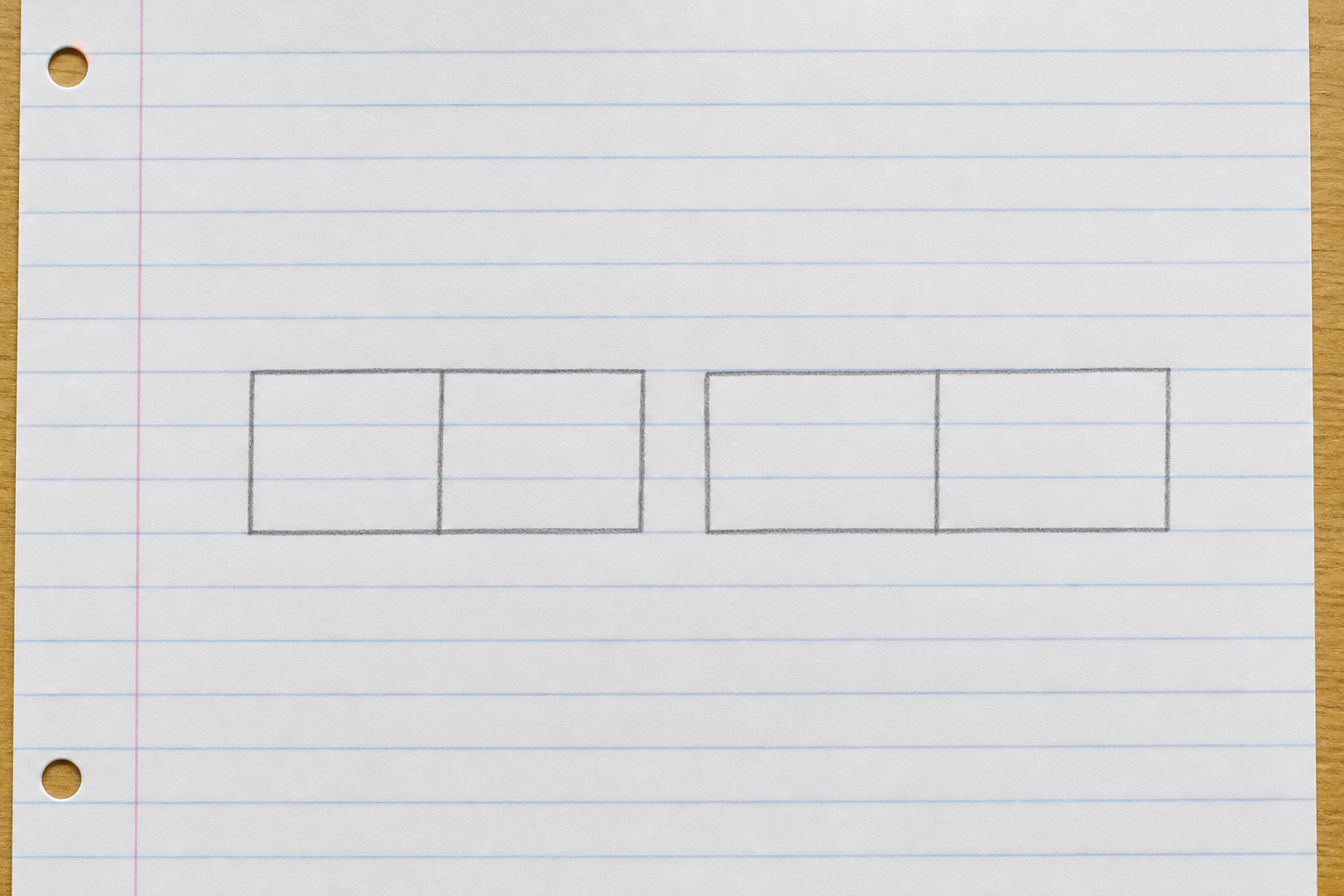
The interactive draws each multiplication as a rectangle that splits into two boxes. Watch where the two-digit number breaks into tens and units, and how each box gets multiplied on its own before we add them.
Now we build 34 × 6 together on the split rectangle. The 34 splits into a tens box and a units box, and we add the two partial products for the answer. Watch the board, predict the big box first, then we check it together.
After that, I will work two more on the board with you: 28 × 5 and 56 × 4. Watch the units box in 28 × 5 — it gets big, so the adding needs care.
In your maths copy, draw a rectangle split into two boxes for 34 × 6, and another for 46 × 5, just like the ones on the board. Fill in each partial product, then add the two boxes to find the answer for each one.
Remember to split the two-digit number into tens and units before you fill the boxes.
Today we solve these shop-and-sport problems together: first 21 stickers on each of 4 pages, then 34 cones costing €5 each, then 47 euro raised by each of 6 pupils, and finally 58 metres run in each of 7 laps. Read each story, spot the words that tell you to multiply, then split the rectangle into boxes to find the answer. The later ones have a units box that carries when you add.
You're previewing this lesson. Get full access to this lesson and hundreds more — each one ready to teach, with interactive activities, printable resources and pupil progress tracking built in.
