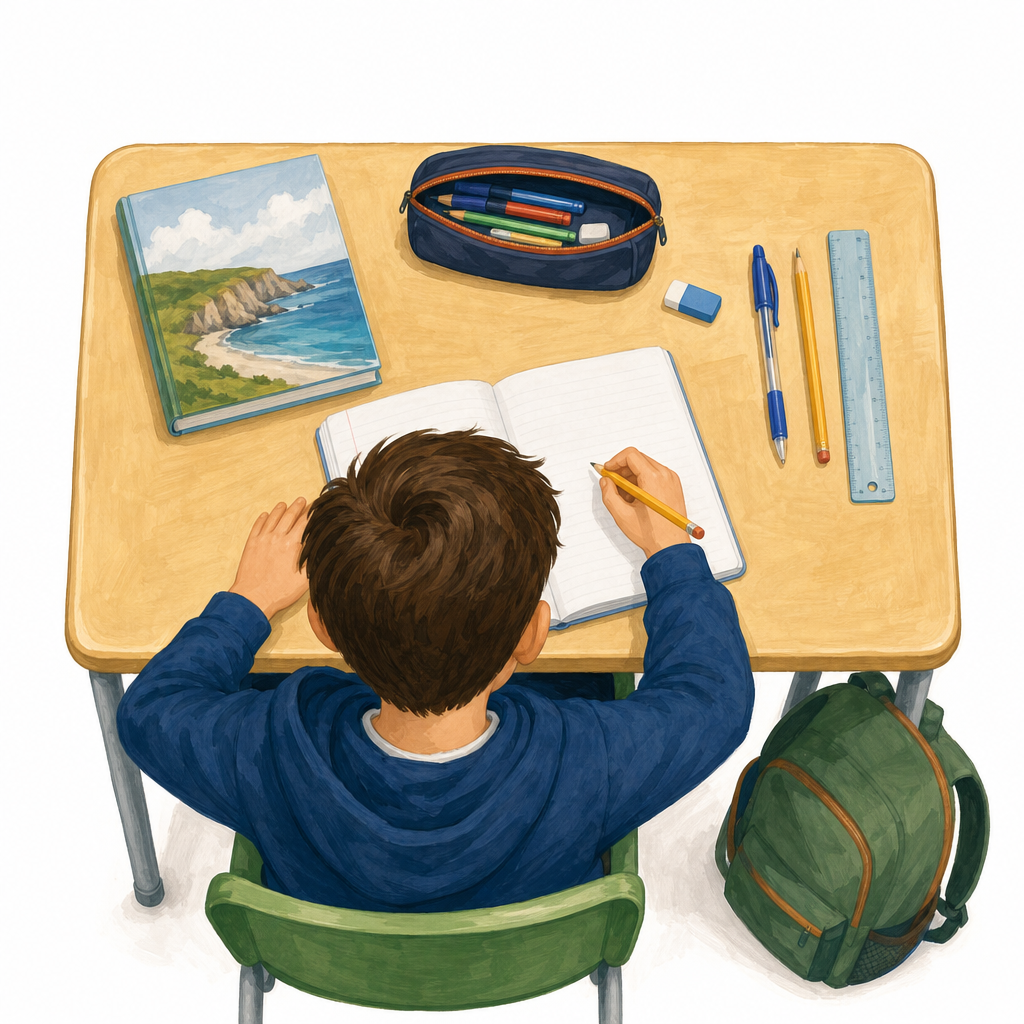
Everything we name today is already sitting near you: pencils, pens, books, a pencil case, a backpack. Hold up a pencil if you have one. In a few minutes you will know eight Spanish words for the kit right in front of you.
Hold up a real pencil and invite a few pupils to hold one up too. Keep the hook light: the point is that today's words are already in the room, not that everyone must have a full pencil case. Do not teach any Spanish yet; the word-table in the next step does that work. Smile and set the tone: these are day-one Spanish school words, and they will leave able to name their own kit.
Today's eight words come in two groups. First, four desk-kit words: tap each one, listen, then say it back together. Then a quick recap of those four. After that, four bag-kit words the same way. Watch which ones take el and which take la.
Do not race all eight at once. Chunk one (desk kit, about 4 minutes): tap and chorally repeat el lápiz, el bolígrafo, la goma, la regla — once all together, once by table. Point at the article every time. Quick choral recap of those four before you move on. Chunk two (bag kit, about 4 minutes): same pattern for el libro, el cuaderno, el estuche, la mochila. Finish with one lightning pass of all eight if time allows. Pronunciation guides: el lápiz (el LAH-peeth), el bolígrafo (el bo-LEE-grah-fo), el libro (el LEE-bro), el cuaderno (el kwah-DEHR-no), el estuche (el es-TOO-cheh), la mochila (lah mo-CHEE-lah), la goma (lah GOH-mah), la regla (lah REH-glah). Coaching tips: lápiz ends with the soft th sound (Spain), tongue at the teeth, not "la-pees". Bolígrafo needs a big stress on LEE; clap it bo-LEE-grah-fo if they rush. Spanish primary pupils often keep everything in a single estuche, which is why bolígrafo, lápiz, goma and regla are high-frequency day-one words. Insist on the article: bare nouns will not carry the gender pairing. Cheer the first clean el bolígrafo; it is a mouthful and they will love nailing it.
This is a classroom in Valencia. Volunteers will drag each Spanish label onto the right object before break starts. Everyone else has two jobs each time a label lands: hold up one finger for el or two for la, then point at the real object on or near your desk if you have one (or mime it). We all say the full phrase together once it is correct.
Run this on the IWB only, whole class. Before anyone starts, model one label yourself and say the full phrase with the article, for example el lápiz (el LAH-peeth). Call volunteers by table so turns feel fair. On every placement: (1) seated class holds up 1 finger for el or 2 for la before the choral say, (2) seated class points at or mimes the real object, (3) choral full phrase together once it is correct. The finger signal keeps every pupil deciding the article, not only whispering along. If a label is placed wrongly, pause and hear the audio again as a class before moving on. When a volunteer lands a tricky one, class applause and a quick "¡Muy bien!". Do not offer a devices path; keep every pupil speaking and signalling from their seat. Keep the scene in plain English ("before break starts"); el recreo is introduced properly in the culture discussion later.
Open your copy. The word list stays on the board. From today's eight words, pick four things you can see on or near your desk. Whisper those four with el or la once, then write each one. Copy the accents carefully from the board (watch el lápiz and el bolígrafo).
Pause the interactive. Before pens move, take about 30 seconds: each pupil silently chooses four words, then the class (or table by table) says their chosen four chorally with the article. Only then does everyone write. This is the only stretch where every pupil's pen is moving. Keep the word-table on screen the whole time so they can check spelling and accents. If anyone freezes, steer them toward shorter high-frequency items: el lápiz, el libro, la goma, la regla. Walk the room and check the article is going in front of every word. A quiet "nice accent on lápiz" as you pass goes a long way. Do not collect these.
Volunteers flip two cards on the board. Each time a Spanish card appears, the whole class says that word with el or la before we judge the match.
A second pass at the same eight words, whole class on the IWB only. Volunteers take turns flipping; the seated class has a job on every Spanish card: say it aloud with the article before the match is judged. If you want more pace, run two faster rounds of four pairs each. If a pair is stuck, whisper the article as a hint before they flip and celebrate the save. If a pair is missed twice, stop and say it together before moving on. Drop any devices or pair-work path; keep the room chorally active.
You're previewing this lesson. Get full access to this lesson and hundreds more — each one ready to teach, with interactive activities, printable resources and pupil progress tracking built in.