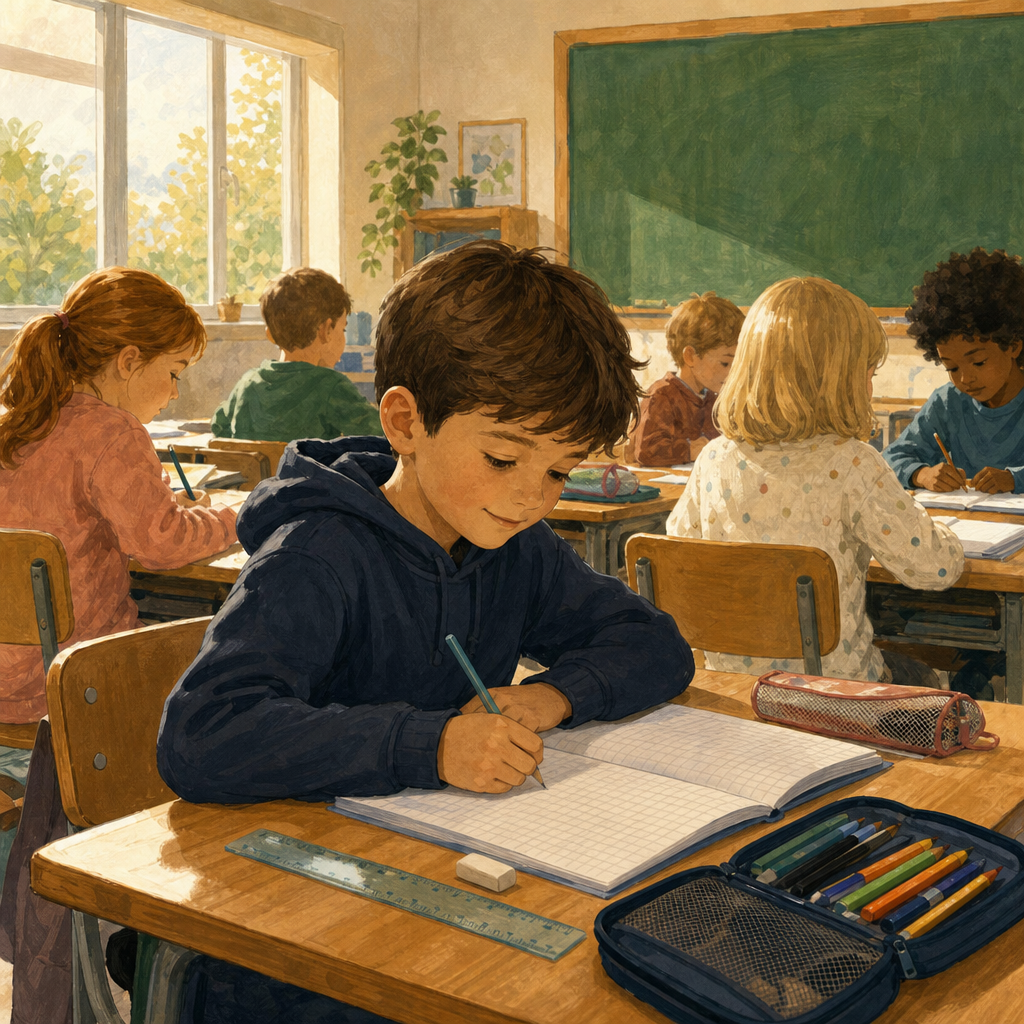
At la rentrée in France, every pupil turns up with a bag packed to a long liste de fournitures: pencil case, copybooks, ruler, rubber and more. Hold up a pencil if you have one. Now look around your own desk: pen, book, copy, ruler, rubber. You already use these every day. By the end of this lesson you will name eight of them in French, each with le or la.
Hold up a pencil yourself and invite a few pupils to hold up one object each. Keep this light and quick: the point is that the vocabulary is already in the room, not that they guess the French yet. A quick nod to la rentrée (the back-to-school restart in France) and the famous stationery list sets a French frame without teaching any words yet. Do not teach any French words here; the word-table in the next step does that.
Here are today's eight classroom objects. We learn them in two sets of four so they stick. First the desk tools, then the bag-and-book words. Tap each one, listen, then say it back together. Watch which ones take le and which take la: you learn the article with the word, as a pair.
Run the word-table in two chunks so later words are not half-forgotten.
Chunk 1, desk tools (about 4 minutes): le crayon, le stylo, la règle, la gomme. Tap each word so the class hears the audio, then everyone repeats twice: once all together, once by table. Point at the article every time. Quick check: point at four real objects on a desk and have tables call the full French label.
Chunk 2, bag and books (about 4 minutes): le livre, le cahier, la trousse, le sac à dos. Same listen–repeat rhythm.
Mixed recap (about 2 minutes): Skip around all eight once more before leaving the table.
Priority sounds only, model these two twice before the full run-through: watch crayon (nasal OHN, not "crown") and règle (REH-gluh, keep the r light and the è open). Pronunciation guides if you need them: le crayon (luh kray-OHN), le stylo (luh stee-LOH), la règle (lah REH-gluh), la gomme (lah GOM), le livre (luh LEE-vruh), le cahier (luh ka-YAY), la trousse (lah TROOS), le sac à dos (luh sak-ah-DOH). Celebrate the nasal in crayon: get them to hold the OHN and grin at how French it sounds; big praise when a table lands it. If a table mumbles the article, stop and model that word again slowly.
A classroom picture is waiting with empty markers. Look at each object. When your table is called, say the full French label out loud (with le or la). Then we click it together on the board. Everyone else: thumbs up if you agree.
Whole-class IWB beat: you (or one named volunteer) click; every seat has a job. Call tables in turn to say the full phrase before you confirm the label. Insist on the article: crayon alone is not enough; le crayon is the answer. When a volunteer gets a tough one first time (especially le sac à dos or la règle), name it out loud and give a quick clap so the class feels the win.
Pronunciation fallback (word-table audio may no longer be on screen): le crayon (luh kray-OHN), le stylo (luh stee-LOH), le livre (luh LEE-vruh), le cahier (luh ka-YAY), la règle (lah REH-gluh), la gomme (lah GOM), la trousse (lah TROOS), le sac à dos (luh sak-ah-DOH). If two labels get mixed up, tap the object marker again to replay its audio if the activity offers it, or say both full phrases slowly yourself from this list, then try the label once more. You can also step back briefly to the word-table in the lesson strip if you need the original audio.
Open your copy and write the names of four things on your own desk right now, each with its article. The word list stays on the board: copy carefully, including le/la and any accent. Take care with the accent on la règle.
Pause the board on the word-table (or leave it visible beside any other slide). Everyone writes: this is the only three minutes where every pupil's pen is moving. Walk the room and check the article is going in front of every word; a list of bare nouns will not carry the gender pairing. Weaker writers may do three items well rather than four with missing accents (accuracy over quantity). Do not collect these. A quiet "lovely accent on règle" as you pass goes a long way.
Part 1, board match (about 6 minutes): We flip two cards on the board. When a French card appears, say it quietly with le or la. Help your table call the English match. Every seat speaks on every turn, not only the person at the front.
Part 2, desk relay (about 4 minutes): Board closed. Real objects only. When the teacher holds one up, your table races (quietly) to call the full French label. Finish with one object hidden behind the teacher's back: Qu'est-ce qui manque? (what is missing?). Answer with le or la and the word. No cards to read: this is you producing from memory.
Part 1, matching-pairs on the IWB (about 6 minutes): Volunteers may flip, but every table must whisper or call the French phrase when a French card appears, then agree the English match before you confirm. If a pair is missed twice, stop and say the French word together before moving on. Listen for the article on every successful match and gently restore it if it is dropped.
Part 2, desk relay off-screen (about 4 minutes): Close the interactive completely so the pattern breaks. Hold up three real desk objects one at a time. Tables race (quietly) to call le/la + word. Finish by hiding one object behind your back: Qu'est-ce qui manque? and take the full French answer. Celebrate a clean full-phrase recall out loud. This is the production beat: they speak without reading a card.
Pronunciation quick list: le crayon (luh kray-OHN), le stylo (luh stee-LOH), le livre (luh LEE-vruh), le cahier (luh ka-YAY), la règle (lah REH-gluh), la gomme (lah GOM), la trousse (lah TROOS), le sac à dos (luh sak-ah-DOH).
You're previewing this lesson. Get full access to this lesson and hundreds more — each one ready to teach, with interactive activities, printable resources and pupil progress tracking built in.