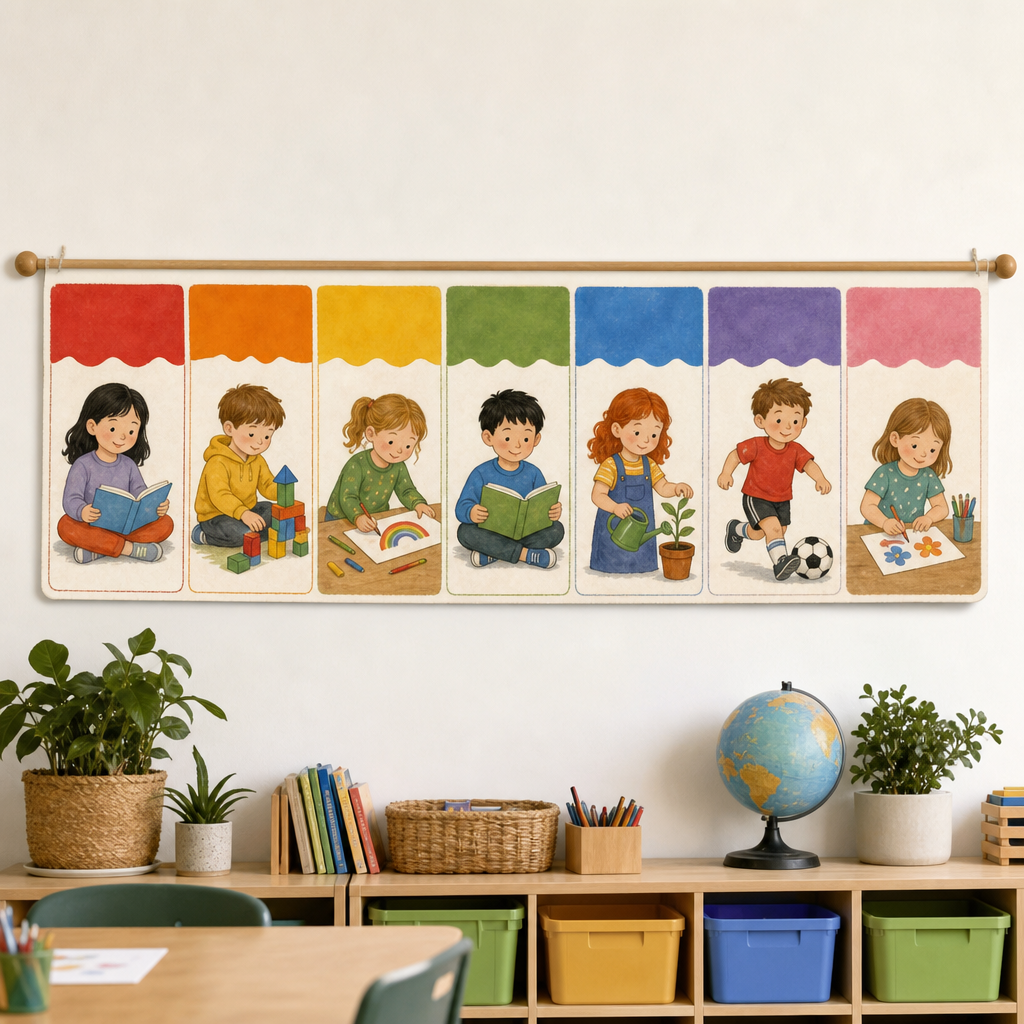
 Which day of the week is best, and which is worst? Say why in English, in one short sentence each.
By the end of this lesson, you will be able to:
- Name all seven days in German
- Join a day and a time to describe your routine
- Spot the day that breaks the German naming pattern
Here are all seven German days. Tap each one, listen, then say it back together. We learn them in two groups first, then run the whole week.
Watch for the day in the middle of the week: its name does not match the English pattern.
Naming a day vs saying on a day
When we name the day we say the full form with der:
der Montag (Monday)
When we say what we do on that day, we start with Am (on), not der:
Am Montag um acht Uhr stehe ich auf. (On Monday at eight o'clock I get up.)
So Am Montag means On Monday. The ending stehe ich auf (I get up) is a phrase you already know, not a new day word.
Volunteers click the pairs on the board. When a pair matches, we all say the full German name together, for example der Freitag.
First we build sentences together out loud. Then open your copy and write one or two sentences saying what you do on different days, each with a time.
Write-in frame
Am ______ um ______ Uhr ______.
Keep every day name capitalised and start with Am.
Time bank (phrases you already know):
- um acht Uhr (at eight o'clock)
- um drei Uhr (at three o'clock)
- um eins Uhr (at one o'clock)
- um zwei Uhr (at two o'clock)
- um zehn Uhr (at ten o'clock)
Optional endings (recycle, not new day words):
- stehe ich auf (I get up)
- spiele ich Fußball (I play football)
Gapped starters:
- Am ______ um ______ Uhr stehe ich auf.
- Am ______ um ______ Uhr spiele ich Fußball.
- Montag — Monday
- Dienstag — Tuesday
- Mittwoch — Wednesday
- Donnerstag — Thursday
- Freitag — Friday
- Samstag — Saturday
- Sonntag — Sunday
Cards show the German day names. Listen for each day called out in German, and mark it when you hear it. When every day on your card is marked, shout Bingo!
Unlock the full learning experience
You're previewing this lesson. Get full access to this lesson and hundreds more — each one ready to teach, with interactive activities, printable resources and pupil progress tracking built in.
This lesson is copyright of Coding Ireland 2017 - 2026. Unauthorised use, copying or distribution is not allowed.