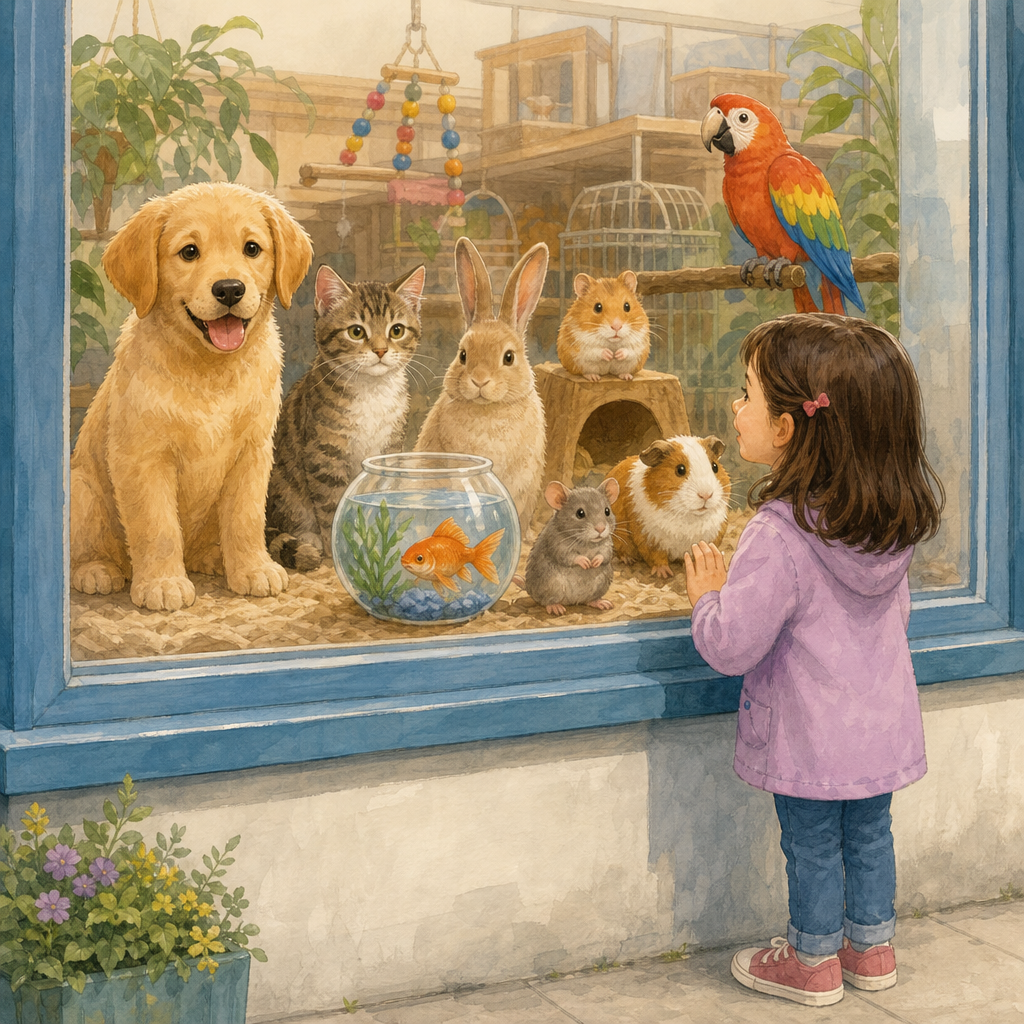
 Hands up if you have a pet at home. Keep your hand up if you can already guess its name in German.
Today you will learn eight pet words, label them on a pet-shop window, and listen to a short scene about a dog.
By the end of this lesson, you will be able to:
- Name eight common pets in German with der, die or das
- Match pet words to pictures in a shop window
- Follow a short spoken scene about a pet dog
Tap each pet on the board, listen carefully, then say the full phrase back together. Watch the article every time: some pets take der, some take die, and some take das.
Watch the pet-shop window on the board. When it is your table's turn, say the full German phrase (for example die Katze) and tell the volunteer where it goes. The volunteer drags the label; the class does the speaking.
After the window is labelled, turn to a partner: one points at a pet, the other says the full phrase with the article.
First we say the models together. Then open your copy and write one sentence about a pet you have or would like.
Board models (copy the pattern that matches your pet):
- Ich habe einen Hund. (ikh HAH-buh EYE-nen HOONT) for a der pet
- Ich habe eine Katze. (ikh HAH-buh EYE-nuh KAT-suh) for a die pet
- Ich habe ein Kaninchen. (ikh HAH-buh ine kah-NEEN-chen) for a das pet
Keep the capital letter on the noun. Use einen after habe for der pets, eine for die pets, and ein for das pets.
- der Hund — the dog
- die Katze — the cat
- das Kaninchen — the rabbit
- der Hamster — the hamster
- der Papagei — the parrot
- der Goldfisch — the goldfish
- die Maus — the mouse
- das Meerschweinchen — the guinea pig
We will hear a short German scene about Max and his dog on the way out. Listen all the way through twice as a class. Then we answer the questions together on the board. Put your hand up if you want a line played again.
Unlock the full learning experience
You're previewing this lesson. Get full access to this lesson and hundreds more — each one ready to teach, with interactive activities, printable resources and pupil progress tracking built in.
This lesson is copyright of Coding Ireland 2017 - 2026. Unauthorised use, copying or distribution is not allowed.