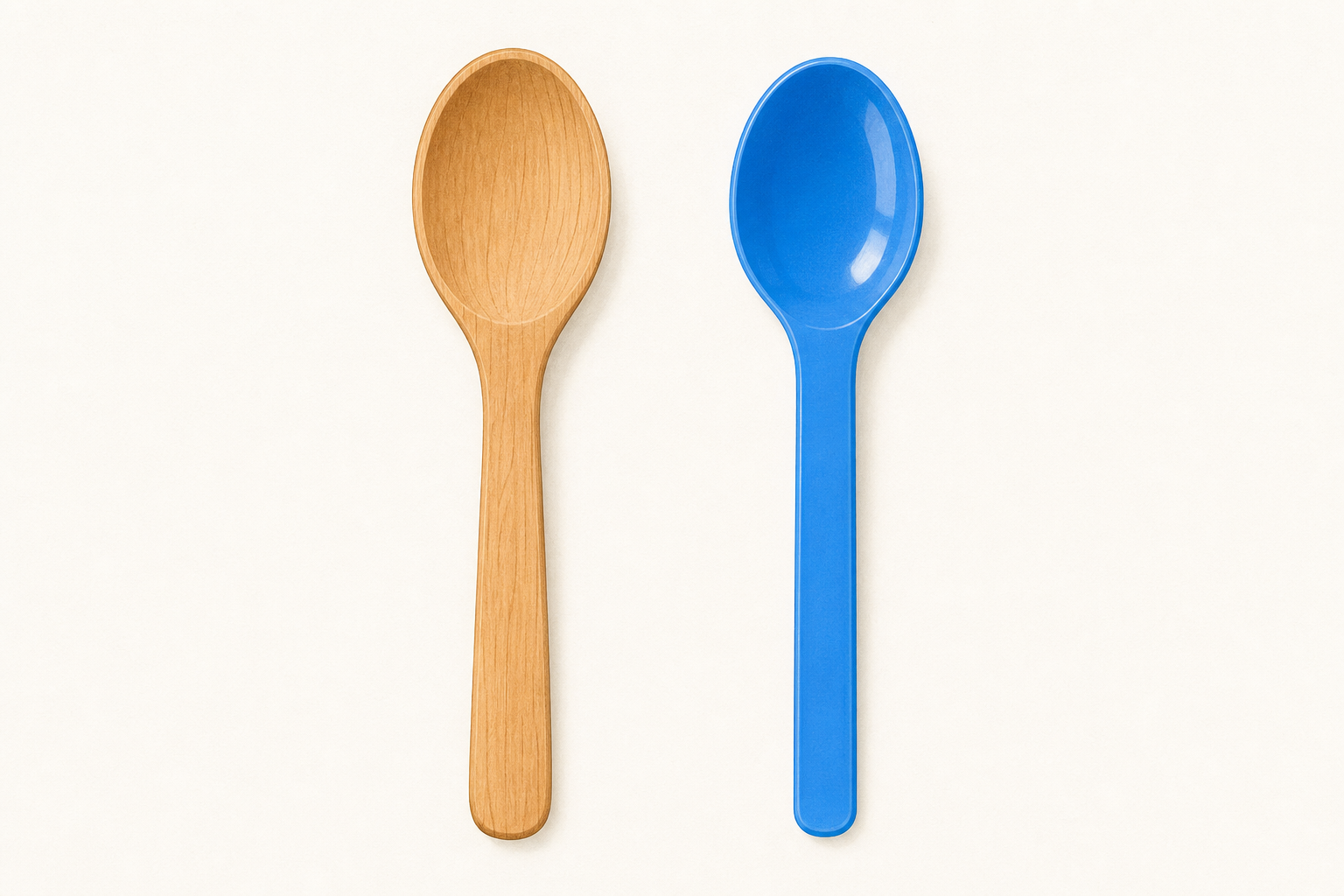
Look at these two things: a wooden spoon and a plastic spoon. Both do the same job. Where do you think each one came from?
Hands up: which one grew or was found in nature, and which one was made by people?
Hold up a wooden spoon and a plastic spoon (or show them on the table). Do not define natural and manufactured yet. Collect two or three quick ideas only.
Key question: How could we sort a whole tray of materials into two big groups: from nature, or made by people?
Have the sample tray ready but keep it covered until the sort step.
Some materials come straight from nature with only light change. We call those natural. Others are made or heavily changed by people. We call those manufactured.
Talk to your partner: is a cotton T-shirt natural, manufactured, or a bit of both? We will use the idea of a raw material (the starting stuff from nature) to help us decide.
Teach the two sorting groups first, then bring in raw material only with the cotton T-shirt edge case. Keep the board short; use the table as your reference.
| Concept | Why it matters | Example |
|---|---|---|
| Natural material — a material that comes from plants, animals, rocks or the ground and has only been lightly changed (cut, washed or shaped), not turned into a new substance in a factory | Knowing where stuff comes from helps us choose materials and look after the planet | A pine cone, a sheep's fleece, or a pebble from the schoolyard |
| Manufactured material — a material people have made or strongly changed, often using machines and factories | Most classroom objects are manufactured, so we need to know they started as something else | A plastic ruler, a metal paperclip, or glass from a jam jar |
| Raw material — the starting substance before people turn it into a finished product | Chemists and materials scientists ask what something is made of and where it began | Trees (for wood and paper), oil (for many plastics), sand (for glass) |
Misconception to head off: children often say anything soft or brown is natural and anything shiny is manufactured. A cotton shirt started natural (cotton plant) but was spun, dyed and sewn — so the finished shirt is manufactured from a natural raw material. Paper is the same: wood is natural; paper is manufactured.
Nature of STEM: chemists ask where the stuff around us comes from and what it is made of. Today we practise that habit with everyday Irish classroom materials.
Worked sort (model aloud before groups start): Hold a wooden lolly stick. I wonder which group it belongs in. I predict natural, because it still looks like wood from a tree. I check — it has grain and came from a tree with only cutting and shaping. I think it is natural (lightly processed wood still counted as natural for our two piles). Then hold a clear plastic cup: oil was changed in a factory, so manufactured.
In your group, sort every sample on your tray into two piles: natural or manufactured. Talk about each one before you place it. If you disagree, put it on a third pile called not sure and be ready to say why.
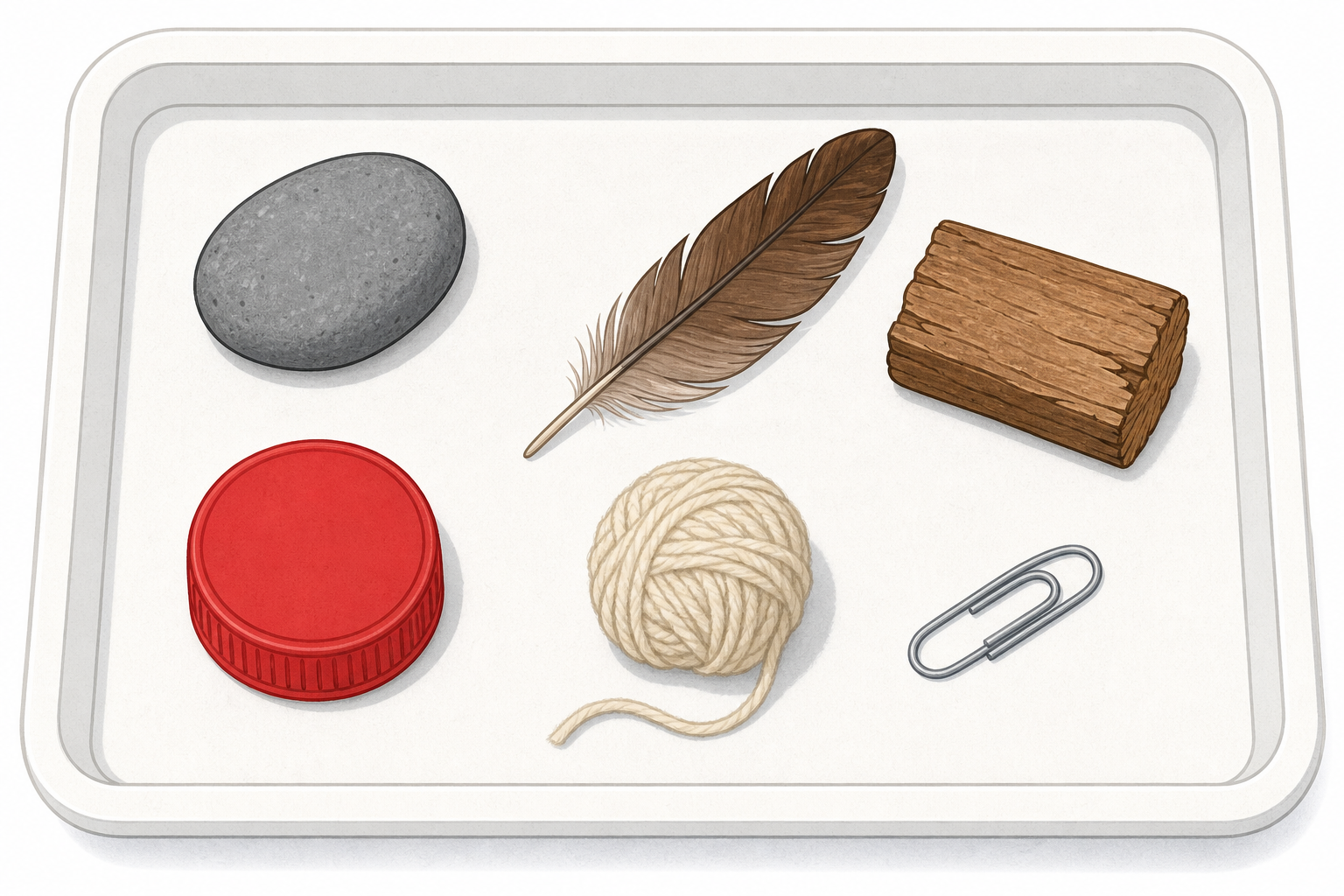
Prepare one tray per group with 8–10 recognisable samples (mix of natural and manufactured). Use samples pupils can name by sight, or add your own quick sticky labels if anything is unclear. Push desks so groups have space.
Suggested tray set (one per group): wood offcut or lolly stick, wool or cotton fibre (not finished cloth), small stone or shell, leaf or cork, paper, plastic bottle lid, aluminium foil, glass marble or clean jar lid, rubber band (finished), polyester fabric scrap.
Edge cases on the tray: keep raw wool/cotton fibre distinct from any finished cloth. Finished rubber bands count as manufactured (natural rubber starts as tree latex but is heavily processed; most classroom rubber is synthetic). Polyester fabric scrap is manufactured (often from oil).
Look-fors: groups using origin language (grew, dug up, made in a factory) rather than only look and feel.
On the interactive, we will sort these materials: wood, wool, stone, cotton, paper, plastic, glass, steel, rubber, polyester fabric.
Polyester fabric means a fabric made by people, often from oil.
Together we will decide: is each one natural or manufactured? Use the question on screen to help you.
Drive the sorting-tree interactive on the IWB. The cards and two groups on screen are wood, wool, stone, cotton, paper, plastic, glass, steel, rubber, and polyester fabric, sorted into natural or manufactured.
Explore: drag each item into natural or manufactured. Use the guiding question: Did this come straight from nature, or did people make or heavily change it?
Agreed placements for you:
Natural rubber starts from tree latex (a natural raw material) but is heavily processed or is synthetic, so we classify finished rubber bands and tyres as manufactured.
If pupils argue about paper or cotton fabric, praise the thinking: cotton fibre is natural; a finished dyed T-shirt and paper are manufactured from natural raw materials. For this tree we sort the named material as we meet it: raw cotton and wood as natural; paper and polyester as manufactured.
Quick verbal checks after the explore sort: call out three or four items (for example plastic, wool, paper, stone). Class shows thumbs for the group before you confirm. Fold watchers in: Do you agree with that pile? What is the raw material behind plastic?
Your group gets one material sample and a research card. First look at the sample only: where do you think it started, and what do you think people did to it?
Then read the card to check and add detail. Decide together: is it natural or manufactured, what was the raw material, and which change people made was the most important? Be ready to tell the class in three short sentences, including your own choice about the most important change.
Give each group one matching sample from the tray and one provided research card (print the set below — one card per group; reuse cards if you have more groups than cards). Pupils look at the sample and form an origin idea before reading the card. The card is a check and source of detail, not a script to copy.
This step is prepare-to-share only. Journal recording happens in the next step, not here.
Card A — Wood: Wood comes from trees such as oak, ash or pine that grow in Irish woodlands and farms. People cut the tree, dry the timber and shape it into spoons, rulers, furniture and buildings. It is a natural material when it is still clearly wood.
Card B — Wool: Wool grows on sheep. On Irish farms, sheep are sheared, then the fleece is washed, spun into yarn and knitted or woven into jumpers and blankets. The fibre starts natural; heavy dyeing and blending can move a finished fabric toward manufactured.
Card C — Paper: Paper usually starts as wood from trees. The wood is broken into pulp, mixed with water, pressed and dried into sheets. Because people change the wood so much, paper counts as manufactured, even though the raw material is natural.
Card D — Plastic: Many everyday plastics begin as oil or natural gas from deep underground. In factories the oil is changed through chemical processes into pellets, then melted and shaped into bottles, lids and rulers. Plastic is manufactured.
Card E — Glass: Glass is made mostly from sand along with other ingredients such as soda ash. The mixture is heated to a very high temperature until it melts, then shaped into jars, windows and marbles. Glass is manufactured from a natural raw material.
Card F — Steel (in a paperclip): Steel is made from iron dug from rocks in the ground, mixed and heated with other ingredients in industry. It is stretched and shaped into paperclips, cans and beams. Steel is manufactured.
Time check at halfway: groups should have sample prediction, card check, and a chosen “most important change”. Prompt: What did people do that nature did not do alone? Which step changed it the most?
Safety: glass samples only if smooth and supervised; no broken glass.
You're previewing this lesson. Get full access to this lesson and hundreds more — each one ready to teach, with interactive activities, printable resources and pupil progress tracking built in.