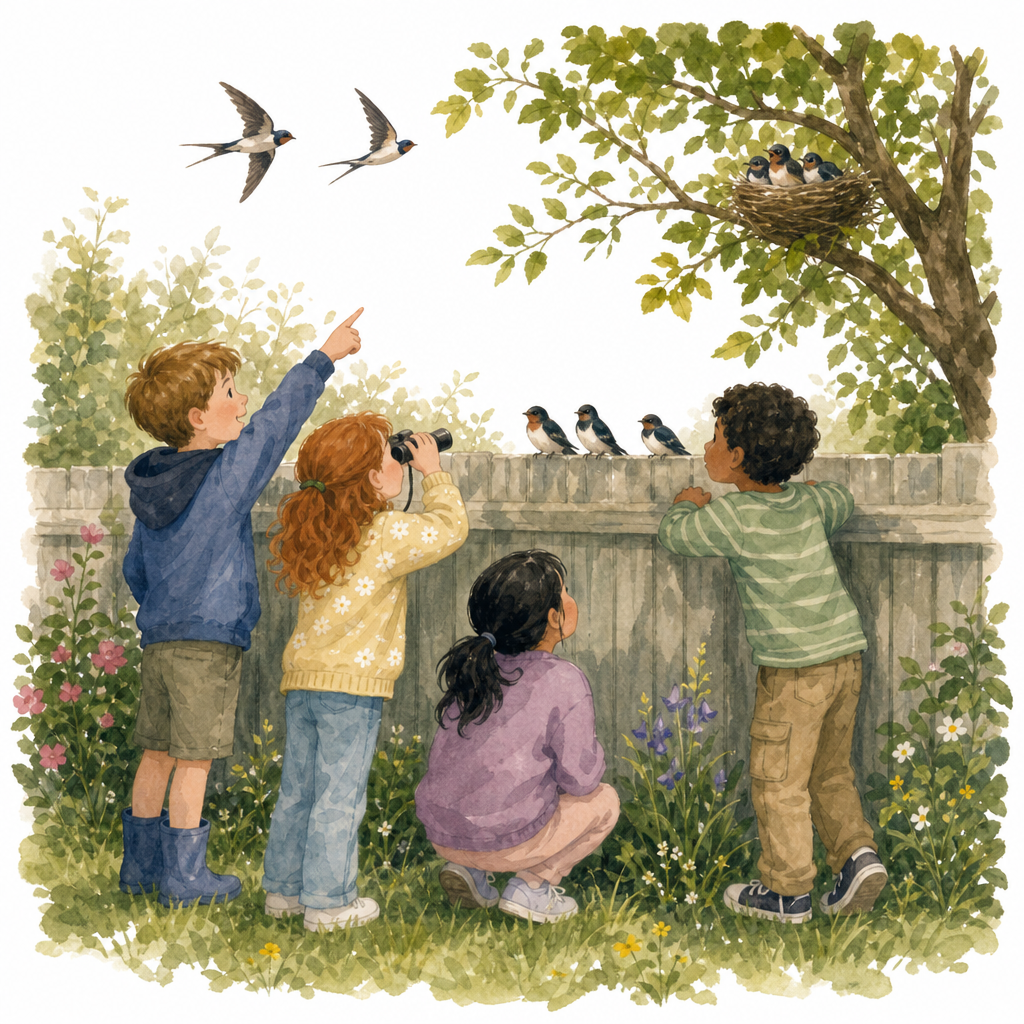
Some birds stay in Ireland all year. Others arrive for a season and then leave again. Which birds do you see in winter, and which only in summer?
Take four or five quick answers in English. Keep it light: robins and crows all year, swallows in summer is plenty. Do not introduce the French words yet. Today they will join a bird to a month in one sentence; a month bank with sound guides appears on the board later, so anyone who has forgotten those months can still take part.
Here are today's eight birds. Listen to the audio and your teacher first, then repeat the French aloud with its article. Check the written form on the card. On a second pass through the deck, try saying the French before you flip.
First pass (model, then choral): Play the audio (or read the French) with the article, class repeats together, then flip to show the written form. Do not ask for an unaided say-before-flip on first meeting. Second pass: English first; invite the class to offer the French before you flip.
Insist on the article every time: bare hibou is not enough; le hibou is the answer. Pronunciation guides: le cygne (luh SEEN-yuh), l'aigle (LAY-gluh), le hibou (luh ee-BOO), le moineau (luh mwah-NOH), le rouge-gorge (luh roozh-GORZH), la mouette (lah moo-ET), le corbeau (luh kor-BOH), le flamant rose (luh flah-MAH(n) rohz).
Gender tip: six birds take le, l'aigle takes l' (masculine, vowel sound), and la mouette is the feminine one in today's set. Soft zh in rouge-gorge. Rouge-gorge is a mouthful: clap the syllables rouge-gorge together once, then race the board audio. Replay any card the class mumbles.
Volunteers flip two cards at a time on the board. When a pair matches, the whole class says the French bird with its article together. Listen for the audio on every flip, then whisper-repeat so every row joins in.
Default procedure (whole-class IWB): One volunteer flips on the board; audio plays; the whole class repeats the French with its article after every reveal and again on each match. Keep the article attached: celebrate la mouette and le hibou, not bare nouns. Pause if a pair is missed twice and say the word together before moving on.
Pair or device play is only an optional extension if your school actually has shared devices ready; do not plan the eight minutes around it. The board-led route is the reliable path so row 3 speaks every word, not only the volunteer.
We just said these sentences aloud. Open your copy and write two sentences, each naming a bird and when you would see it. Use a pattern below and take care with accents and articles.
Main pattern:
En avril, je vois le rouge-gorge. (In April, I see the robin.)
En décembre, je vois le moineau. (In December, I see the sparrow.)
Other idea:
En hiver, je vois le corbeau. (In winter, I see the crow.)
Month bank (choose from these):
Bird bank (keep the article):
le cygne, l'aigle, le hibou, le moineau, le rouge-gorge, la mouette, le corbeau, le flamant rose
Before pens move: Point to the patterns still on the board. Class repeats both main models once more (zhuh vwah; en ah-VREEL; en day-SAHM-bruh), then open copies. The month bank and bird bank are built into the IWB description: no separate sheet is required. Months came from Months of the Year and were chorused again on the spin step, so this is retrieval into writing.
Everyone writes two full sentences. Walk the room and check each sentence has the correct article on the bird (la mouette is the feminine one) and a month or season from the bank. Do not collect the copies. If a pupil is stuck, offer: En juillet, je vois la mouette (en zhwee-YAY, zhuh vwah lah moo-ET).
Month sound guides if anyone asks (same as the spin bank): janvier (zhah(n)-VYAY), mars (marss), avril (ah-VREEL), mai (meh), juin (zhwa(n)), juillet (zhwee-YAY), septembre (sep-TAH(m)-bruh), décembre (day-SAHM-bruh), hiver (ee-VAIR), été (ay-TAY).
You are birdwatching in the school garden (or beside a quiet French river). First we learn the months we need today, then the wheel lands on a bird. Say its French name aloud with the article. Stretch challenge: add when you might spot it, using the pattern and month bank on the board.
Months we need today (say each with the teacher):
Pattern on the board:
En avril, je vois le rouge-gorge. (In April, I see the robin.)
En décembre, je vois le moineau. (In December, I see the sparrow.)
Stretch idea: En hiver, je vois le corbeau. (In winter, I see the crow.)
1. Months refresher (about 2 minutes): Months were taught earlier in Months of the Year, so this is retrieval, not first exposure. Move briskly and spend the time you save on the sentence stem. Point to each line on the IWB. Class chorally repeats each month once after you, reading the sound guide beside it on the board. Sticky items: juillet (zhwee-YAY) and décembre (day-SAHM-bruh). Re-chorus any mumbled line. Do not skip this beat.
2. Quick vrai/faux listen (about 2 minutes) so this step is not only another noun drill. You say a full sentence; class shows thumbs up (vrai) or thumbs down (faux). Examples: En décembre, je vois le flamant rose (faux for Ireland), En hiver, je vois le corbeau (vrai). Keep it playful and brisk.
3. Sentence stem, then wheel: Leave the stem on the board: En ___, je vois… Chorally rehearse the two model sentences once: En avril, je vois le rouge-gorge (en ah-VREEL, zhuh vwah luh roozh-GORZH) and En décembre, je vois le moineau (en day-SAHM-bruh, zhuh vwah luh mwah-NOH). Substitute two more birds chorally (e.g. la mouette, le cygne).
Spin on the board and cold-call fairly. Minimum answer: full noun with article. Stretch (only after the choral stem): the full En [mois], je vois… sentence, or the alternate winter frame for stronger pupils. If someone freezes, class whisper-calls the word once, then that pupil repeats it alone. Month bank stays visible for the whole spin.
You're previewing this lesson. Get full access to this lesson and hundreds more — each one ready to teach, with interactive activities, printable resources and pupil progress tracking built in.