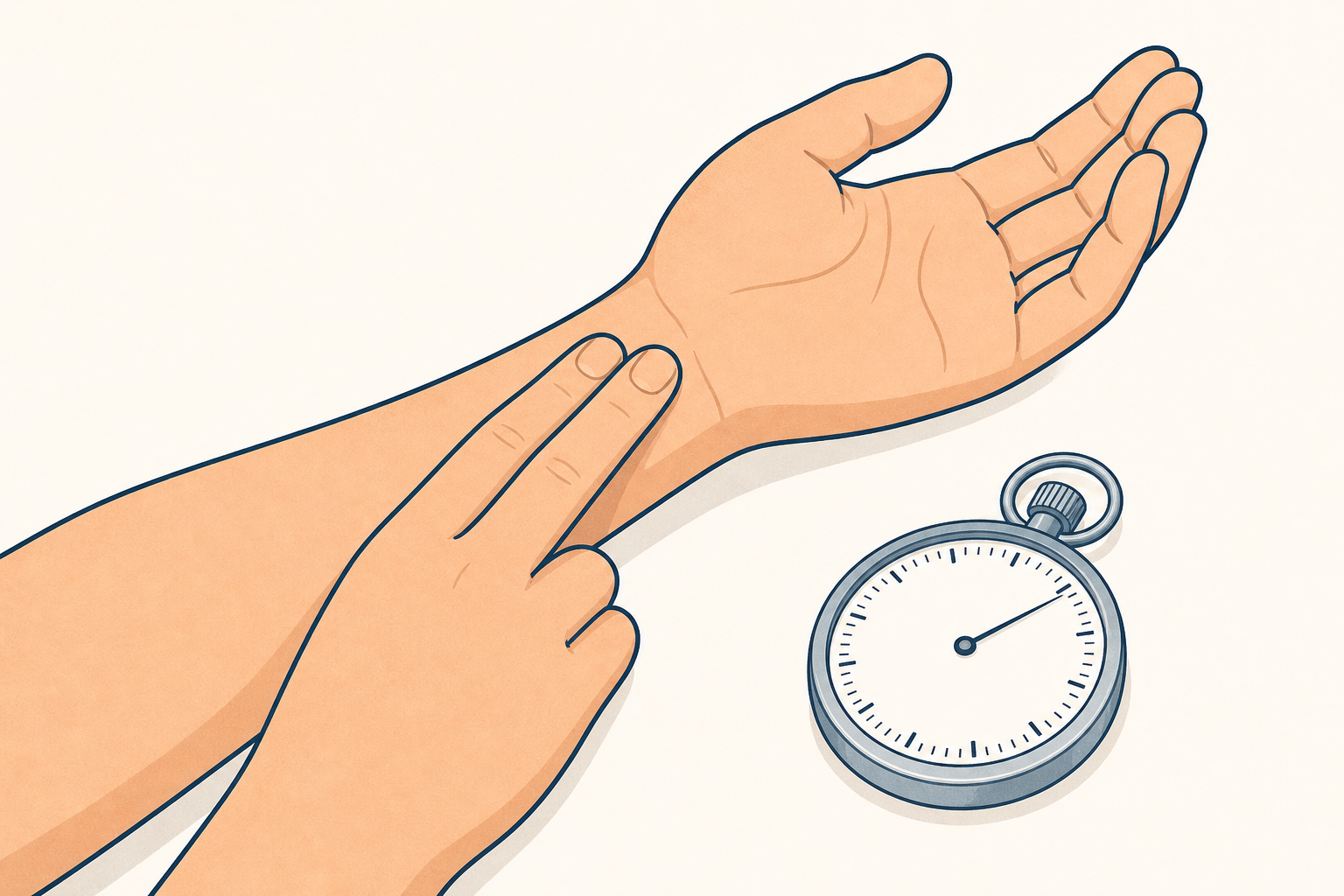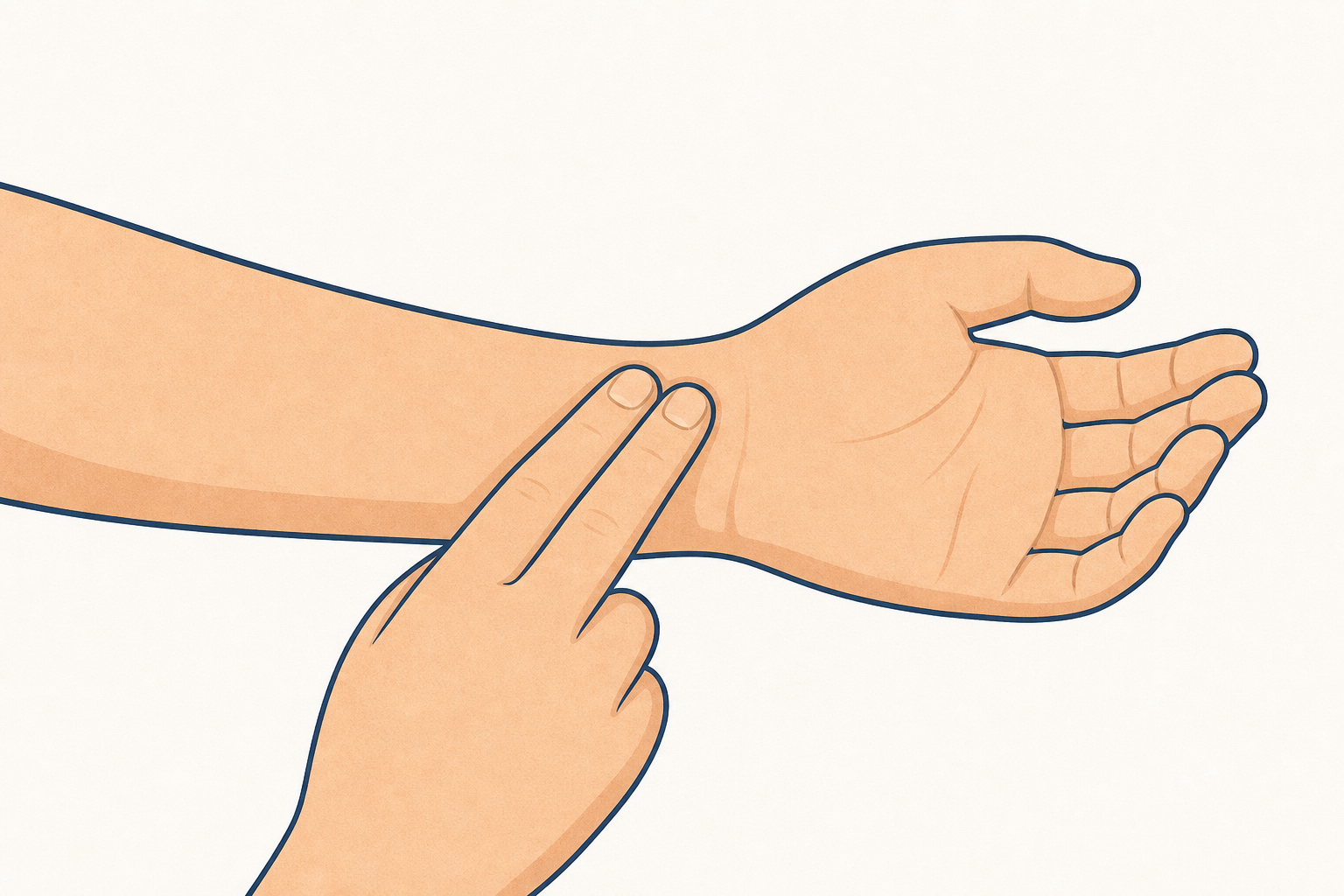
Put two fingers gently on the side of your wrist. Can you feel a tiny beat under your skin?
That beat is your heart at work. Do you think it always beats at the same speed, or can something make it speed up?
Keep this beat light and curious. Do not hand out stopwatches or name the full investigation yet.
Invite a few volunteers to find their wrist pulse. If someone cannot find it, try the side of the neck gently, or have a partner check. Never press hard.
Key question: What do you already think makes a heart beat faster? Collect two or three ideas only, then move on.
Before the lesson: print the Investigation Journal pages; gather stopwatches or prepare to use the on-screen timer; clear a small floor space for marching or dancing on the spot.
Look at the body diagram on the board. Drag each label onto the organ you think it names.
Heart — the pump that pushes blood around the body. Pulse — the beat you feel when that blood is pushed through.
Where does the heart sit? Which two organs sit either side of it?
| Concept | Why it matters | Example |
|---|---|---|
| Heart — a strong muscle that works like a pump, pushing blood around the body so oxygen and nutrients reach every part | Every time you run, climb stairs or dance, your body needs more oxygen, so the heart has to pump harder | Place a hand flat on the left side of the chest after a short march on the spot — you can feel the pump working faster |
| Pulse — the beat you feel in an artery as the heart pushes blood through it | We cannot see the heart from outside, so the pulse is how we measure how hard it is working | Two fingers on the wrist or the side of the neck, counting beats for 15 seconds |
Fair test and middle value are doing-language later in the lesson (live example on the board), not full terms to hold now. Keep this step on locating the heart and naming pulse.
Interactive activity: open the diagram-labeller on the IWB in explore mode. Labels start off the diagram: lungs, heart, stomach and intestines. Invite the class to place them together (volunteers at the board, or call-outs while you drag). Do not reveal placements until the class has had a go.
Answers to draw out (after placing): the heart sits slightly to the left of centre in the chest; the two organs either side are the lungs — they take in air so the blood can pick up oxygen.
Where and why (if a pupil asks why it sits there): the heart sits almost in the middle of the chest, a little to the left, protected by the ribcage and close to the lungs so blood can pick up oxygen before it is sent around the body. It is roughly fist-sized.
Misconception to head off: children often draw the heart as a cartoon valentine on the far left. The real heart sits almost in the middle, a little to the left, and is roughly fist-sized.
Nature of STEM: scientists once thought blood moved back and forth like a tide. Over time, careful measuring and observation showed the heart is a one-way pump that sends blood around a loop. A doctor called William Harvey helped show that the heart is a one-way pump — that is why counting the pulse tells us how hard the pump is working.
Ask: If the heart is the pump, what job do the lungs beside it do? (They take in air so the blood can pick up oxygen.)
We know the heart is a pump. Now we will find out what makes it work harder.
In your group, choose two activities to compare with resting. Will you try walking on the spot, dancing, or running on the spot? Predict: which activity will make the pulse highest, and why?
Later we will share on a class chart with three labels: resting, gentler activity, and livelier activity. Your quieter choice (for example a walk) will sit under gentler activity. Your stronger choice (for example a dance or run on the spot) will sit under livelier activity.
This is the open choice of the lesson. The theme is fixed (pulse and activity), but each group chooses which two activities to compare with rest. Typical choices: rest, walk on the spot, dance, run on the spot. Keep activities safe and in one place — no racing around the room.
Pacing cap for later: rest plus two chosen activities is the full target. A clean rest-plus-one-activity comparison is the minimum that still answers the question; the second activity is the stretch if time allows. A third activity is only if a group finishes early.
Format: think-pair-share, then whole-class. Hear two or three group predictions aloud. Predictions are never wrong; they start the science.
Pupils who should not exercise (asthma flare, recent illness, or any medical reason) become the group's timekeeper and recorder. Check quietly before you begin.
Sentence stems to offer: I think … will make the heart beat fastest because…
Pooling preview (say once, pointing at the board labels): later every group's results go into three shared bins — resting, gentler activity, and livelier activity — so different choices can still be compared fairly. Groups should already know which of their two choices maps to gentler and which to livelier.
Five cards appear on the board: the activity, how fast the heart beats, the counting time, who we measure, and how long we exercise (one minute).
Call out where each card belongs. We change one thing, measure one thing, and keep the rest the same. Then fill in your Investigation Journal page for the test your group designed.
Interactive activity: open the fair-test-planner in explore mode. Drive it on the IWB while the class calls out placements. Treat "fair test" as doing-language here: change one thing, measure one thing, keep the rest the same — no long definition to memorise.
If a card lands in the wrong bin, ask what would go wrong if we changed that too? rather than simply correcting it.
Modelled investigation (do this live before groups write):
Then each group completes its own Investigation Journal page: their question, their chosen activities (rest plus two), what they will measure, and what they will keep the same. Circulate and check every group has only one thing in Change.
In each group you need three jobs:
Only the person measured finds the pulse (two fingers on the wrist). Use this same way every time.
Resting
Each activity
Finish resting first, then your quieter activity, then your stronger one. Stay in your space. If you feel dizzy or unwell, stop and tell the teacher.
Two fingers (not the thumb) on the inside of the wrist, in line with the base of the thumb, or gently on the side of the neck. Press lightly. Practise once as a class before the real trials. Only the person measured needs to find a pulse; timekeeper and recorder watch and write.
Rotate so more than one pupil is measured if time allows, but keep who we measure the same within one full set of activities so the comparison stays fair.
Minimum that still counts: resting (three sitting counts) plus one chosen activity (three full activity-then-count goes). That is enough to answer the question and feed the class chart. Target if the group is on track: rest plus both chosen activities. Do not let groups start a second activity until the first comparison is clean. If the room is slow after rest plus one, stop there and move to recording — a valid fair comparison beats a rushed half-method. Cap at rest plus two in this slot; a third activity is only for a group that finishes early.
What to expect: resting 15-second counts for this age often sit around the low twenties (for example about 20 beats in 15 seconds), and livelier activity commonly lifts that higher. Exact numbers vary a lot by child. The pattern (higher after more effort) matters more than matching any textbook figure.
If the pulse is hard to find after exercise: wait only a second or two, breathe out, try again. Do not press harder. A slow hunt means the elevated pulse has already dropped.
Safety: anyone who should not exercise is timekeeper or recorder only. Stop anyone who looks pale, dizzy or short of breath. Clear space so nobody collides.
You're previewing this lesson. Get full access to this lesson and hundreds more — each one ready to teach, with interactive activities, printable resources and pupil progress tracking built in.