1 - Start ~4 mins
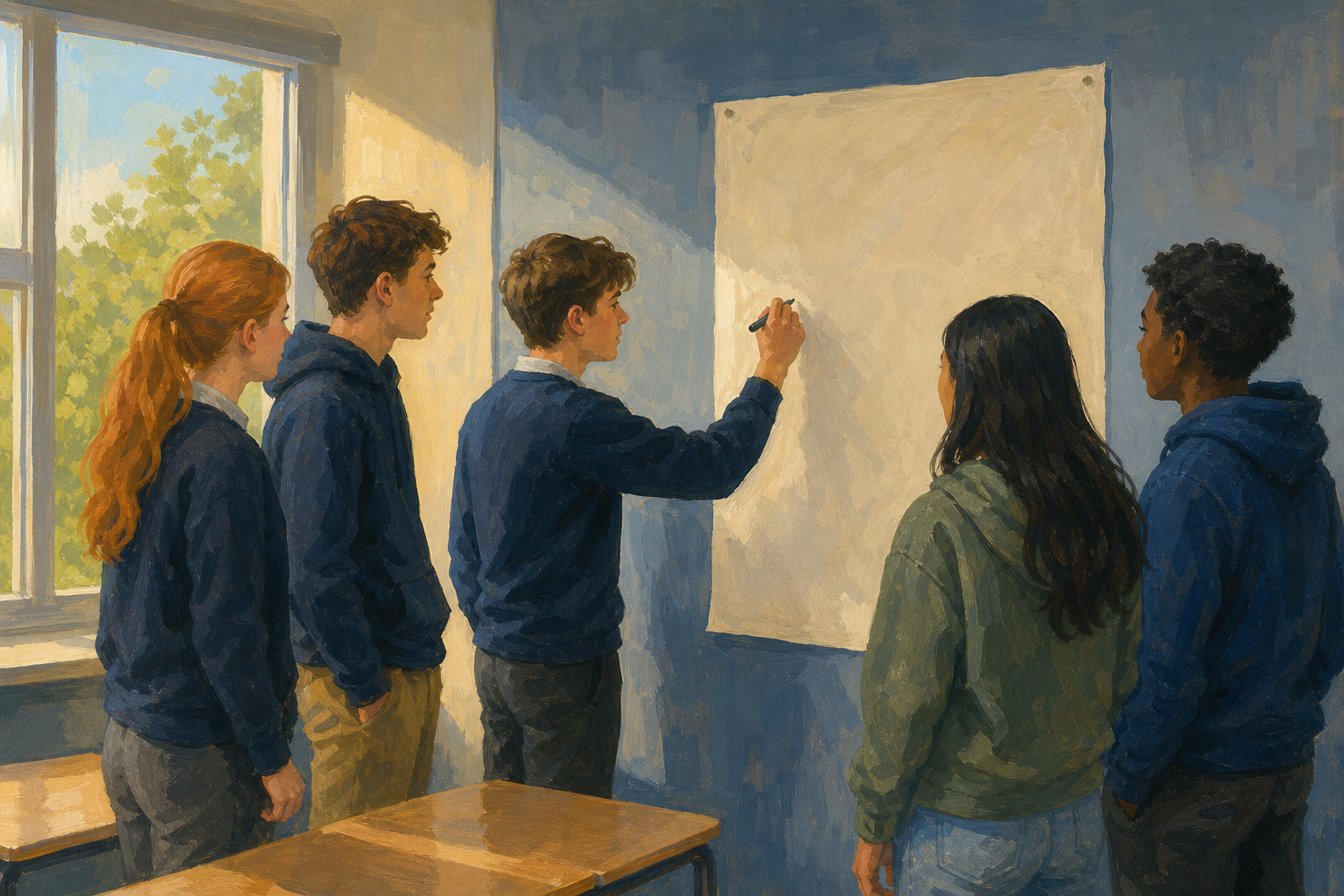 Today you turn the rights and duties you have examined into one short charter this class will hold itself to.
A charter only works if every line is something a person can actually do, or refuse to do, on an ordinary Tuesday. Vague hopes do not count. By the end of this period the class will have agreed its own version, named where it will live, and decided how it will be used.
2 - What a Usable Line Looks Like ~9 mins
A charter statement has to be something you can check. If nobody could tell whether you kept it, it is not usable yet.
Listen to each pair. For each one, decide which version the class could actually hold someone to, and say why.
Pair A: "Be respectful" / "Do not interrupt when someone is explaining an idea."
Pair B: "Be inclusive" / "If two people are left without a group, invite them to join yours."
Pair C: "Stand up for others" / "If I hear a joke that targets someone's background, I say it is not okay."
Pair D: "Be fair" / "Share credit for work that was done together."
The pattern: name the action, not the virtue.
3 - Build Our Class Charter ~19 mins
First, listen while your class's own First lines we owe each other, the list you wrote in the first lesson of this strand, is read back. Those lines are raw material, not the finished charter. Keep, reword, or drop them as you go.
In small groups, draft under the four headings on the board. Each group takes one heading (or finishes early and helps a neighbour). Aim for at most two checkable statements per heading. Every statement must be something a person in this room could do, or refuse to do. Before the whole class comes back together, each group hands up one line to keep (or reword) and one line from First lines we owe each other to drop, with a short reason.
Then the class works as one. Offer lines, challenge wording that is still a vague value, and merge repeats. If anyone disagrees with a line, they get a few seconds to say why, then the class votes. A line goes in only when the class clearly votes for it. The finished list is called Our class charter.
Our class charter
4 - Where It Lives ~5 mins
A charter nobody can find is not a charter.
As a class, agree three things out loud:
1. Where Our class charter will live for the rest of the course.
2. When you will actually use it (for example at the start of a discussion, after a disagreement, or before a citizenship action).
3. What happens if someone thinks a line is being broken.
Keep the answers short enough to write under the charter itself. Be ready in the recap to name one line and say when this class would actually use it next week.
5 - What You Covered ~3 mins
In this lesson you:
- Told the difference between a vague value and a charter line someone can actually keep
- Used First lines we owe each other as raw material, not as a finished product
- Agreed Our class charter, with rights and responsibilities written as real actions
- Decided where the charter lives and how this class will use it
Before you leave: pick one line from Our class charter and say out loud when this class would actually use it next week. That is how the charter gets applied, not only where it sits.
Later work in this course will come back to the charter you agreed.
Unlock the full learning experience
You're previewing this lesson. Get full access to this lesson and hundreds more — each one ready to teach, with interactive activities, printable resources and pupil progress tracking built in.
This lesson is copyright of Coding Ireland 2017 - 2026. Unauthorised use, copying or distribution is not allowed.