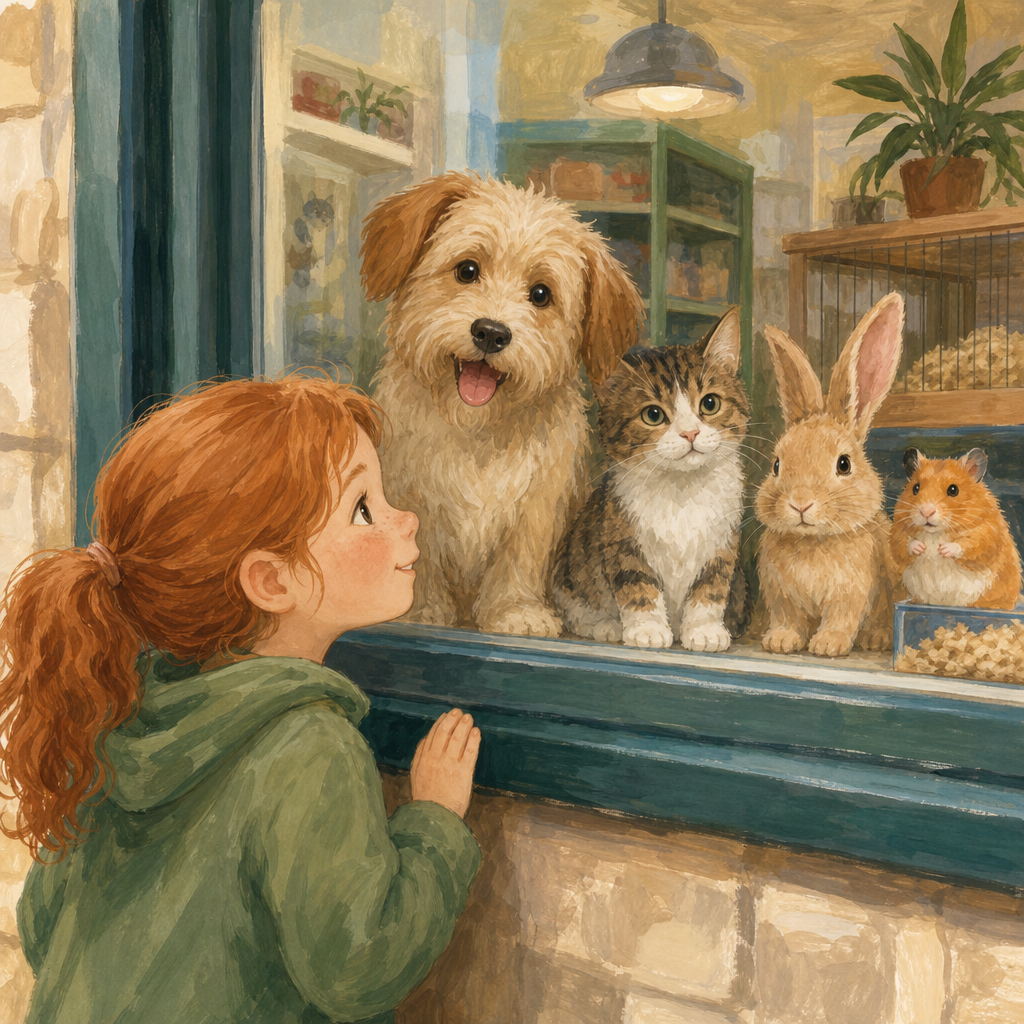
Describe your pet (or a pet you would love) in English in five words. Keep it short: name, size, colour, one fact.
Take three or four quick five-word descriptions, no more. The point is to wake up pet vocabulary and colour words from earlier work before the German list appears. Do not translate yet; the word-table in the next step does that job. Smile at the funny ones (tiny dragons count) so the room feels safe before the new language arrives.
Listen when each pet is played, then say it back together with der, die or das.
When we say what we would like, the article swaps:
der Hund → Ich möchte einen Hund. (I would like a dog.)
die Katze → Ich möchte eine Katze. (I would like a cat.)
das Kaninchen → Ich möchte ein Kaninchen. Es ist weiß. (I would like a rabbit. It is white.)
Practise: Ich möchte ____. Colour optional.
Chunk the table. First five: der Hund (dair HOONT), die Katze (dee KAT-suh), der Papagei (dair pa-pa-GUY), der Goldfisch (dair GOLT-fish), die Maus (dee MOWSS). Chorus twice (whole class, then by table). Then add der Hamster (dair HAM-stuh) and the two long words: das Kaninchen (dahs kah-NEEN-khen), das Meerschweinchen (dahs MAIR-shvine-khen). Meerschweinchen is a glorious long word: clap the syllables together (Meer-schwein-chen) and cheer the table that nails it. Extra choral turn on both -chen words before any game.
After the list, run a one-minute chorus of the stem alone: point at the board swap der Hund → einen Hund, die Katze → eine Katze, das Kaninchen → ein Kaninchen. Teaching script (say this once, plain): “When we say Ich möchte, der Hund becomes einen Hund, die Katze becomes eine Katze, and das Kaninchen becomes ein Kaninchen — teach it as a set phrase today; do not explain case.” Then model slowly: Ich möchte einen Hund (ikh MURKH-tuh EYE-nen HOONT), optional echo Er ist braun (air ist BROWN); Ich möchte eine Katze (ikh MURKH-tuh EYE-nuh KAT-suh), Sie ist weiß (zee ist VICE); Ich möchte ein Kaninchen (ikh MURKH-tuh ine kah-NEEN-khen), Es ist weiß (es ist VICE). Invite two or three volunteers to swap only the pet slot. Keep colours to the ones already in the examples until the copy moment. Productive goal today is one stem: Ich möchte + pet; Er/Sie/Es ist + colour is optional echo, not required writing.
You are labelling the window of a Tierhandlung (pet shop) near a U-Bahn stop in Vienna. Put each German label on the right animal. Say the full naming form with der, die or das as you place it.
Run this on the IWB with volunteers only. Insist on the article for the naming form: Hund alone is not enough; der Hund is the answer. If a label lands wrong, say the correct pair together once before moving on. This checks recognition after the first listen-and-repeat pass. (Extension only if your school already uses paired tablets: one table may try a second round on devices after the class round.)
Open your copy and write one sentence saying which pet you would like. Use today’s stem and keep a capital letter on every German noun.
Model on the board (copy this pattern):
Ich möchte einen Hund.
Word bank (choose one pet form):
einen Hund · eine Katze · einen Papagei · einen Goldfisch · ein Kaninchen · einen Hamster · eine Maus · ein Meerschweinchen
Optional colour echo: Er / Sie / Es ist braun / weiß / schwarz / grau.
Pause the board. Leave the filled model strip and the accusative word bank visible (not only the nominative word-table). Everyone writes one full sentence with the stem Ich möchte + pet form from the bank. The colour line is optional stretch, not required. Walk the room and check that nouns are capitalised and that pupils used einen/eine/ein, not der/die/das, after möchte. If you see der/die/das after möchte, point at the model and have them swap in einen/eine/ein — do not open a grammar talk. Brilliant effort if they kept the set-phrase article and a capital letter; that is real German already. Do not collect these.
Flip two cards at a time and find each German pet with its English meaning. Say the German quietly, article included, as you turn each card.
A second pass at the same eight words through memory pairs. Whole class on the IWB with volunteers. If a pair is missed twice, stop and say it together before continuing. Listen for the article on every German reveal. Enjoy the long ones when they land: a quiet cheer for Meerschweinchen keeps energy up without slowing the game. This second recognition pass lands before anyone writes, so spellings and articles feel more secure for the copy moment that follows.
You're previewing this lesson. Get full access to this lesson and hundreds more — each one ready to teach, with interactive activities, printable resources and pupil progress tracking built in.