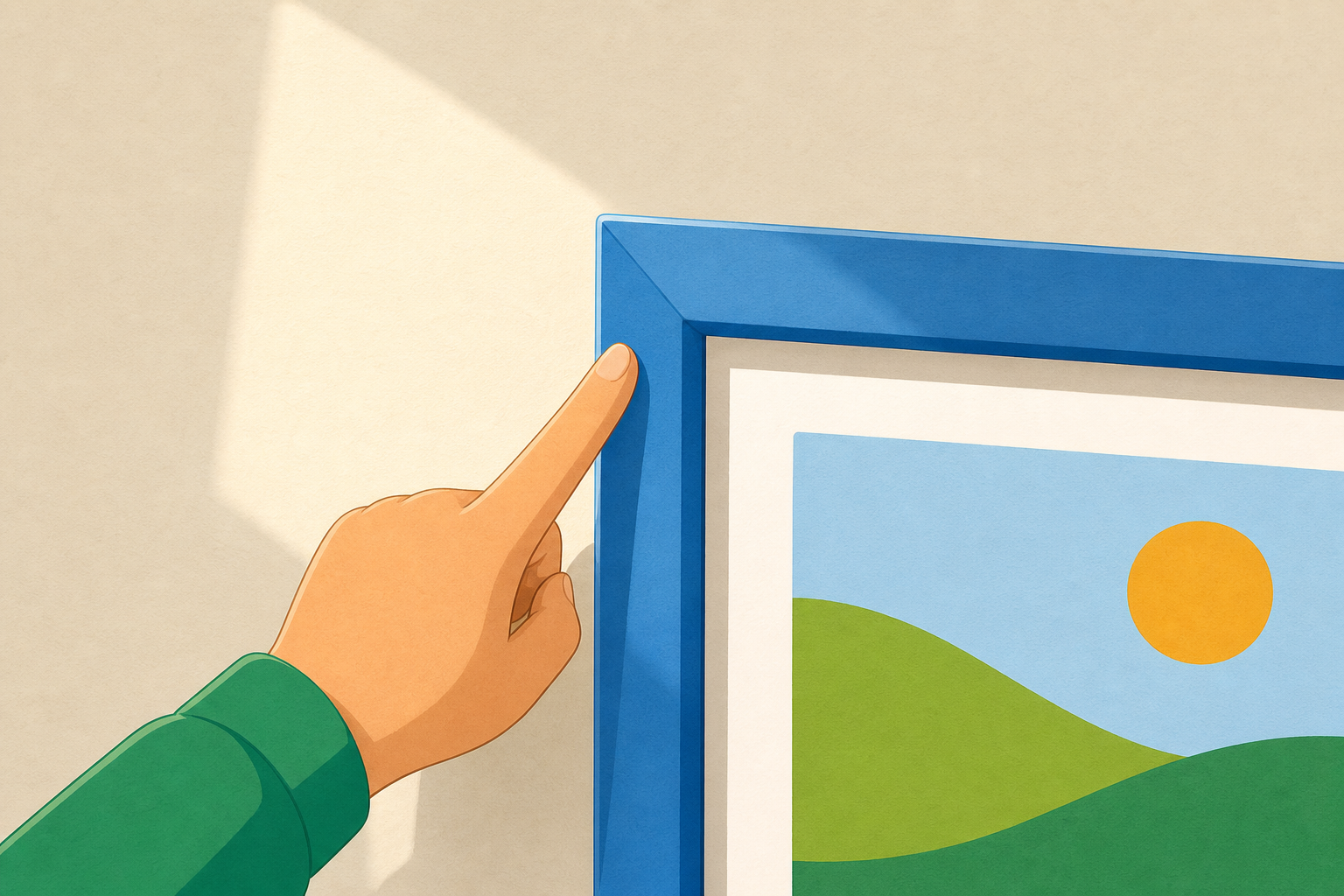
Imagine a tiny ant standing at one corner of the picture frame at the front of the room. The ant decides to walk all the way around the very outside edge and stop back where it started. How could we work out exactly how far that little ant has travelled?
Have a think: what would you measure, and what would you do with the numbers you got?
Trace your finger right around the edge of the picture frame (or the IWB frame) and back to the start as you read the question. Take three hands-up answers, not open call-outs. Listen for the idea of measuring the edges and adding them — that is the whole lesson in one sentence.
Four shapes are on the grid, each with its sides already added up. See how we go right around the outside and count each side once. That total distance around the shape is called the perimeter.
Point to each side as its length comes up. Triangle: three sides, 3 + 4 + 5 = 12 cm, touch each once.
L-shape is the trap: it bends, so six sides, not four. Run a finger right around so nobody skips the two short inside steps. 5 + 2 + 3 + 3 + 2 + 5 = 20 cm.
Square: all four sides equal, 6 + 6 + 6 + 6 = 24 cm. Ask whether we really need to measure all four, to plant the equal-sides idea for next lesson.
Rectangle: two long, two short, 8 + 3 + 8 + 3 = 22 cm.
Throughout, stress touching each side once and only once.
One pupil at a time comes to the board, picks a shape on the grid, then clicks each side in turn while the running total adds up. The rest of the class follows the total out loud and agrees the final answer.
Go right around the outside until you land back where you started.
This round is for talking it through together — pupils take turns at the board and the class agrees or corrects out loud.
Call individual pupils up one at a time to click each side of a shape. The rest of the class watches the running total and confirms the final answer. Mix in a four-sided shape and at least one shape with five or six sides so the count every side point keeps getting practised. If a pupil double-clicks a side or skips one, pause and ask the class did the ant walk that edge already?
Two questions to put to the pupil at the board: Which side did you start on, and did you end back there? How many sides did this shape have altogether?
In your maths copy (or on the squared paper sheet), draw any four-sided shape. Write the length on each of the four sides. Then add all the sides together and write "perimeter = ___ cm" underneath your shape.
Hand out the squared paper sheet to any pupil who prefers it for neater sides. Walk the room, glance that every side has a length written on it and that all four are added — no marking, this is whole-class copybook practice, not assessment. Watch for anyone who adds only two or three sides.
Today we measure real flat objects around the room with a ruler. For each object, measure every side, add them up, and find the perimeter in centimetres. Work right around so no side is missed. Measure as many as you can, starting with one.
Stretch: find the perimeter of your whole desktop in centimetres.
These are the practice questions — set the objects out at four or five stations, with two or three copies of each object per station so a small group can each measure and pass on. Keep the pass-on rhythm brisk; the class confirms each reading aloud at the end. If you have fewer copies, run it as a pass-on chain rather than stations so no object sits idle.
Circulate and catch alignment slips on the spot — the ruler's zero must line up with the start of each edge. The triangle is the key check: its three sides must all be added, not just the two that look obvious. For the desktop stretch, remind pupils a desk is measured in centimetres but may run past 30 cm, so they lay the ruler end-over-end. Reconcile any disagreement on a measurement as you circulate.
Look at these two rectangles. They look very different from each other. One is long and thin. The other is shorter and fatter. We will add every side of each shape and compare the totals.
Long thin rectangle: sides 9 cm, 1 cm, 9 cm, 1 cm. Add right around: 9 + 1 + 9 + 1 = 20 cm.
Shorter fatter rectangle: sides 6 cm, 4 cm, 6 cm, 4 cm. Add right around: 6 + 4 + 6 + 4 = 20 cm.
Both perimeters are 20 cm. Different-looking shapes can have the same perimeter. How could you check another pair for yourself?
Draw or hold up the two rectangles side by side so the class sees they look different. Point and add each side once: long thin 9 + 1 + 9 + 1 = 20 cm, then shorter fatter 6 + 4 + 6 + 4 = 20 cm. Pause on the matching totals.
Revoice: the shape can look different but the sides still add to the same total. Head off the slip that a bigger-looking shape always has a bigger perimeter. Ask one pupil how they would check a new pair (measure or label every side, add once around).
Next we will find a smarter, quicker way to add the sides of rectangles and regular shapes, where some sides are equal.
Recap the key phrase one last time: add every side, touch each side once. The next lesson builds the equal-sides shortcut, so flag the square and rectangle from today as the bridge.
You're previewing this lesson. Get full access to this lesson and hundreds more — each one ready to teach, with interactive activities, printable resources and pupil progress tracking built in.