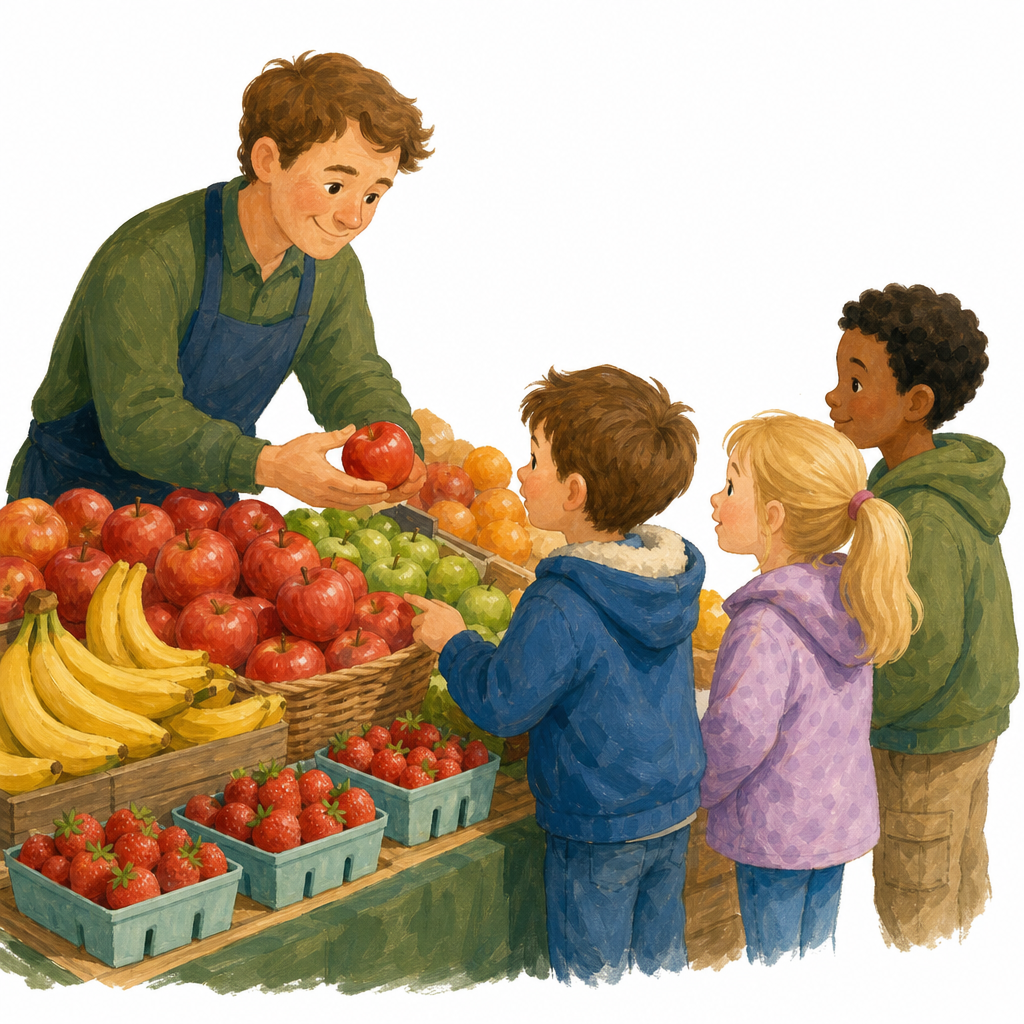
Which French fruit word do you already know? Someone in this room almost certainly knows one. Shout it out if you do, even if you are only half sure.
Collect three or four guesses and leave them hanging; do not confirm yet. The word-table in the next step will reveal the full set. If nobody offers a fruit, prompt gently with cognates such as banana or orange, without saying the French yourself yet.
Your teacher will tap each fruit on the board. Listen, then say it back together, twice. Watch the little word in front: most take le or la; l'orange takes l' (it is still feminine). There is no easy rule, so learn the little word as part of the fruit name.
You will meet them in two mini-sets of four, with a quick recall game in the middle.
Whole-class IWB path (default): you tap; the class listens and repeats. Nobody needs a device.
Set 1 (core): la pomme (lah POM), la banane (lah bah-NAN), l'orange (loh-RAHNZH), le citron (luh see-TROH(n)). Tap each word and have the class repeat twice, once all together and once by table. Point at the article every time.
Elision (say this aloud once): l'orange uses l' because orange starts with a vowel sound; it is still feminine (from la + orange). The a disappears so you do not say two vowel sounds in a row.
Mid-set recall (about 1 minute): say the English (apple, banana, orange, lemon) and the class calls back the full French with article. Keep it brisk and choral.
Set 2: la fraise (lah FREZ), la poire (lah PWAHR), then stretch items le raisin (luh reh-ZAN) and la cerise (lah suh-REEZ). Same tap-listen-repeat twice pattern. Confirm any cognates from the hook here.
This is their first careful look at grammatical gender, so go slowly and never drop the article. Aim for confident production of the core six; recognition is enough for the two stretch items today.
First, say all eight fruit phrases together one more time with your teacher.
Then look at the market stall on the board. When it is your turn, say the full phrase out loud (little word and fruit), then choose the label. Everyone else whisper-says it in your place.
After the labels are on, your teacher will model a real market request and pin two frames on the board for later:
The class repeats the Je voudrais line once together. Both frames stay on the board until the end of the lesson.
Default path: whole-class IWB with volunteers. Before anyone labels, lead one rapid choral sweep of all eight full phrases (article + fruit) so the forms are fresh.
Invite volunteers to the board in turn. Insist on the full phrase spoken aloud before the click: pomme alone is not enough; la pomme is the answer. The rest of the class whisper-says the same phrase so every pupil is speaking, not only the volunteer.
If a label is missed twice, pause and say the word together before moving on. Keep pointing at le, la, and l' so gender stays visible while they play.
Bridge to the market (final 60–90 seconds): leave the labelled stall up. Point at one fruit image and model slowly: Je voudrais la pomme, s'il vous plaît (zhuh voo-DRAY lah POM, seel voo PLAY). Class repeats once chorally. Write both frames on the board now and leave them up through step 7:
Do not open pair work yet; this is only a first hearing of the request line. You will model Je prends fully in step 6. Keep this bridge tight so labelling still gets the bulk of the 8 minutes.
If your class already has 1:1 devices, pupils may run the same labelling activity at their seats after the choral sweep; otherwise stay on the IWB.
Copy the eight fruits from the board. Write the little word (le, la, or l') with each one. Put a star beside any little word that surprised you.
Pause the board. Everyone writes: this is the only stretch where every pupil's pen is moving. Keep the word-table fully visible while they copy. Five minutes gives time to spell carefully and decide on stars.
Walk the room and check the article is going in front of every word; a list of bare nouns will not carry the gender pairing. Watch especially for l'orange written with the apostrophe.
If time is tight for some pupils, they may finish the last two after the sort, but most should manage all eight. Do not collect these. Celebrate a star or two aloud so the class sees that surprise is normal.
Quick reset first: your teacher says a fruit in English; call back the French with its little word.
Column key:
Worked examples (sort these together on the board):
Now sort the rest. When it is your turn at the board, say the full phrase, then drag it into the masculine or feminine column. Everyone else whisper-says the phrase with you.
Default path: whole-class IWB with volunteers. Nobody needs a device. You or a pupil drags; the class stays involved by whisper-saying each phrase.
Before the drag activity: run a 60–90 second teacher-led reset. You say the English for the core six (apple, banana, orange, lemon, strawberry, pear); the class calls back the full French with article. Add the stretch pair if the class is flying.
Display the column key on the board: le = masculine (boy words); la / l' (from la) = feminine (girl words). Model all three worked examples on the IWB before anyone else drags, and sort l'orange together as a class so nobody freezes on the apostrophe.
Remind them that French has no neat spelling rule for fruit gender: they learn each article with the noun. If a pupil drops a word in the wrong column, ask the class which little word gave the clue (le, la, or l' hiding feminine la).
Pronunciation backup if needed: la pomme (lah POM), le citron (luh see-TROH(n)), l'orange (loh-RAHNZH).
Exit bridge (final 20–30 seconds): point at two core-six fruit images still on screen. Class chorally reads the board frame once each: Je voudrais la fraise, s'il vous plaît and Je voudrais le citron, s'il vous plaît. This wakes the request line before pairs use it in step 6. Keep both market frames visible on a side board the whole step.
You're previewing this lesson. Get full access to this lesson and hundreds more — each one ready to teach, with interactive activities, printable resources and pupil progress tracking built in.