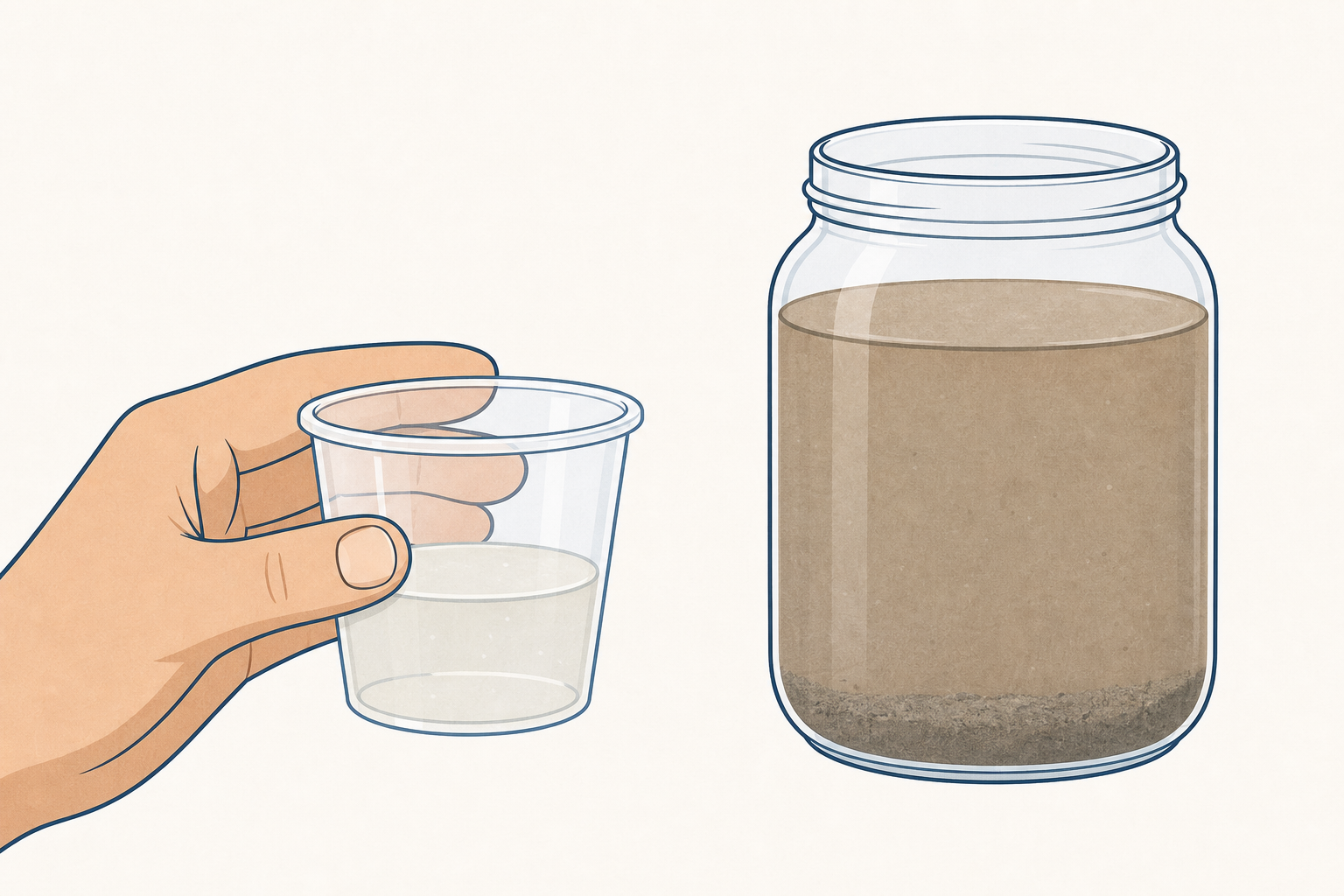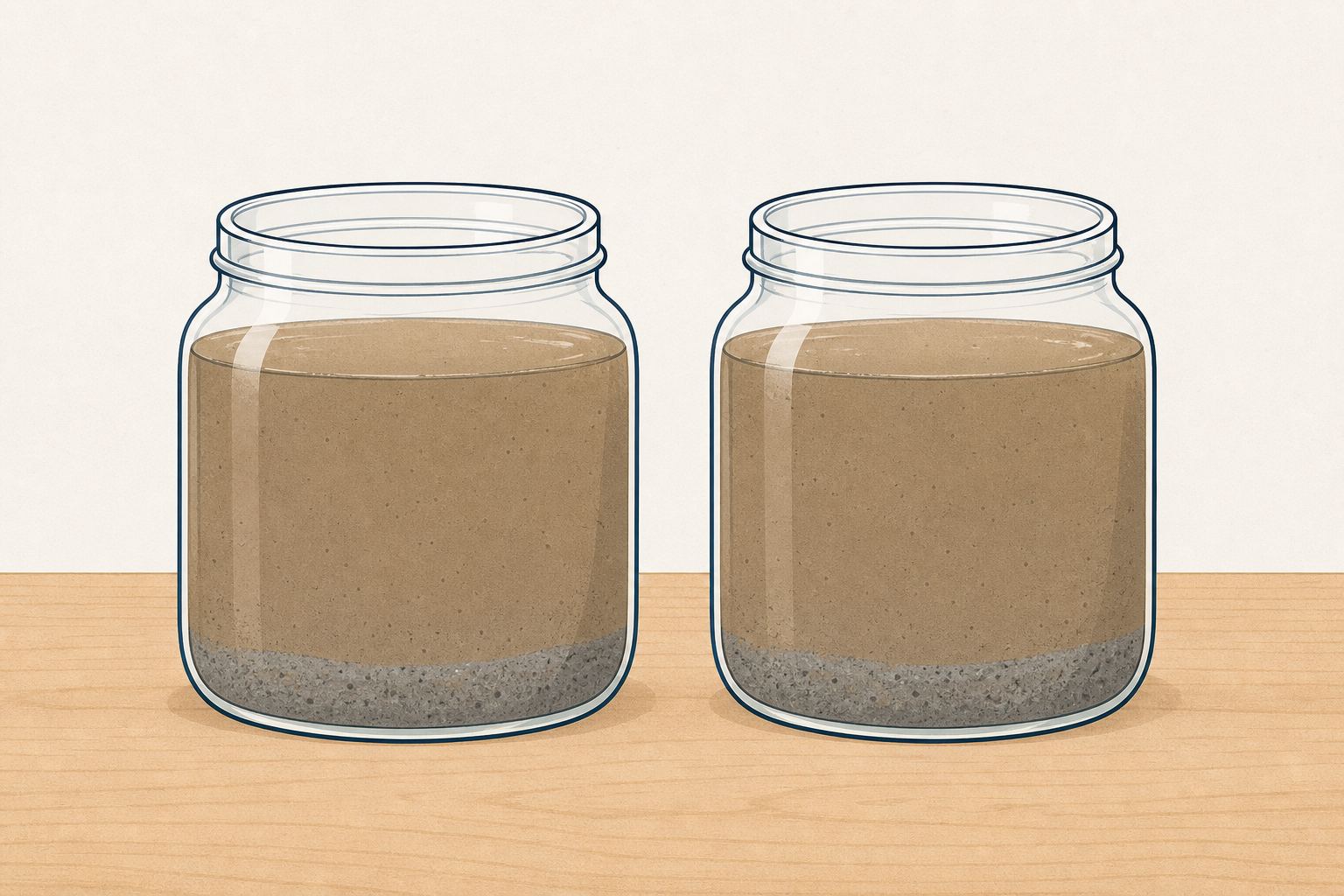
Your teacher has two jars on the desk. Both hold the same mix of sand, salt and water. One of them is our baseline: poured through nothing, so we can compare every result against it later. How could we get the sand back out of the water, and how would we test a way fairly?
Hold up one clear jar of mixed sand, salt and water so the whole class can see the cloudy swirl. Stand a second jar of the same mixture beside it and name it aloud as the baseline (poured through nothing). You will compare later results against it. Leave both jars visible.
Keep this beat light: one question and a quick hands-up of ideas. Do not name variables or hand out kit yet.
Key questions: What can you see in the jar? Which part looks easiest to get out first? What would “fair” mean if two groups tried different ways?
Nature of STEM: Separating mixtures is everyday chemistry, the same idea behind cleaning water and recovering useful materials.
The theme is the same for everyone: separate the sand from the water. Your group chooses which two methods to compare:
A strong testable question sounds like this: Does filtering leave less sand in the water than sieving?
Agree in your group which two methods you will compare and which you think will leave less sand, and why. You will write the full question on your Investigation Journal page in the next step.
Remind the class that a 6th-class pupil can already turn a theme into a testable question. You set the theme; each group designs the specifics.
This step is oral only: groups choose two methods and say a rough prediction with a because. Do not hand the Investigation Journal page yet. Writing the full question and plan comes in the next step.
Put the model question on the board and leave it up: Does filtering leave less sand in the water than sieving?
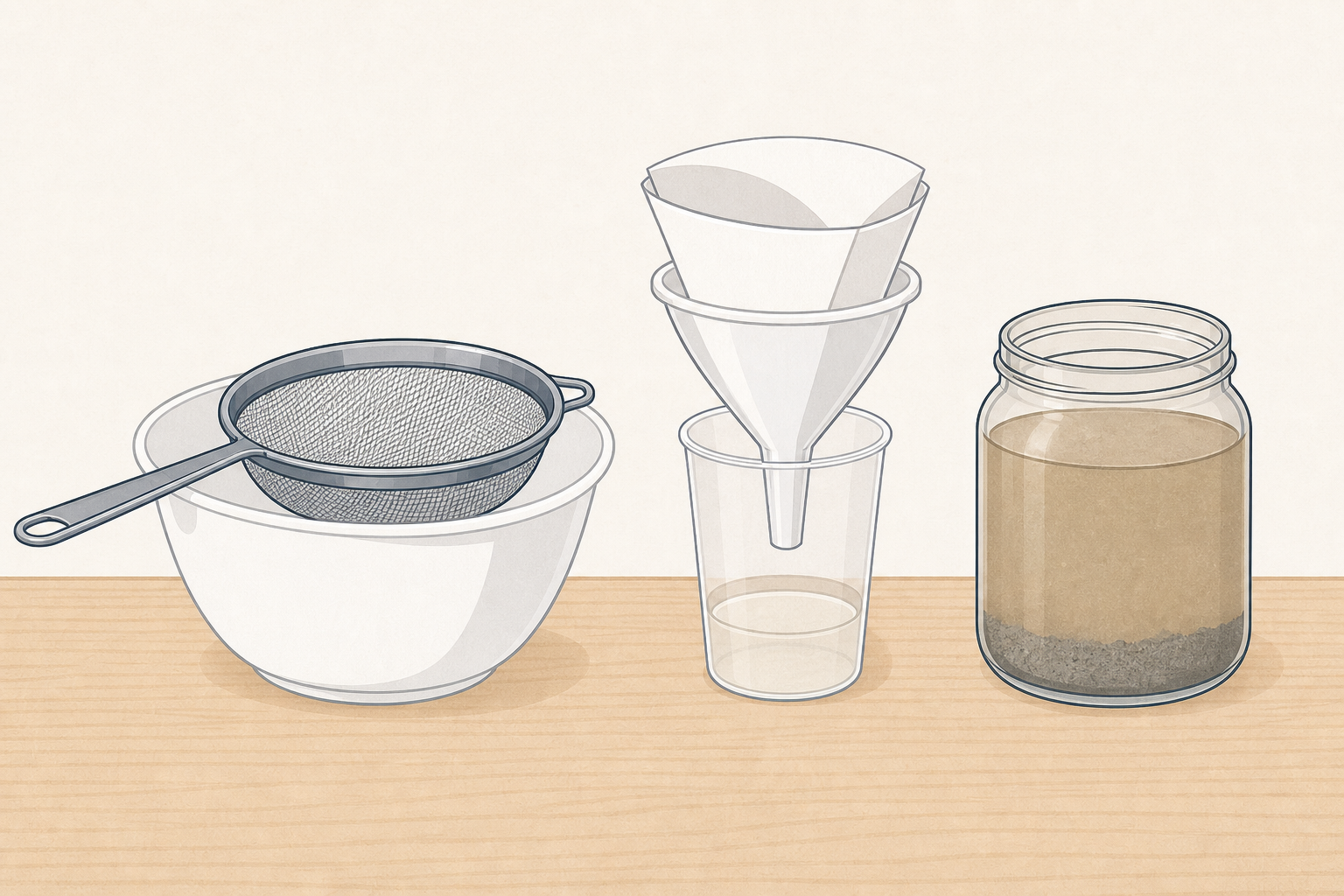
Methods on offer (say the plain meaning as you point to the kit):
Evaporation is not a pupil method today.
Predictions are never wrong. They are the start of the science. Push for a because: “We think filtering will win because the holes are smaller.”
Differentiation: less confident groups pick from two named methods you shortlist; confident groups phrase their own question fully when they write it next (“Does filtering leave less sand in the water than settling when we use the same amount of mixture?”).
Five cards are on the board: the separation method, how much sand is left, amount of mixture, time allowed, the container. Call out where each belongs: Change, Measure, or Keep the same.
That sort is a fair test: change only one thing, measure one result, and keep everything else the same.
Then complete your Investigation Journal page: which two methods you will compare, your prediction with a because, what you will keep the same, and how your group will judge “sand left” on our shared cloudiness scale (1 = clear, 5 = very cloudy, as cloudy as the baseline jar).
Time means the same rule for both your methods, for example two minutes still for settling, or pour and wait the same two minutes before you score.
A cloudiness score is what you saw. Keep that separate from what you think it means when you write later.
The printable page (or an improvised equivalent grid if needed) must give pupils labelled space for all of the following so you can check the look-fors:
| Concept | Why it matters | Example |
|---|---|---|
| Fair test — change only one thing, measure one result, keep everything else the same | If two things change at once, you cannot tell which one caused the result | Same scoop of mixture, same time and same cup type; only the method changes |
| Method — the separation way you choose to try | This is the one thing groups are allowed to change today | Sieving versus filtering, or filtering versus settling |
| Observation — the reading you take | Scientists keep what they saw separate from what they think it means | Cloudiness score 2 after filtering |
| Inference — what the reading suggests | A conclusion must rest on evidence, not on hoping you were right | So filtering trapped more sand than the sieve |
Lead with the five cards and the Change / Measure / Keep-the-same sort first. Hang only fair test on that beat before groups write.
Cards on screen: the separation method, how much sand is left, amount of mixture, time allowed, the container.
Target placement: drag the separation method to Change, how much sand is left to Measure, and the other three to Keep the same.
The on-screen prediction line is a neutral stem (Method A vs Method B). Your oral worked model can still use filtering versus sieving.
Point again at the baseline jar named in Getting Started. Agree the shared cloudiness scale on the board before groups finish their planner page: 1 = clear, 5 = very cloudy (as cloudy as the baseline). Then one short line only: score 2 is what you saw (observation); “filtering won” is what you think (inference). Do not expand this into a second mini-lesson here.
I wonder which leaves less sand, filtering or sieving. I predict filtering, because the paper holes are finer. I will change only the method. I will keep one scoop of mixture, two minutes, and the same clear cup. I will measure cloudiness from 1 to 5 against the baseline jar. After one quick demo pour through filter paper: I observed score 2. I think the paper held back more sand than leaving the baseline alone.
Protect planner time: keep the whole-class sort and scale agreement brisk (a few minutes) so every group leaves this step with methods, controls and the measure rule written before kit is touched.
Checkpoint before kit: do not dismiss any group to the side bench until you have seen, on their Investigation Journal page, (1) two named methods, (2) amount, time rule and container listed as kept the same, and (3) the cloudiness 1–5 measure rule. Less confident groups get a 30-second stem prompt; no group starts pouring without a complete plan.
Kit claim (end of this step / start of next): each group collects only the tools for their two chosen methods (sieve and/or funnel with filter paper; settling groups need clear cups and the timer, not a sieve they will not use).
Misconception to head off: “We should use more mixture for the method we like.” That makes the test unfair. Another: writing “filtering is better” in the results column. That is an inference, not the reading.
Groups also decide whether they will pour off settled water or only judge after a fixed still time. That detail is theirs, as long as both of their methods use the same rule and the still time fits inside the practical window (about two minutes per trial is realistic).
Collect only the tools for the two methods your group chose. Run the fair test you planned. Compare each result against the baseline jar (the one poured through nothing). Hold each result cup beside the baseline and score cloudiness from 1 (clear) to 5 (as cloudy as the baseline / very cloudy), same rule for every trial.
Run each method twice (two trials each). Score cloudiness after every trial and write the score on your Investigation Journal page straight away. Keep the amount of mixture, the time rule and the container the same every time.
You’re doing what scientists do: same rules every time, so the numbers can be trusted.
One station per group: mixture jar, two clear result cups, shared baseline jar visible at the front (or one baseline per pair of groups), shared timer or stopwatch. After the planner checkpoint, groups collect only the tools for their two chosen methods from the side bench (sieve and/or funnel with filter paper). Settling-only pairs do not need a sieve sitting unused on the desk.
Scores are written during trials, not after. Aim for roughly: 2 minutes kit claim and stir; then four short trials with scoring as you go. For settling comparisons, still-time burns the clock. Cap still time at about two minutes per trial unless both of that group’s methods can share a slightly longer time and you will still finish inside the window. Keep pour-through groups moving so the class is not waiting on one slow station.
Hold each result cup beside the baseline jar. Score 1 if the water looks clear, up to 5 if it looks as cloudy as the baseline (or very cloudy). Use that same rule for every trial and every method.
Filtering usually gives the clearest water (lowest score). Sieving often lets fine sand through. Settling improves with time but two minutes may still look cloudy compared with a good filter. If every score comes out the same, the mixture scoop is too small or the time is too short. Lengthen the still time slightly for settling groups only if both of their methods can share the new time and you still finish inside the practical window.
Wipe spills at once. No tasting. Sand stays out of eyes; wash hands at the end. No heat sources for pupils. Pour sandy waste into the class waste bucket, not down the sink.
Fold watchers in: when one group is pouring at the front bench, ask the class: “Do you think their score will beat the baseline? What must they keep the same?”
Fast finishers: sketch one change that would make their test unfair, or say where the dissolved salt still is after the sand is removed (still dissolved in the water).
Check your Investigation Journal page. Make sure every trial score is written. Write what you saw (the cloudiness score) in one place and what you think it means in another. Do not mix them up.
Recording is required in this lesson, not homework. Most scores should already be on the page from the practical; use this beat to finish gaps and separate observations from inferences before the class discussion.
Circulate and check against the page sections: every group has two trials per method in the results table; scores are clear in the observation space; no one has written “filtering is better” in a results cell (that belongs under inference).
Look-fors:
If a group’s two trials disagree a lot, ask them what might have changed (scoop size, stirring, timing) rather than calling the test a failure. That is useful fair-test talk for the next lesson in this project.
You're previewing this lesson. Get full access to this lesson and hundreds more — each one ready to teach, with interactive activities, printable resources and pupil progress tracking built in.