1 - Start ~4 mins
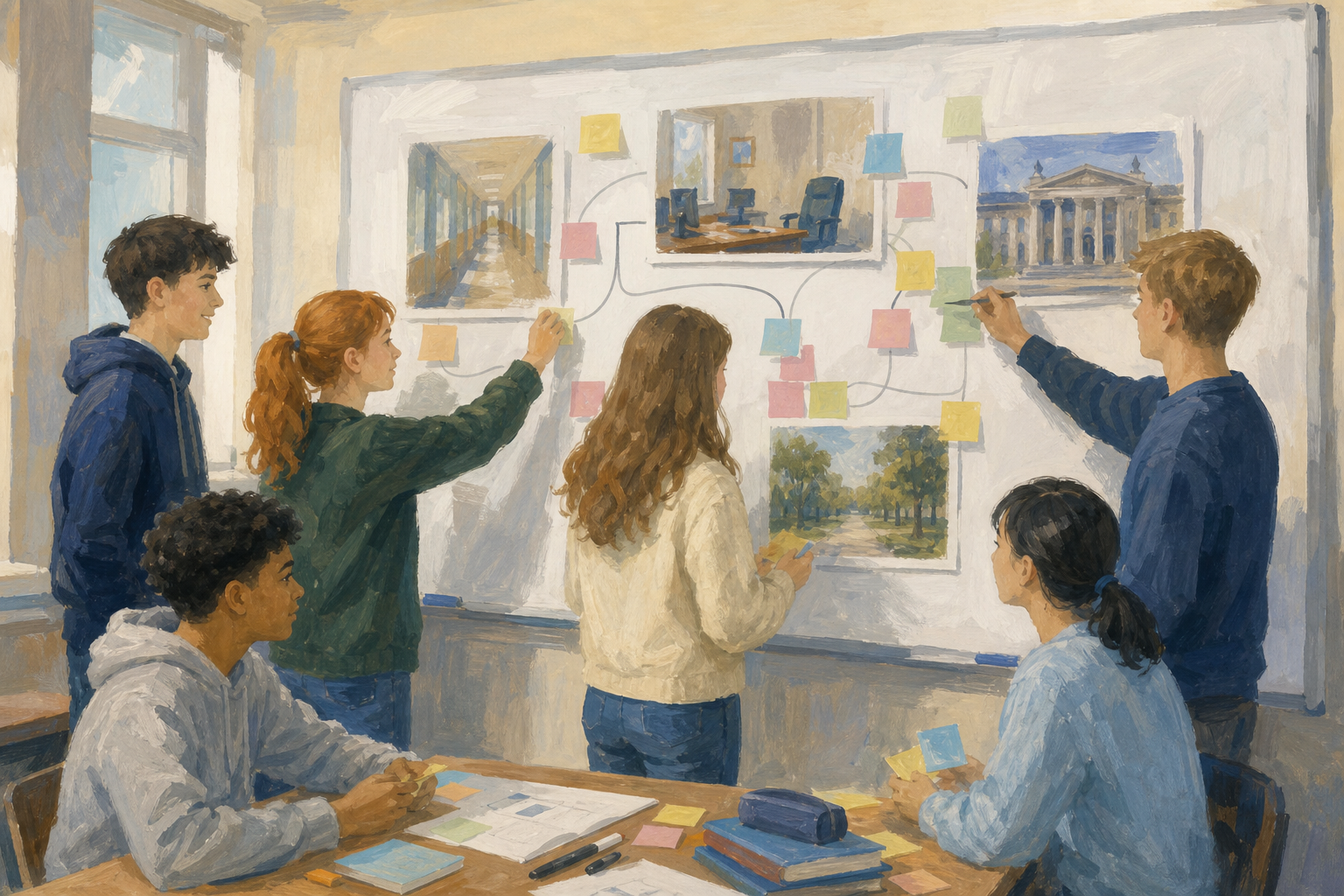 Today you plan your third citizenship action. It has to connect to democracy, power or the law, and it has to be real: afterwards, something should be different, and somebody outside this room should have noticed.
A poster that only this class sees is not enough. Somebody who can actually decide something has to hear from you.
2 - What Makes a Democracy Action Real ~9 mins
Awareness-raising tells people something. A democracy action goes further: it puts a clear ask in front of a person or body that holds a decision.
In school, that might be the student council, a year head, the principal, or another staff member who owns a rule or a routine. Locally, it might be a county councillor or the local authority on something that affects your area.
What you plan today must pass three checks:
- It is about democracy, power, voice or the law, not only about a preference.
- You can finish it in the weeks you actually have.
- A named decision-maker receives something from you, and you can record what they said or did.
Here are three possible actions to test. Your class can add one short idea of its own:
- Ask the principal to publish how student-council motions are answered, and by when.
- Ask the year head to trial a fixed slot for year-group voice in the next half-term.
- Ask a county councillor how a local bye-law or area complaint is logged and followed up.
As a class, test these against the three checks and settle on one action. Write who the decision-maker is beside it in a full sentence. That is the action you will lay out on the planner next.
3 - Lay the Work Across the Weeks ~19 mins
You are co-building one shared plan for the action the class just agreed. Work from the planner on the board or projector. Do not make a separate plan on your own device. If your device is open, use it only to follow the plan on the board.
In short pair bursts, propose one milestone for each kind of work, then call it up so it can go on the class planner. Place milestones across the weeks and across the three kinds of work: finding things out, making the piece, and getting it heard. On each milestone, name who does it. Different students should own different steps.
Fill in the Getting it heard row, and who keeps the evidence, before you add more detail to the Finding things out cards. Make sure the final column says clearly what "done" looks like.
Empty boxes matter. A blank in the first week means you have not really started. A full row on only one kind of work means the ask never reaches anyone.
Our democracy action plan
4 - Make Sense of It ~5 mins
Use this time to finish two jobs:
- Name the evidence owner, and say what counts as evidence for this action (what you asked, who you asked, what they said, what changed, what did not).
- Fix one clear gap before you leave (an empty early box, a missing decision-maker contact, or a silent Getting it heard cell).
A plan with no evidence owner is a plan you will not be able to write up later.
5 - What You Covered ~3 mins
You can now tell the difference between raising awareness and a democracy action that puts an ask in front of a decision-maker.
You have agreed one school or local action, laid it across the weeks it will really take, named who does the work, and said who keeps the evidence.
Next time you run the plan, not the idea of the plan.
Unlock the full learning experience
You're previewing this lesson. Get full access to this lesson and hundreds more — each one ready to teach, with interactive activities, printable resources and pupil progress tracking built in.
This lesson is copyright of Coding Ireland 2017 - 2026. Unauthorised use, copying or distribution is not allowed.