1 - Start ~4 mins
2 - Local Action, Real Weeks ~5 mins
An action about a world challenge still has to land somewhere you can reach. Changing a rule in another country is not something a class can do on a Tuesday. Changing what people in this school or this place notice, say or do is.
A plan that survives names three kinds of work running side by side: finding things out, making something, and getting it in front of somebody. It also says what happens this week, what happens next, and what “finished” looks like. You will learn those tracks properly by placing real milestones on the grid next.
3 - Lay the Weeks Out ~23 mins
Open the planner below. The start is the option written in full on the board. The finish is the action done, with somebody outside the class having noticed.
First, in pairs for two minutes, jot one possible milestone for each of the three tracks.
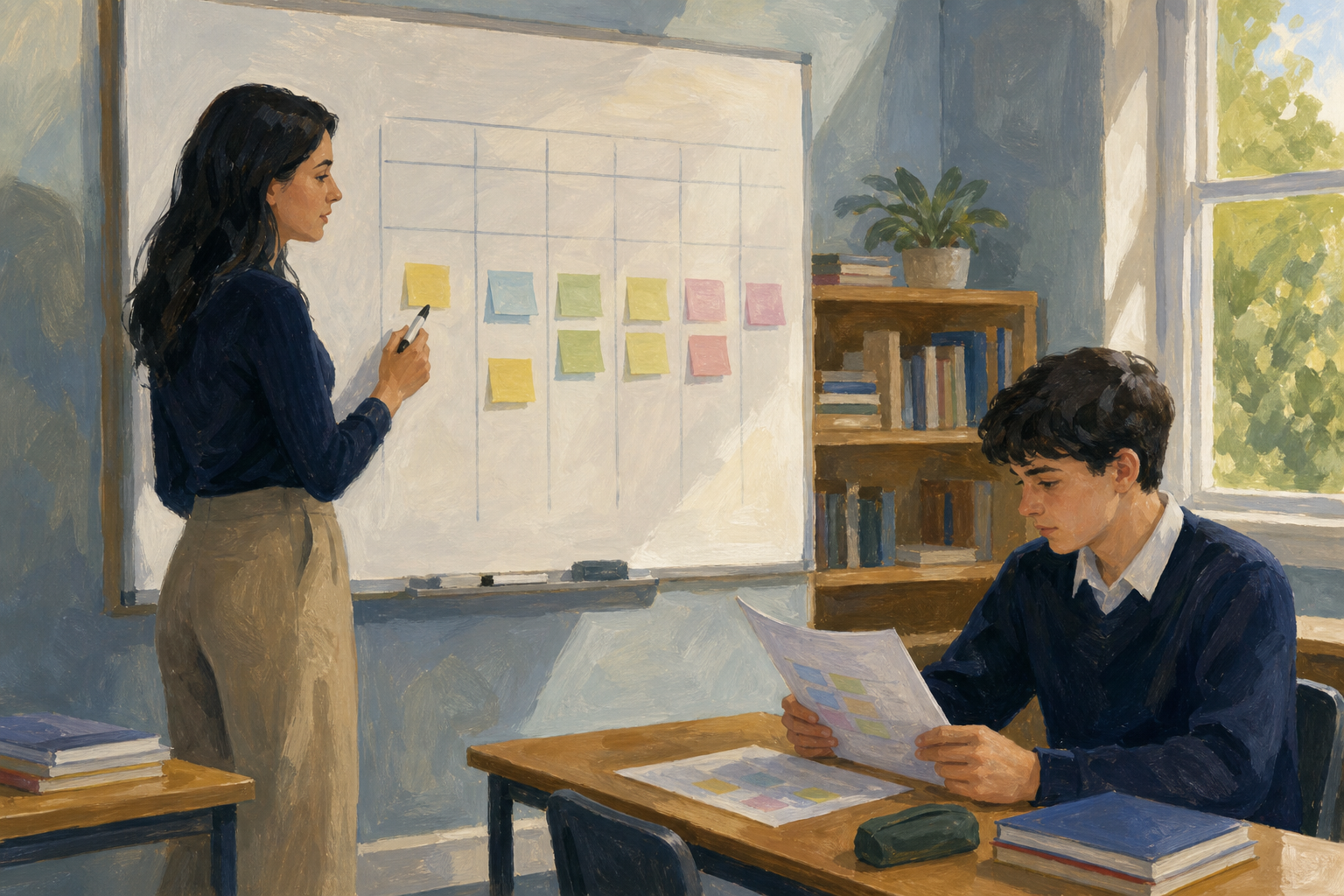
Then, as a class, call out milestones while your teacher places them on the board, across three tracks and three time horizons. Every square you can fill honestly gets a milestone. Empty squares are information: they show what you still have to invent.
When the grid holds a workable shape, the class stops changing it. Your teacher then writes on the board, in plain words, who does each main job, the real dates, and the one sentence that means “this is done”. To finish, take sixty seconds to put your initials next to a job, on your own or with your partner. Any job left without a name is a risk the class will talk about next.
Plan for the option we backed
4 - Make Sense of It ~5 mins
Look at the plan the class made.
Where is the thinnest track? Where is the busiest week? Does the done-sentence describe a change somebody else could see, or only that the class finished a task?
Agree one risk that could stall this plan (a permission, a date clash, a job with no name) and the fix you will use if it happens.
5 - What You Covered ~3 mins
Unlock the full learning experience
You're previewing this lesson. Get full access to this lesson and hundreds more — each one ready to teach, with interactive activities, printable resources and pupil progress tracking built in.
This lesson is copyright of Coding Ireland 2017 - 2026. Unauthorised use, copying or distribution is not allowed.