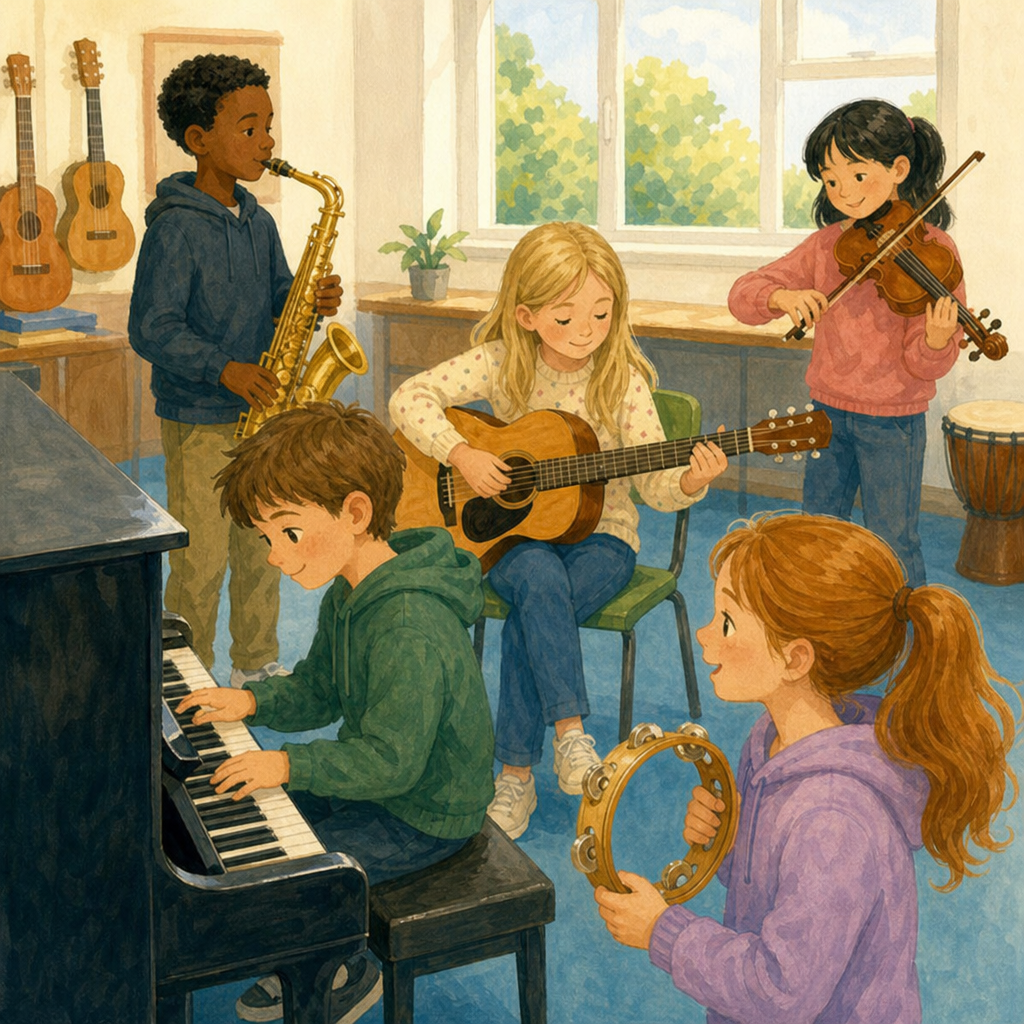
 Hands up if you play an instrument. Hands up if you would like to play one. Today you learn how to say both things in French: what you already play, and what you would like to try.
By the end of this lesson, you will be able to:
- Name eight instruments in French
- Say what you play, or what you would like to play
- Spot instrument names that came from other languages
We will tap each instrument on the board. Listen, then say it back together. Notice the article every time: le or la.
Pattern strip: le → du · la → de la
Then try the two sentence patterns:
- Je joue du piano (I play the piano)
- Je voudrais jouer de la guitare (I would like to play the guitar)
Imagine a busy French collège music room getting ready for Fête de la Musique (21 June), when free concerts fill towns across France. Watch the picture on the board. When it is your table's turn, call out the French label with le or la. A volunteer places it. Everyone else whispers the word as it lands.
Open your copy and write one sentence about an instrument you play or would like to play. Copy the article and spelling carefully from the board.
Full frames (examples):
- Je joue du piano. / Je joue de la flûte. / Je joue du tambourin.
- Je voudrais jouer du violon. / Je voudrais jouer de la guitare. / Je voudrais jouer de la trompette.
Support stem if you need it: Je joue ____ ____. or Je voudrais jouer ____ ____.
- le piano — Piano
- la guitare — Guitar
- le violon — Violin
- la flûte — Flute
- la batterie — Drums
- la trompette — Trumpet
- le saxophone — Saxophone
- le tambourin — Tambourine
Fête de la Musique energy: free street music all over France. Use your printed bingo card. Listen carefully and mark each instrument as you hear it in French. When every instrument on your card is crossed off, shout Bingo! then read your instruments back in French.
Unlock the full learning experience
You're previewing this lesson. Get full access to this lesson and hundreds more — each one ready to teach, with interactive activities, printable resources and pupil progress tracking built in.
This lesson is copyright of Coding Ireland 2017 - 2026. Unauthorised use, copying or distribution is not allowed.