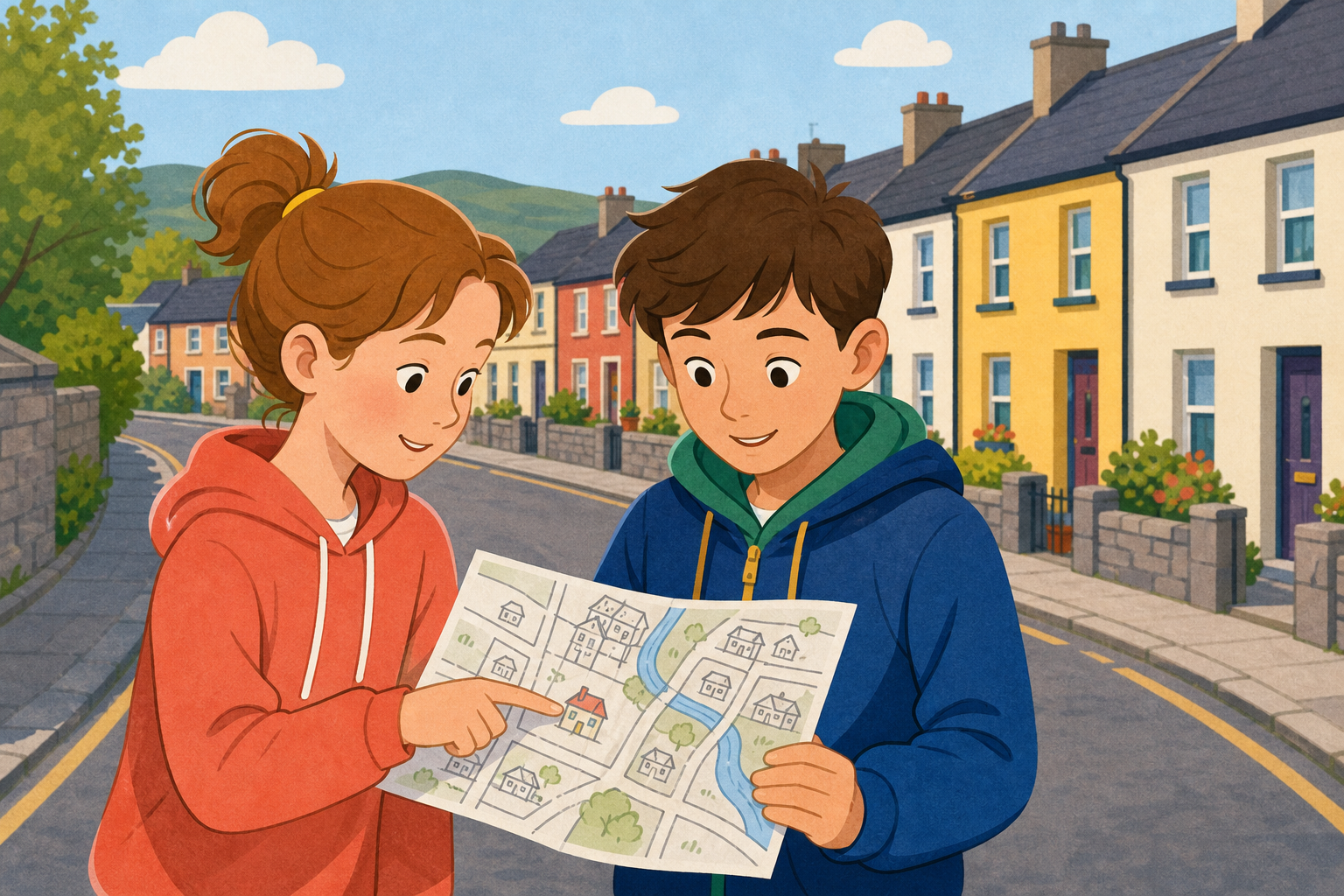
Imagine you wanted to tell a friend exactly where your house is on a grid map of your estate. Saying "near the green" or "the third row" is not quite enough. How could you give your friend a set of directions so clear that they land on the right house every single time?
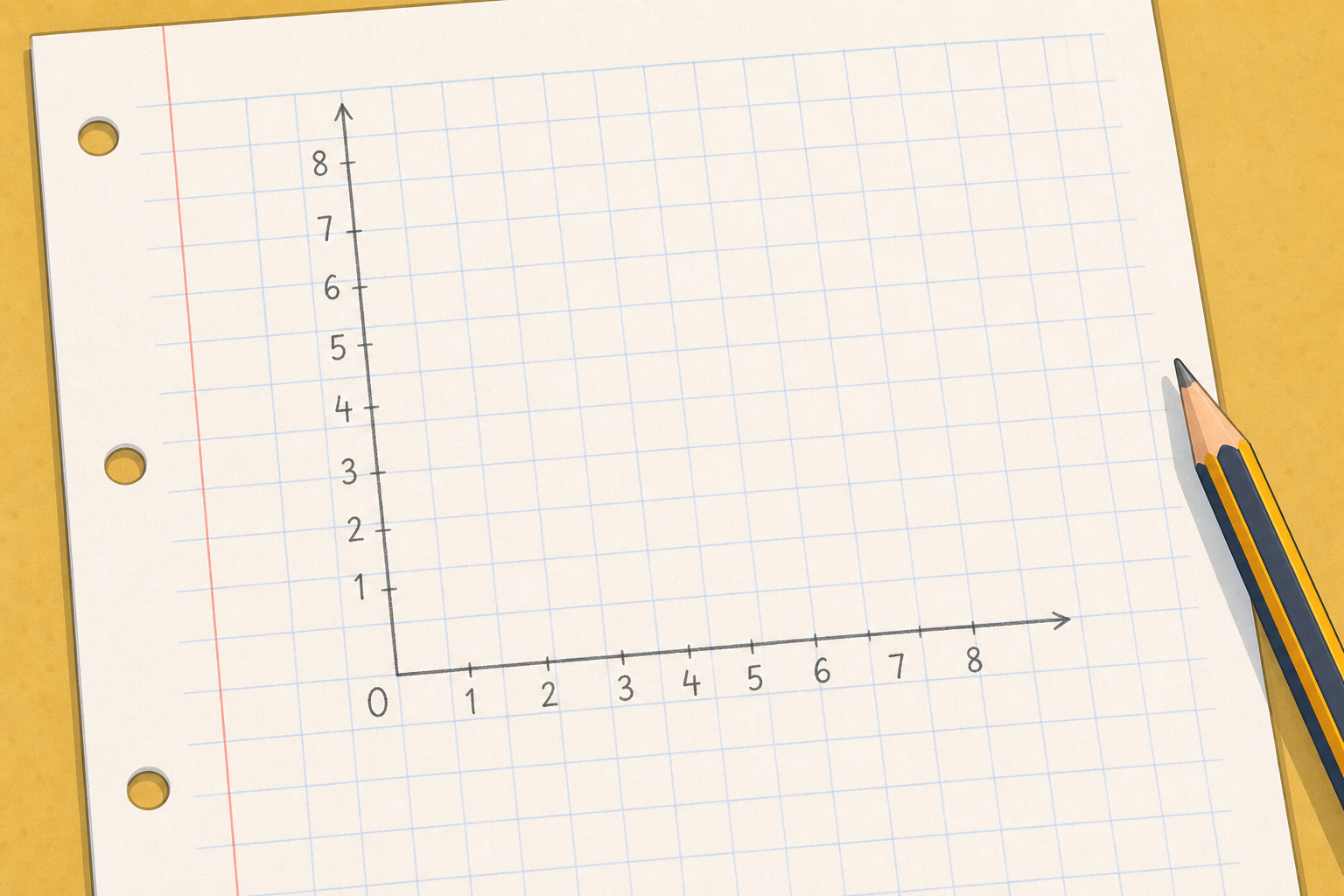
Take two or three hands-up suggestions, not open call-outs. Listen for any answer that uses a number for 'across' and a number for 'up' — revoice it as so you need two numbers: one for across, one for up. Don't resolve it fully here; the grid is built in the next step.
The illustration shows four points on the grid. Look at each co-ordinate pair and where its point sits.
Same rule each point: along the corridor, then up the stairs. Start at the corner where the number lines meet.
(3, 4) — 3 along, then 4 up. Trace the 3 across with your finger before going up; this is the core move.
(5, 0) — second number 0, so 5 along and no move up. Stress the point lives on the across line, not above it.
(0, 6) — mirror case: first number 0, so no move along, just 6 up. Sits on the line running up.
(7, 7) — both 7, but still two separate moves: 7 along, then 7 up. Ask the class to compare the two journeys; same length here, point lands on the slanting line where across matches up.
Today we explore together: I will call out a co-ordinate pair, and one pupil will come up and plot it on the grid. The rest of the class watches the board and decides whether the point landed on the right address.
Remember our rule, along first, then up.
This round is for talking it through together — one pupil plots at the board and the watching class agrees or corrects out loud.
Call four points and rotate four pupils to the board, one per point. For each one, ask the watching class did they go along first, then up? before confirming. Watch hardest for the pupil who counts up before across — revoice the slip rather than just correcting it. The two zero-co-ordinate points are the ones to slow down on.
Take a sheet of pre-ruled grid paper and mark 0 to 8 along each axis. Then plot each of these points and label each one with its co-ordinate pair:
Hand out the pre-ruled grid paper (listed in manipulatives) so the time goes on plotting, not ruling. Walk the room glancing at whether the across move was done before the up move — no marking, this is whole-class copybook practice. Look especially at how pupils handle the two zero-co-ordinate points.
Today we work through these challenges together: first plot a single point, then plot three points that join up to make a triangle, then complete a square where three corners are already placed, and finally plot four points that make a square yourself. We will check each one before moving on.
These are the practice questions — pupils take turns at the board, check each answer, and the class confirms before moving on. Keep the board work brisk rather than over-explaining.
The challenges climb from a single point to a triangle to the complete-the-square task to a four-point square. On the complete-the-square challenge, three corners are already on the grid, so ask the class to predict where the fourth corner goes before the pupil places it. Watch for the swap slip where a pupil enters the up number before the across number.
Why must we always go along before up? What happens to (3, 4) if we read it the wrong way round and plot (4, 3) instead — do the two points land in the same place?
Listen for pupils naming that swapping the numbers gives a different point, not the same one. Revoice a strong answer: so the order is part of the address, just like the order of the digits in a house number. Head off the misconception that (3, 4) and (4, 3) are 'the same point because they use the same numbers'.
Next we stretch the grid below zero and to the left, splitting it into four quadrants so we can give addresses to points that go down and back as well as across and up.
Keep this brief. Recap the along-then-up rule once more, then signpost the four-quadrant plane coming next so pupils expect the grid to grow.
You're previewing this lesson. Get full access to this lesson and hundreds more — each one ready to teach, with interactive activities, printable resources and pupil progress tracking built in.