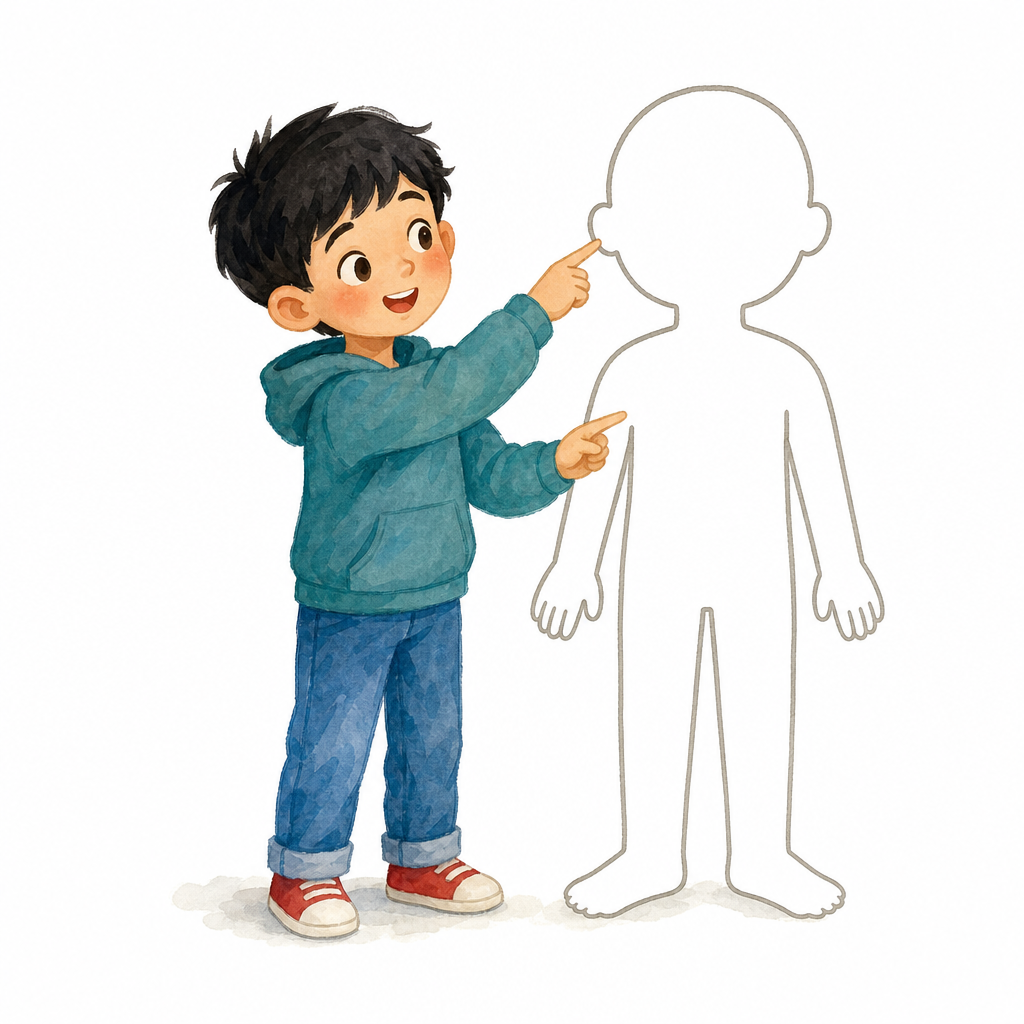
How would you show someone your arm hurts if you had no words for it? Watch a few classmates mime, then imagine you are abroad at night and you need the real German phrase.
Invite two or three volunteers to mime (whole class watching, not partner work). Keep it short: the point is the gap they feel when they have no words. Tell them German has a short, useful frame: Mir tut der Arm weh (meer toot dair ARM vay), which means my arm hurts. You will meet the full set of body parts next, ready for a night-duty pharmacy (die Apotheke) abroad.
You are at a night-duty Apotheke in Munich and need to tell the pharmacist what hurts. Listen to the German on each card first (article included), repeat it chorally, then flip to check the English. After each word we build Mir tut … weh.
Whole class on the board. Order every card: you (or the audio) model first → class repeats with the article → then flip. Never ask them to invent the sound before they have heard it.
After each flip, model the hurts sentence once and have the class echo it with a dramatic groan if you like: ham it up on Mir tut der Kopf weh and especially Mir tun die Zähne weh.
Worked examples (singular frame):
Plural exception: die Zähne takes the plural verb: Mir tun die Zähne weh. (meer toon dee TSAY-nuh vay) My teeth hurt. Flag this clearly when that card appears; do not let the class say Mir tut die Zähne weh.
Point at the article every time. Bare nouns will not carry gender. Watch the ß in Fuß (FOOS).
60-second lock-in after the last card: everyone stands. Call three hurts lines; class points to or holds that body part. Silly movement now locks the words better than another silent board round. Then sit for the next game.
Still at the night-duty pharmacy desk: flip two cards at a time and match each German body part to its English meaning. Say the German quietly as you turn each card, article included. When a pair is found, the class echoes the hurts line for that part.
Run as whole-class turns on the board. If a pair is missed twice, pause and say the word together before moving on. Keep insisting on der, die or das with every match.
After each correct pair, choral Mir tut … weh (or Mir tun die Zähne weh for teeth). A quick mid-game check: hold up a hand and ask for die Hand (dee HANT) without looking at the board, then point to your foot for der Fuß.
Energy beat: celebrate any pair that keeps the article without a prompt. Make the article the victory, not the speed. Between matches you can call one surprise TPR line (Mir tut der Fuß weh) so the class jumps up, points, and sits again. Same vocab, a jolt of movement.
Open your copy. Using the model and word bank still on the board, write one full sentence saying that a part of you hurts.
Pause the board and leave at least one worked sentence fully visible (German + English gloss), plus a word bank of all eight body parts with articles:
Model once more before pens move. Pupils write only the hurts sentence (one is enough). Walk the room and check full sentences with articles, not bare word lists. Support: they may copy the frame and swap in a different body part from the bank. Do not collect these. Hear → say → see → write: they have now heard and said the frame many times (flashcards, matching, label) and seen the spellings on the board before writing.
Look at the first-aid poster figure on the board. Help us choose the right German label for each body part. Say the word quietly with its article when it lands, then build the hurts line as if you are reporting to the Apothekerin.
Volunteers come to the board one at a time, or the class votes before each click. This is whole-class IWB work, not devices on desks.
After a label lands, ask for the hurts sentence with that body part: e.g. Mir tut das Bein weh (meer toot dass BINE vay), Mir tut der Mund weh (meer toot dair MOONT vay). For teeth: Mir tun die Zähne weh.
This is the production check after recognition. Cheer any label that keeps der/die/das without a prompt. Celebrate careful articles more than speed.
You're previewing this lesson. Get full access to this lesson and hundreds more — each one ready to teach, with interactive activities, printable resources and pupil progress tracking built in.