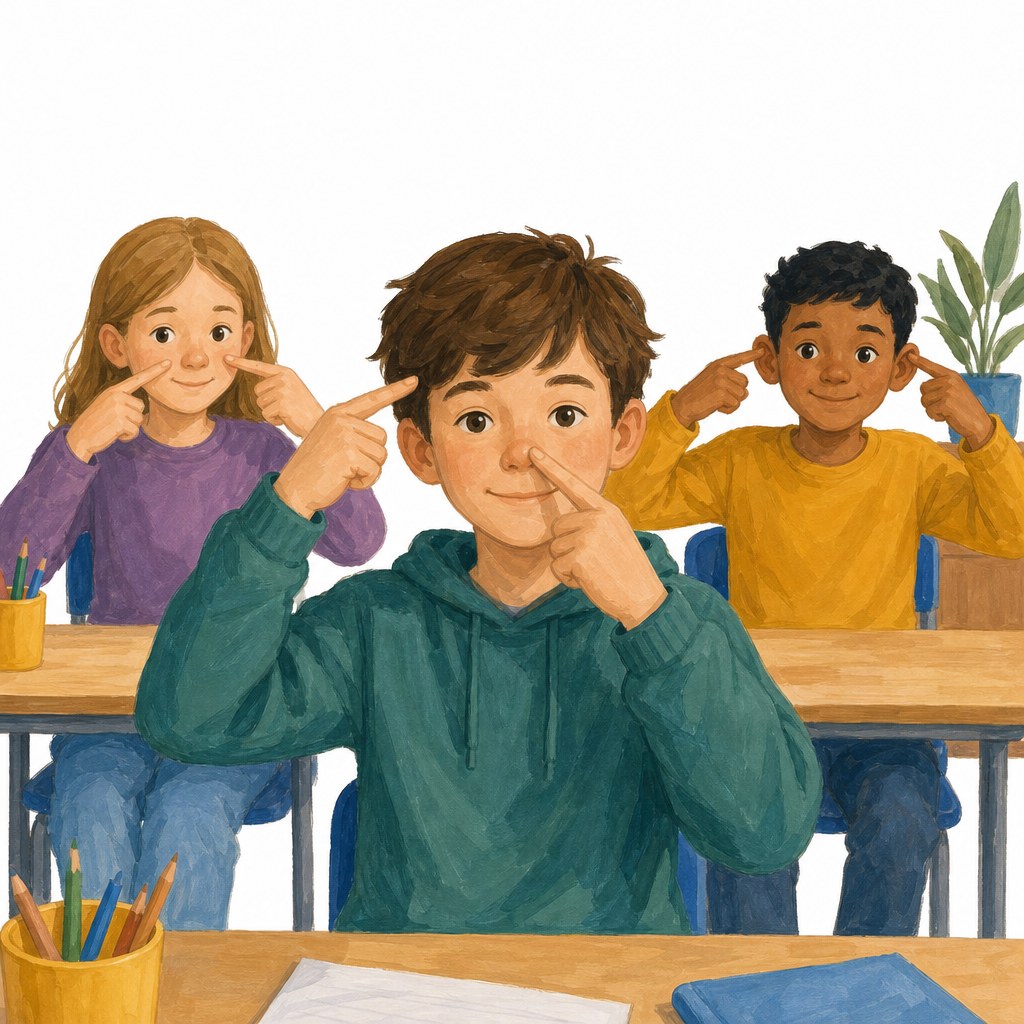
Put your hand on your head, then on your nose, then on your ear. You already know the English names for these parts of your body. Today you will learn eight body parts in Spanish, including the ones that take a plural article, and you will use them in a quick game of Simón dice.
Lead the class in touching head, nose and ear once, then freeze. Keep the tone playful — this is a body warm-up, not a test. Do not teach any Spanish yet; the hook is only to wake up the body and the English labels. Keep it to under a minute so the word-table can carry the real first meeting with the words. Mention that Simón dice (Simon Says) is coming later so they know movement is part of the lesson.
Here are today's eight body parts. Listen to each one, then say it back together. Watch which words take el or la, and which take los or las.
Reveal and chorus in two chunks of four so the load stays manageable. Chunk 1 (head and face): la cabeza, la nariz, la boca, los ojos. Quick point-on-yourself recap of those four. Chunk 2 (the rest): las orejas, los dedos, los dientes, el brazo. Class repeats each word twice: once all together, once by table. You (or a volunteer) operate the board; pupils listen, repeat and point. Point at the article every time so the pair is what they hear.
Pronunciation guides: la cabeza (lah kah-BEH-sah), la nariz (lah nah-REES), la boca (lah BOH-kah), los ojos (lohs OH-hohs — the j is the fun one, like a soft English h; get them to exaggerate lohs OH-hohs once for a laugh, then settle it), las orejas (lahs oh-REH-hahs), los dedos (lohs DEH-dohs), los dientes (lohs dee-EN-tehs), el brazo (el BRAH-soh). Pause on the four plurals and ask what those four have in common before you move on. Praise full phrases: "Great, los ojos!"
First, match each Spanish body-part phrase to its English meaning. Every time a Spanish card is turned, the whole class whispers the full phrase (article included) before the match is checked. When a pair is correct, everyone points to that body part on themselves.
Then play a short round of Simón dice (Simon Says) with today's eight phrases: listen for the Spanish and only move when you hear Simón dice.
Matching (about 7 minutes): Demo one or two pairs on the IWB with a volunteer so the class sees the full-phrase rule, then hand out physical word cards to tables. Tables play matching together. Every time a Spanish card is flipped, the whole table (and class, if you are demoing) whispers the full phrase — ojos alone is not the answer, los ojos is. On a correct match, everyone points to that part on themselves. Celebrate clean full phrases out loud — "Great, los dientes!" — so the article habit feels like a win. If a pair is missed twice, stop and chorus the Spanish before moving on. Listen for the soft j in ojos and the tapped r in nariz and orejas.
Simón dice (about 3 minutes): Stand everyone up. You lead first: "Simón dice: toca la cabeza / la nariz / la boca / los ojos / las orejas / los dedos / los dientes / el brazo." Mix in one trap without Simón dice so they freeze. Then let a confident pupil lead one round reading from the still-visible list. Keep it brisk and laughing — this is the Spanish classroom game that makes the words stick in the body.
Open your copy and write the eight body parts with their articles. Circle the two you found hardest to say.
Pause the board. Everyone writes; this is the only three minutes where every pupil's pen is moving. Keep the word-table on screen while they copy. Walk the room and check the article is going in front of every word, including los and las on the plurals. Quiet word of praise when you see a clean full phrase on the page. Do not collect these.
Look at the figure on the board. Before each label is placed, the whole class points to that body part on yourselves and whisper-says the full Spanish phrase. Then a volunteer puts the label on the figure. Check the article matches what you wrote in your copy.
Keep every pupil active: before each label, call the English or show the blank marker, class points on their own body and whisper-says the full Spanish phrase, then a volunteer drags the label. After two volunteer labels, you can also let the class direct from seats while one pupil drags. Before the last two labels go on, ask which words still need a home and whether those leftover words are singular or plural. If a label lands on the wrong marker, chorus the correct word together and try again. When the last label lands, give the class a quick round of applause before moving on.
You're previewing this lesson. Get full access to this lesson and hundreds more — each one ready to teach, with interactive activities, printable resources and pupil progress tracking built in.