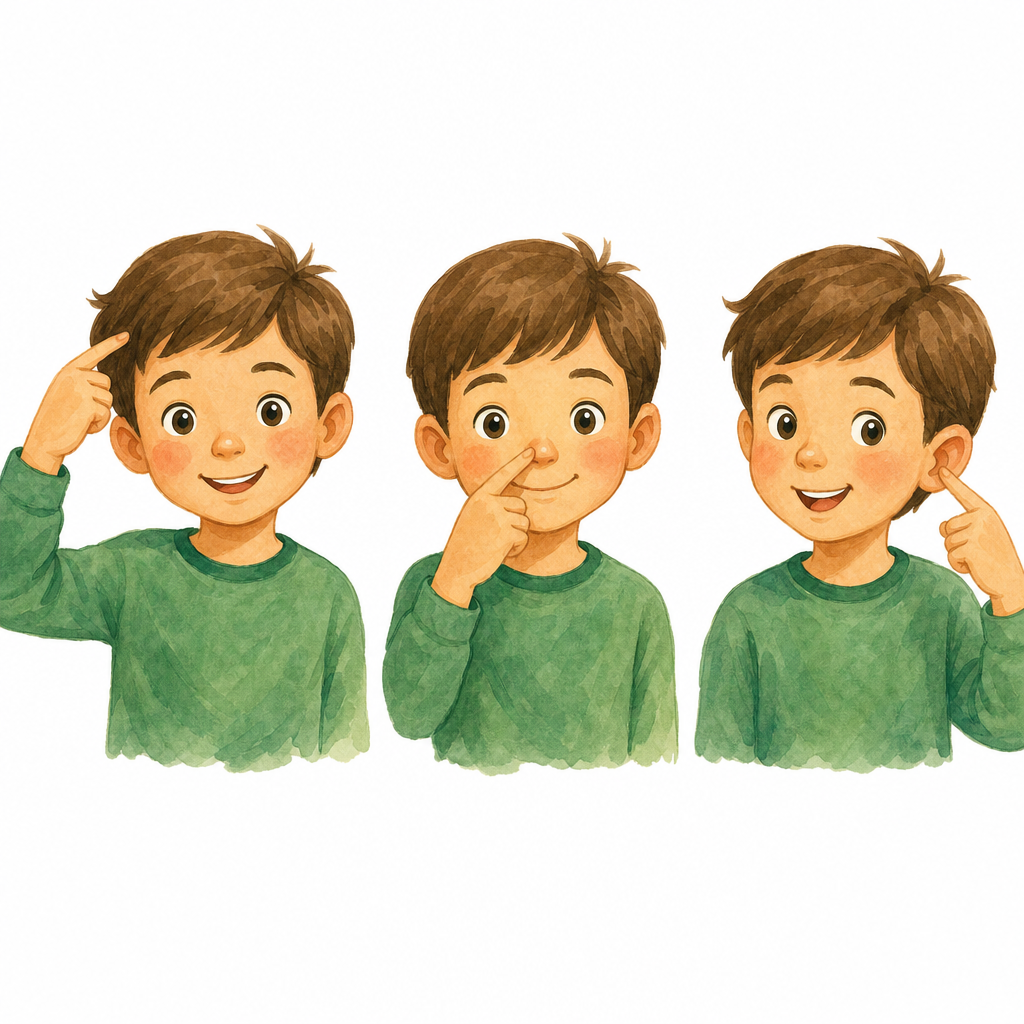
Touch your head, your nose, your ear. You already know the English words. By the end of today you will name eight body parts in French, with the right le, la or les in front of each one. Later we will play a French version of Simon Says: Jacques a dit.
Lead a quick Simon-Says style warm-up in English first: head, nose, ear, hand. Keep it to about a minute so the class is moving and ready. Do not introduce the full French list yet; the word-table in the next step does that job. Tell them that once they know the French words, the same game becomes Jacques a dit (the French Simon Says) and they will play it later today. If anyone already knows a French body-part word, smile and park it: "Great, we will meet that one in a moment."
Here are today's eight body parts. Tap each one, listen, then say it back together.
We will learn them in two groups of four. Watch which take le, which take la, and which take les. When a word starts with a vowel sound after les, you hear a linking z: les oreilles sounds like "lay zoh-RAY" and les yeux like "lay zyuh".
Run the list in two chunks so the class can hold the sounds. First four (face): la tête (lah tet), le nez (luh nay), les oreilles (lay zoh-RAY), les yeux (lay zyuh). Tap each word; class repeats twice (all together, then by table). Point at the article every time so the pair is what they hear.
Then the next four: la bouche (lah boosh), la main (lah mah(n), soft nasal n), le pied (luh pyay), le bras (luh brah). Play les yeux and les oreilles an extra time and celebrate when the liaison clicks: "Yes, that little z sound is the link."
After the full list, ask: "Which ones take la? Which take le? Which take les?" Count them together so the articles are noticed, not just heard. Optional extension if you have a spare minute later: the song Tête, épaules, genoux et pieds (Head, shoulders, knees and feet) uses some of these words, pupils often love spotting the ones they know.
Flip two cards at a time and find each French body-part word with its English meaning. Say the French quietly, article included, as you turn each card.
Whole class on the IWB with volunteers taking turns. Tables can call the next pair from their seats, no devices needed. Insist on the full phrase: "tête" alone is not the answer, "la tête" is. If a pair is missed twice, stop and say it together before moving on. This consolidates meaning after the word-table so the label game later feels fair. Praise full phrases out loud when you hear them ("la main, not main, perfect").
Open your copy and write the eight body parts with their articles. Circle the two you found hardest to say.
Pause the board. Everyone writes: this is the only three minutes where every pupil's pen is moving. Keep the word-table on screen while they copy. Walk the room and check the article is going in front of every word, including the plurals les oreilles and les yeux. Do not collect these.
Look at the figure and the word tags below. Before each tag is placed, the whole class whispers the French phrase together. Then a volunteer clicks the correct label. At the end we play a quick round of Jacques a dit: listen, touch the part, and say the French.
Run this on the IWB with volunteers. Before the first label, model one fully: point to the head on the figure and say la tête (lah tet), class whispers it, then place the tag. Keep that beat for every label: point → whole class whispers the full phrase → volunteer places the tag. If a wrong label is chosen, invite the class to try again rather than correcting yourself straight away.
When the figure is fully labelled, give the class a quick round of applause, eight articles, no word list. Then run 60–90 seconds of Jacques a dit: you call la main, le pied, les yeux and so on; the whole class touches that part and repeats the phrase. Let one confident pupil call two or three rounds. Every voice gets a turn without devices or scripts.
You're previewing this lesson. Get full access to this lesson and hundreds more — each one ready to teach, with interactive activities, printable resources and pupil progress tracking built in.