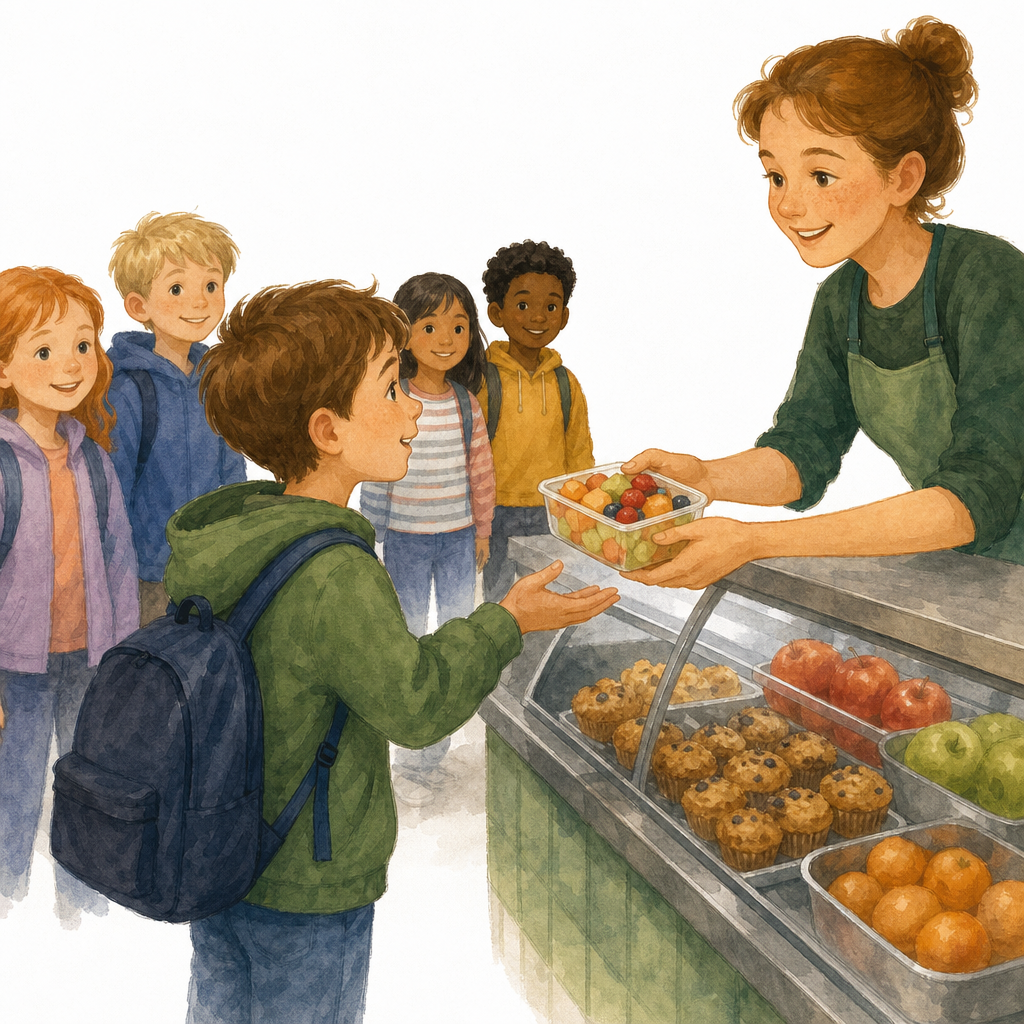
Watch what happens when we ask for a pencil with and without please. Which version works better?
Today you will learn eight German polite phrases so you can ask for something properly, not just point. Think of a busy school kiosk in Berlin: a little word can open the queue.
Open with a quick demonstration: ask a pupil for a pencil in a flat, blunt way, then again with a warm please. Keep it light so nobody feels scolded. Collect two or three reactions about why the polite version works better, then move straight into the word table.
Quick culture hook: in Germany, bitte turns up constantly in shops, on trains and at the school kiosk, not only at the dinner table. Pupils will hear it everywhere.
Pronunciation you will need today: Bitte (BIT-tuh), Danke (DAHN-kuh), Bitte schön (BIT-tuh shurn), Entschuldigung (ent-SHOOL-dee-goong), Entschuldige (ent-SHOOL-dee-guh), Entschuldigen Sie (ent-SHOOL-dee-gen zee), Ja (yah), Nein (nine).
Here are today's eight polite phrases. Tap each one, listen, then say it back together. Notice how short most of them are: a little word can do a lot of work.
Keep all eight visible, but pace the oral work in two clusters so nobody drowns in the list.
Cluster 1 (core request words): Bitte, Danke, Bitte schön, Ja, Nein. Tap each, class repeats twice (whole class, then by table). Point at the screen so eyes stay on the spelling as well as the sound.
Cluster 2 (excuse-me family): Entschuldigung, Entschuldige, Entschuldigen Sie. Spend longer on Entschuldigung: break it into chunks (Ent-schul-di-gung), class says each chunk, then the whole word twice. After a strong choral pass, give a quick longest-word victory lap (cheer the table that lands it cleanest). Flag that Entschuldige is for a friend and Entschuldigen Sie is the polite form for an adult or stranger.
Flag that Bitte (BIT-tuh) will come back in Talk time because it means more than one thing.
Before the matching game, model this short kiosk exchange once with a volunteer so production has a clear target: A says Ein Wasser, bitte (ine VAS-ser, BIT-tuh: A water, please). B answers Bitte schön (BIT-tuh shurn: Here you are). A replies Danke (DAHN-kuh: Thank you).
Watch the board. Volunteers flip two cards at a time and find each German phrase with its English meaning. When a German card appears, everyone says that German phrase aloud together so your ear gets another go.
Run this as a whole-class game on the IWB only. Volunteers take turns flipping; the rest of the class stays on echo duty. Audio plays on every flip, so pause and have the class echo any phrase that is missed twice.
Listen especially for the soft sch in schön (shurn) and the long middle of Entschuldigung. If a pair is stuck, reveal the English first and ask which German phrase they would choose before they flip again.
Keep energy high: after every three matches, a quick silent thumbs-up if the class echo was strong, or one more choral pass if it was muddy.
Open your copy. Write the German for please and the German for thank you. Then copy the full drink request from the board, including the English underneath.
Pause the board and project this model clearly before anyone writes:
Ein Wasser, bitte (ine VAS-ser, BIT-tuh): A water, please.
Choral-read the model twice, then keep it on screen for the whole copy moment. The task is exactly: write Bitte and Danke, then copy that full model sentence (pupils who already know another drink word may substitute it if it is still visible, but nobody invents spelling from memory).
Check that bitte appears in the request, and that capital letters are copied carefully. Do not collect the copies.
You are at the school kiosk in Berlin. Work with a partner. Keep the full German script on the board the whole time and stick to those lines.
Round 1: Order a drink politely, take what is handed over, and thank your partner.
Round 2: Practise a short excuse-me exchange after a gentle bump (choose the friend form or the adult form from the board).
Optional: One partner offers an imaginary drink; the other accepts or refuses, then thanks them if they take it.
When you hear the signal, swap roles so both of you ask and both of you answer.
Project this full script and the two drink prompts for the whole step. Do not leave pairs to invent lines.
Board script to project:
Round 1 (order a drink)
Round 2 (excuse me)
Optional offer
Choral-read Round 1 twice with the class before pairs begin, then model once with a volunteer. Keep the board visible while pairs practise.
Circulate and listen for full phrases rather than single words. Prompt shy pairs by starting the first line with them, then stepping back. Specific praise works wonders here: if you hear a gorgeous Bitte schön, freeze the room for one second and have everyone echo that version.
After about five minutes, signal a swap so both partners ask and both answer. Squeeze in Round 2 so the excuse-me family gets a real productive pass, not just recognition. End by inviting two confident pairs to perform for the class.
Do not let Partner B answer a request with Ja or Nein alone in Round 1: those answer an offer. Round 1 reply is always Bitte schön, then A's Danke.
You're previewing this lesson. Get full access to this lesson and hundreds more — each one ready to teach, with interactive activities, printable resources and pupil progress tracking built in.