Here are two questions. How tall am I? and How tall is everyone in our class?
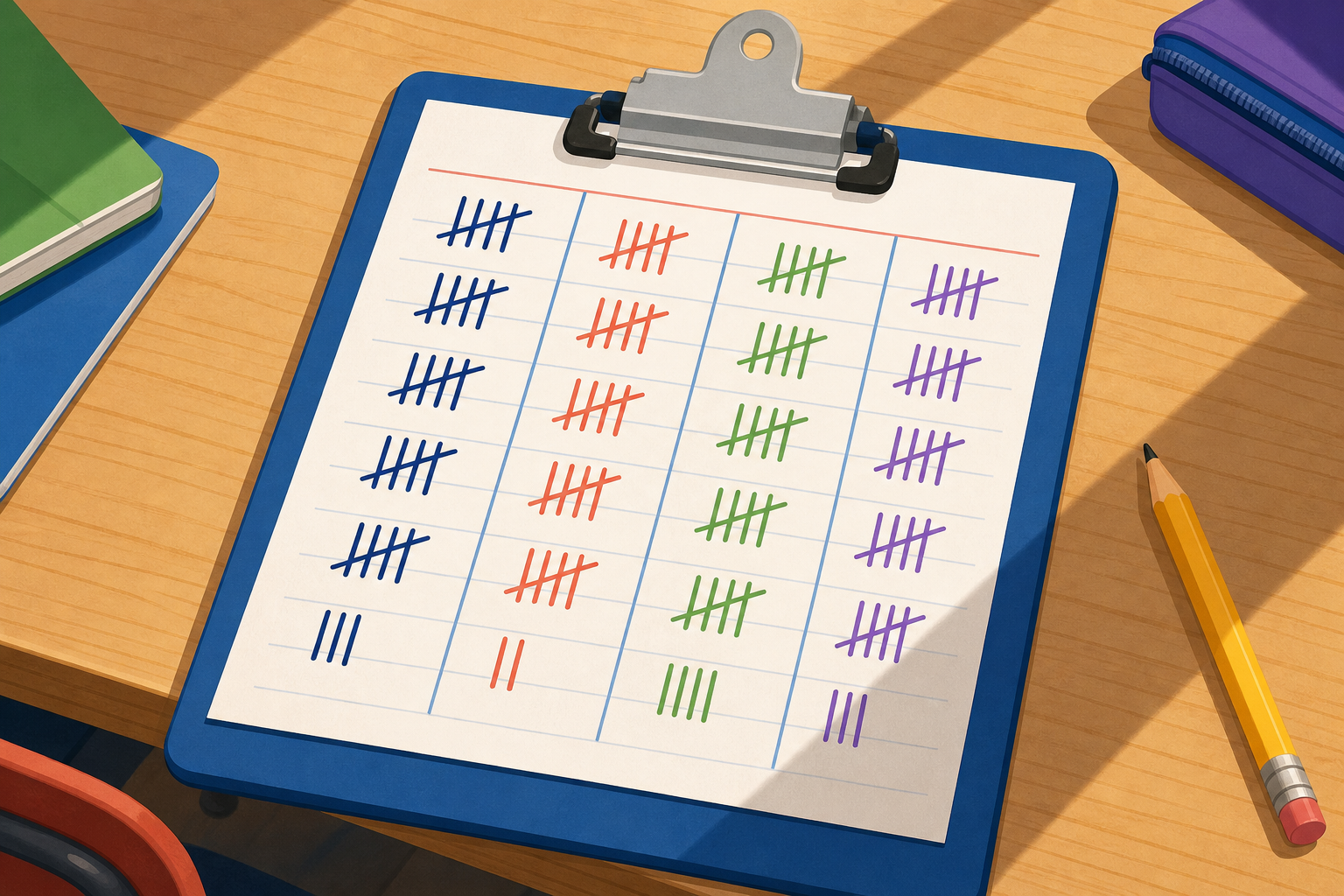
One of these is worth surveying the whole class about. The other you could answer with a single measurement. Which is which, and what makes a question worth asking lots of people?
Let's sort some questions together. A statistical question is one that expects lots of different answers when you ask a group of people. A question with just one fixed answer is not worth surveying.
Look at each of these four and decide: would the answers vary from person to person, or would everyone give the same answer?
Let's try this in your groups. Draft one statistical question you could survey the class with, then agree what kind of answers you'd expect to get back, and whether they'd really vary.
Write your draft on your group's paper first. Then we'll share each group's question at the board and refine the wording together so it is clear and gives a good spread of answers.
In your maths copy, write three statistical questions you could survey the class with. Beside each one, note what kind of answers you would expect to get back.
For example, beside What is your favourite sport? you might write a spread of sport names; beside How many minutes do you read at home? you might write a range of numbers.
Now let's run our agreed class question together. Our class question is the one we agreed on at the end of the discussion, written at the top of the board now.
Each of you writes your answer on a response card. As the cards come up, the recorder reads them out and writes each one into a list on the board, in the order they are read. This complete, unsorted list is our raw data: every answer written exactly as given, before any sorting or counting.
We'll gather answers row by row, so we may only get through part of the class today — that's fine. Watch for any response that doesn't actually fit the question, and if you spot one, explain why it doesn't belong.
The class's agreed statistical question, written at the top of the board at the end of the discussion step
Collect:
Show it as: A single raw list of responses, written exactly as given, before any sorting
What did you notice about our survey? Did our question give a good spread of answers, or did most people say the same thing? If we asked a vague question, what kind of mess might we end up with in our list?
Next we take a raw list like the one we built today and start to organise it — sorting wide-spread values into equal groups so the mess becomes a tidy table.
You're previewing this lesson. Get full access to this lesson and hundreds more — each one ready to teach, with interactive activities, printable resources and pupil progress tracking built in.