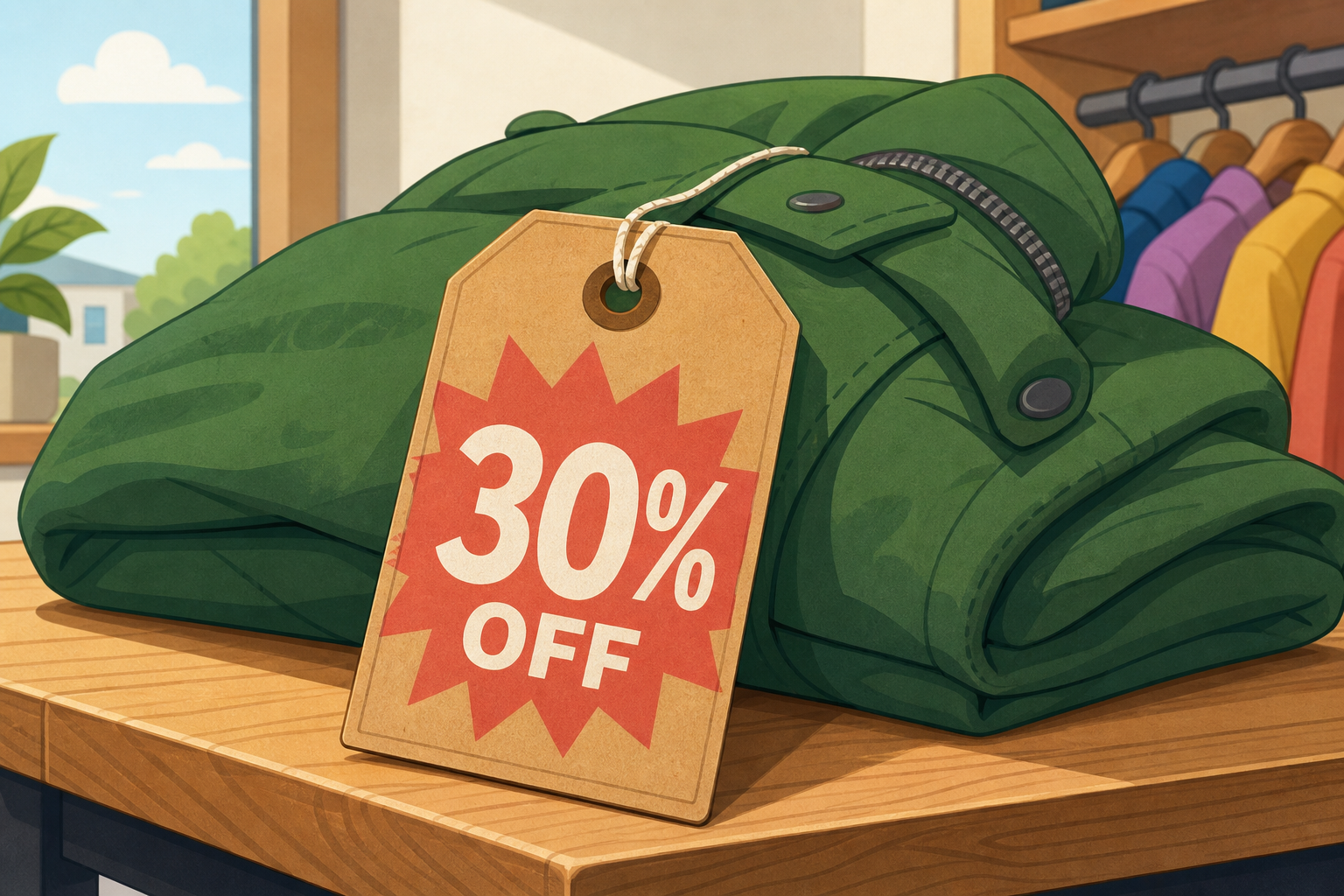
You are in a shop and you spot a sale tag: 30% OFF, €50. So what do you actually hand over at the till, and how much did you just save? Take a moment and picture it before we work it out together.
Display the tag as pupils settle. Take three hands-up answers only, not open call-outs. Listen for whoever says €35 straight away and whoever gets stuck on the saving versus the final price — both are useful contributions to revoice later.
Three price tags. Each time we build the percentage from one starting fact: 10%. Watch how the saving and the price to pay always add back to the original, and on the last one the total grows instead of shrinking. Predict each answer before you check.
Method to establish and keep visible: find 10% by dividing by ten, halve it for 5%, add lots of it for bigger percentages; name the 1% move once (divide 10% by ten) — they need it for the VAT problem later.
€50 coat, 30% off: 10% = €5, halve for 5% = €2.50, 30% = 3 × €5 = €15 saving, €35 left. Stress €15 + €35 = €50 — the whole bar is always the original.
€80 game, 25% off: hold the prediction (bigger or smaller than €15?) until pupils commit. Then 10% = €8, 5% = €4, so 25% = €8 + €8 + €4 = €20 off, €60 left. Dearer item loses more money for the same percentage.
€200 bill, 10% added on: the switch from taking-off to adding-on. Hold the length prediction (longer or shorter?). Then 10% = €20 added on top, bill becomes €220; extra €20 drawn past the original €200 mark — longer bar than we started with.
Today we work through this short shopping list together, one item at a time: a €60 jacket with 20% off, then a €30 top with 25% off, then a €120 bill with 10% service added, and finally a €80 pair of boots with 15% off. For each item we find the change, then say the final price, and check it makes sense against the original.
Here is one worked all the way through, so you can see the moves. Take the €30 top, 25% off: 10% of €30 is €3, halve it for 5% (€1.50), so 25% is €3 + €3 + €1.50 = €7.50. The saving lands on a cent here, €7.50, which is fine. Take €7.50 off €30 and you pay €22.50.
This round is for talking it through together — pupils take turns at the board and the class agrees or corrects out loud.
Run each item as: find 10% first, build up or halve to the percentage needed, then decide add or take-off. On the €60 jacket, 10% is €6 so 20% is €12 off, paying €48. On the €30 top, the €7.50 saving is worked on screen — watch for pupils dropping the cent. On the €120 bill, 10% is €12 added, giving €132 — the only increase in the round, so flag the direction change. On the €80 boots, 10% is €8 and 5% is €4, so 15% is €12 off, paying €68. Keep the board work brisk. Do not have pupils write here — the copybook beat comes next.
In your maths copy, make a four-column row for each item: the original price, the percentage change, the amount of change, and the final price. Box the final price in each row.
Walk the room glancing at the four columns and whether the final price is boxed — this is whole-class copybook practice, not marking. Watch for anyone adding on when they should be taking off on the €120 row.
Today we'll work through a set of shopping problems together, and they get a little harder each time. First, find the sale price of a €35 game with 30% off, then the saving on a €150 coat with 40% off, then the total after 23% VAT is added to €120 (VAT is a tax added on top of the price — here 23% is added to €120), and finally, here's the tricky one: which is the better deal, 30% off €90 or €70 with 10% added?
The VAT one is the biggest step, so here is how we build 23%: 10% of €120 is €12, so 20% is €24. For the last 3%, find 1% first (divide €12 by ten = €1.20), then 3% is 3 × €1.20 = €3.60. Add them: €24 + €3.60 = €27.60 of VAT, giving a total of €147.60.
These are the practice questions — pupils take turns at the board, check each answer, and the class confirms before moving on. Keep the board work brisk rather than over-explaining.
This is a open-ended round — every pupil can find 10%, and the strongest stretch to the two-offer comparison. If time is short, set the two-offer comparison as the item to return to.
You're previewing this lesson. Get full access to this lesson and hundreds more — each one ready to teach, with interactive activities, printable resources and pupil progress tracking built in.