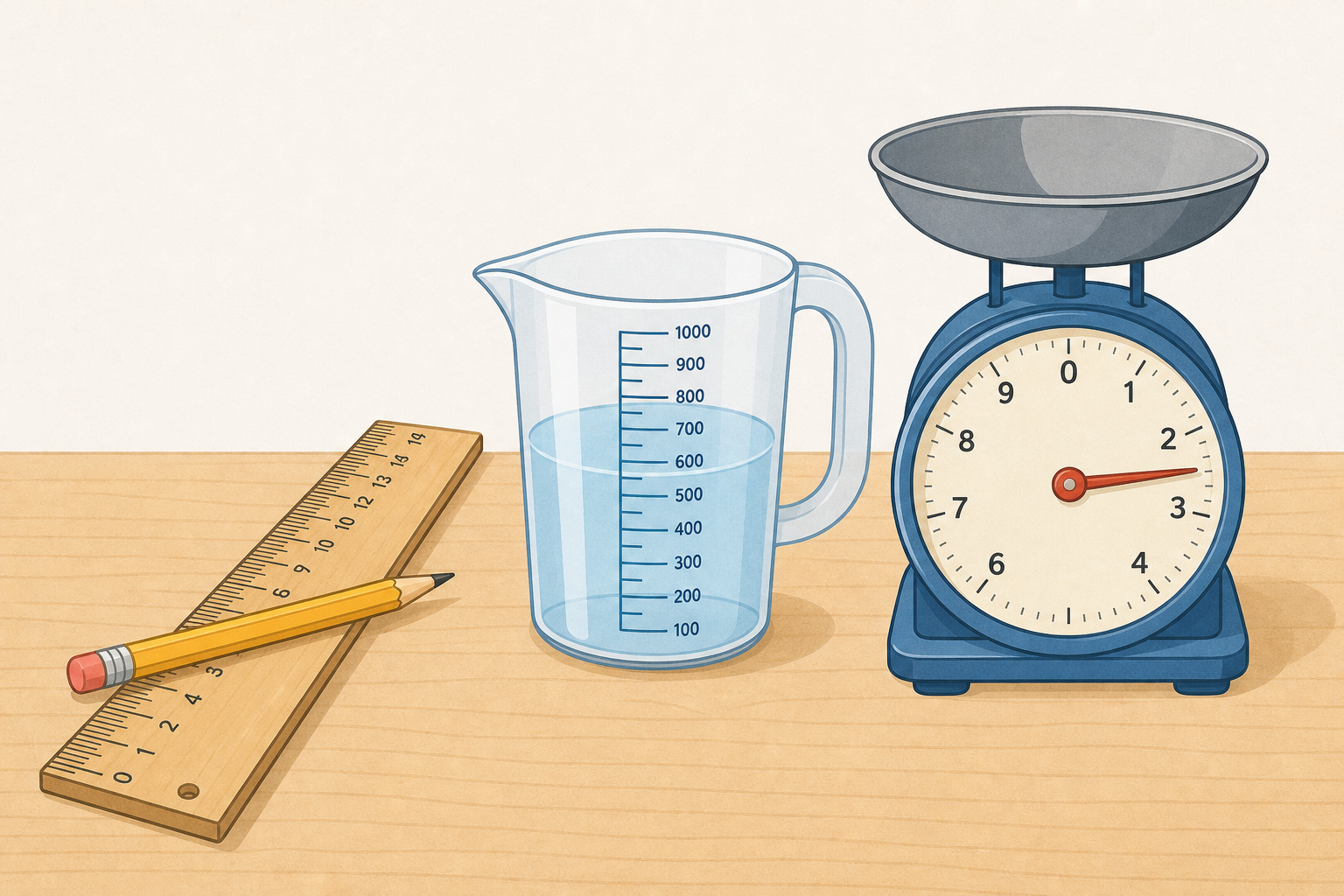
Here are three instruments, and on each one the pointer has stopped between two numbered marks: a ruler, a measuring jug and a weighing scale.
None of them lands neatly on a number. So what is each one actually reading? And how would you work out the little marks that have no number written on them?
Hold up the three real instruments (or show the photo) and take three hands-up answers, not open call-outs. Give five seconds of quiet think-time first.
Do not resolve the readings yet — the whole lesson is about the method. If a pupil says 'about 14 centimetres', revoice it as a question: can we be more exact than 'about'?
The interactive shows a ruler, a measuring jug and two weighing scales in turn. The same trick works every time — count the spaces in one gap, work out what one space is worth, then read the pointer. Watch where each pointer lands and what one small space is worth.
Name the move each time: count the spaces, divide the gap, then read.
Ruler: pencil edge halfway between 14 cm and 15 cm, ten 1 mm spaces, reads 14.5 cm. Ask what one space past 14 would read.
Jug: five spaces from 300 ml to 400, so 100 ÷ 5 = 20 ml each; water three spaces up reads 360 ml. The divide-by-5 is the point — hold out for a pupil to say 20, not 10.
Scale (1.25 kg): ten spaces from 1 to 1.5 kg, so 50 g each; needle five spaces past 1 kg, 5 × 50 = 250 g, reads 1.25 kg. The 50 g spaces catch pupils who guess about 1.2.
Last scale: numbers only at whole kilograms, so find the division first — four spaces per kilo, 1000 ÷ 4 = 250 g each; needle three spaces past 2 kg, 3 × 250 = 750 g, reads 2.75 kg. Linger here; give it real dwell time.
If a jug or scale face does not render, hold up the real jug or scales (or the printed card) and work the same count-divide-read steps on it.
Before you go hands-on, let's bring one more ruler reading up on the board and work it through together as a class.
Show this interactive on the IWB; pupils call out each move and explain their thinking. This is a fresh reading, not a repeat of the earlier example, so pupils apply the count-divide-read method to a new value straight after seeing it modelled. This lesson is where the count-divide-read method and reading square-on are first established, so later measuring lessons reapply it rather than teaching it again.
In your maths copy, for each of the four instruments write three things, one under the other:
Underline the unit on every reading.
Walk the room glancing at whether pupils have written the division value before the reading — that order is the whole method. No individual marking; this is whole-class copybook practice.
Now you measure. Each group has a real ruler, a part-filled measuring jug and a set of weighing scales.
Work through them in order. First the ruler: measure the glue stick. Then the jug: read the water level. Then the scales: weigh the object on your table. For each one, say out loud what one small space is worth before you read the pointer. Keep your eye square to the scale.
If your class has only one or two sets of scales, take turns at a scales station while the others start on the ruler and jug. Any group without a real jug or scales can use the printed instrument cards instead — the reading skill is exactly the same.
Minimum kit per group is a ruler and a glue stick; a jug and scales can be shared as a station if you have only one or two, and any group without real kit uses the printed cards. Pupils measure at their desks with their own instruments — circulate and catch alignment slips on the spot. The class reads aloud and you reconcile any disagreement as you circulate.
Watch for the glue stick not started at zero, and for pupils reading the jug from above or below the surface. Crouch to eye level with a group to model the square-on read. Pair a pupil who is less secure with a peer who reads carefully.
Real instruments carry this step, so nothing here depends on the board rendering a jug or scale; the printed instrument cards are the backup for any group short of real kit.
You're previewing this lesson. Get full access to this lesson and hundreds more — each one ready to teach, with interactive activities, printable resources and pupil progress tracking built in.