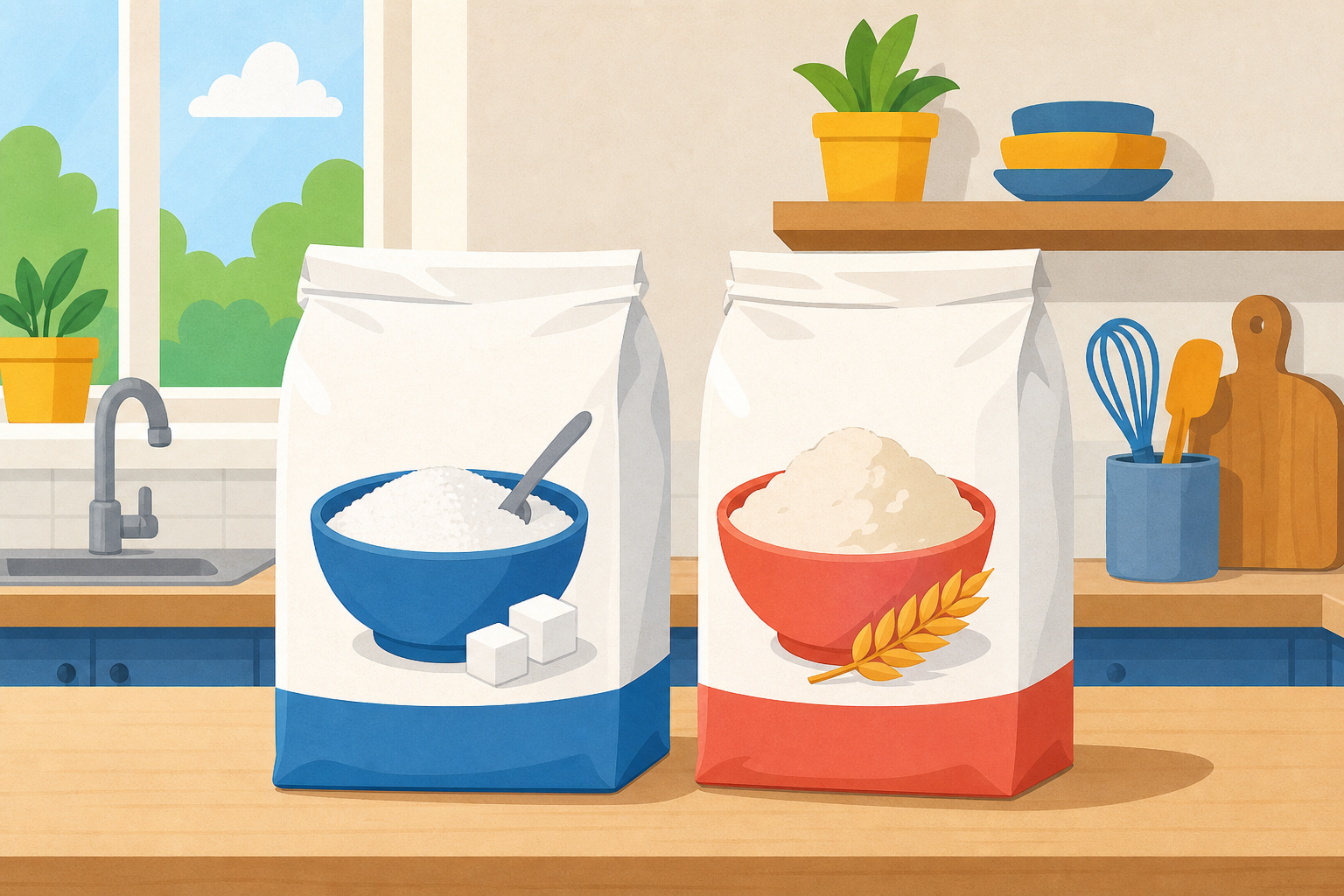
Here are two things from the shop: a bag of sugar with 1 kg written on the label, and a bag of flour with 1,000 g written on the label. Hands up: which one is heavier, the sugar or the flour? Or are they somehow the same?
Display the two labels side by side as pupils settle. Take three hands-up answers, not open call-outs, and don't confirm yet — the surprise that they weigh exactly the same is the hook for the whole lesson. Write 1 kg = 1,000 g on the board to hold the question open.
The interactive shows a conversion ladder for weights between kilograms and grams. Look at how the digits sit across the columns on each card. Notice which way we multiply and which way we divide.
First we work one rename all the way through on the board:
1,500 g → kg and g
Then we watch the ladder with three more: 1 kg to grams, 2 kg to grams, and the mixed unit 1 kg 200 g combined into grams.
Point at the gap chip carrying the × 1,000 throughout.
Worked example on the board first (narrate, do not rely on the interactive to animate the split): 1,500 g → kg and g.
Slip to watch: pupils writing 1.5 kg or dropping the 500 g. Keep kg and g, never a decimal kilogram.
Ex 1, 1 kg to g: same weight, two names. 1 kg = 1,000 g. Link back to the sugar and flour from the hook.
Ex 2, 2 kg to g: pause before the reveal, take a prediction. If 1 kg is 1,000 g, how many grams in 2 kg? Answer 2,000 g, each kilogram carries another thousand.
Ex 3, 1,500 g to kg and g: replay the board example on the ladder so the digits step into place. Result 1 kg 500 g.
Ex 4, 1 kg 200 g to grams: combine first, the kilogram is 1,000 g, still have 200 g, together 1,200 g. Ladder can show 1,200 g and 1 kg 200 g as the same weight.
Don't move on until the class can say × 1,000 goes to grams, ÷ 1,000 goes back, and a mixed unit is combined first before reading the total in grams.
Today we work through these weights together on the ladder: first 3 kg to grams, then 4,000 g back to kilograms, then 1 kg 200 g to grams, and finally 2,750 g to kilograms and grams. Before each one we will say whether we multiply or divide.
This round is for talking it through together — pupils take turns at the board and the class agrees or corrects out loud.
Rotate two pupils, one per weight. Before each drag, ask the class: are we going to a smaller unit or a bigger one?, that decides multiply or divide.
In your maths copy, complete this short rename column, showing your working beside each one:
For each line, first write whether you are multiplying by 1,000 or dividing by 1,000.
Walk the room glancing for the × 1,000 or ÷ 1,000 note beside each line — this is whole-class copybook practice, not marking. The third line, 1 kg 200 g, is the same mixed-unit weight the class combined together in Watch and Notice and Try It Together, so pupils have seen the combine step before meeting it here. Watch for the last line: pupils who do not write 1 kg 750 g have forgotten there is a full thousand in 1,750.
We work through four renamings on the board, and they get a step harder as we go. The first two are single steps: 4 kg to grams multiplies by 1,000, and 5,000 g to kilograms divides by 1,000. The last two ask for the answer in both units: 1,300 g and then 2,250 g, each written as a number of kilograms and the grams left over. Type the kilograms in the first box and the leftover grams in the second.
These are the practice questions — pupils take turns at the board, check each answer, and the class confirms before moving on. Keep the board work brisk rather than over-explaining.
The last two are the ones that catch people out. For 1,300 g, pupils divide by 1,000 to get 1 kg with 300 g left over; watch that the leftover is not dropped or turned into another kilogram. For 2,250 g the split is 2 kg 250 g. Ask each pupil to predict before they press Check.
You're previewing this lesson. Get full access to this lesson and hundreds more — each one ready to teach, with interactive activities, printable resources and pupil progress tracking built in.