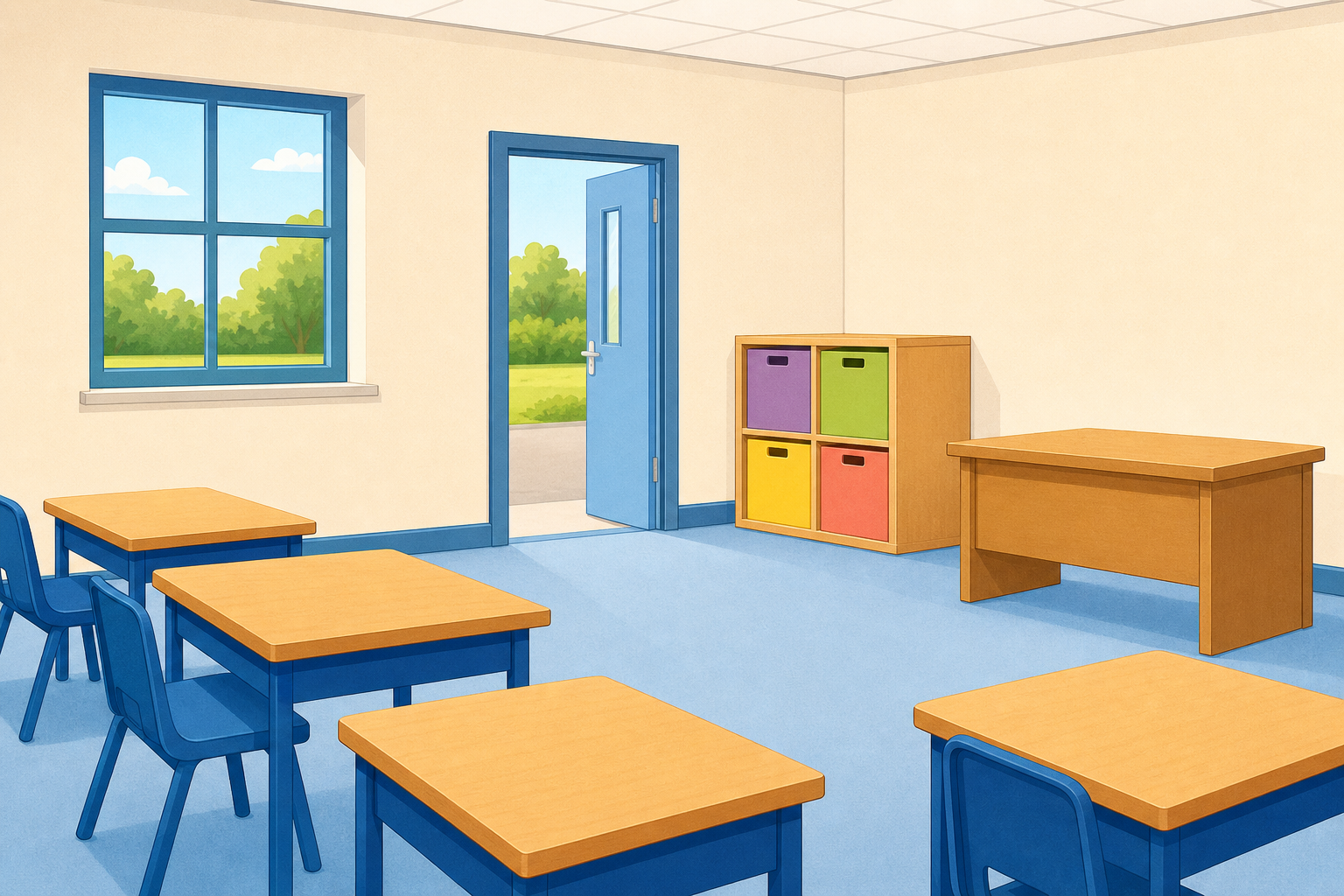
Look around the room. Where can you already see a perfectly square corner?
Hands up and point to one you can see from your seat.
Take three or four hands-up answers, pointing at each corner named. Give a few seconds of quiet looking-time before hands go up.
Square corner is the phrase to hold onto here. Keep the folded-paper tester out of sight for now; it appears in the next step.
A square corner has a special name in maths: a right angle. To check whether a corner really is a right angle, we make and use a folded-paper tester.
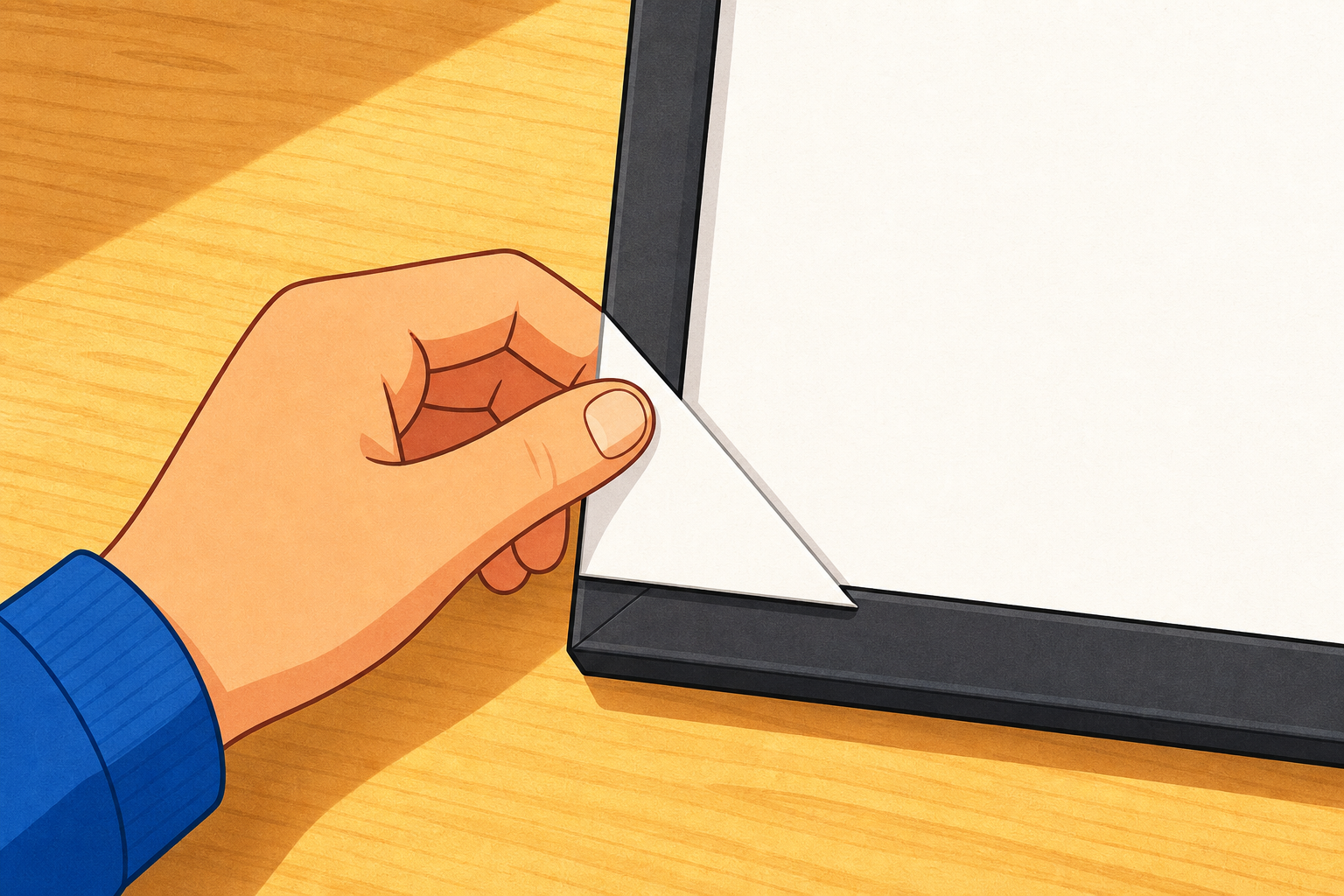
First we make the tester together. Take one sheet of paper. Fold it carefully in half and press the crease flat. Fold it in half again the other way and press that crease flat too. The sharp folded point is a perfect square corner. That point is your right-angle tester.
Now watch the tester held into four different corners. Notice which ones it fits exactly, with both edges lying flat, and which one it does not fit. If both edges lie flat, the corner is a right angle. If a gap opens, it is not.
Real paper demo, not on-screen. Give every pupil one A4 sheet before you start so they fold along with you.
Worked example, end to end (do this once, slowly):
Say the fits-or-does-not-fit rule aloud each time. Pause on the last one so pupils spot the gap themselves.
Slip to watch: pupils who fold loosely or stop after one fold, so the point is rounded, not square. Refold with them before testing. Also watch pupils who judge by side length instead of the corner; revoice: it is the square-ness of the corner that matters, not how long the sides are.
Keep the tester in every pupil’s hand for the sorting steps that follow.
One pupil comes to the board while everyone else watches and agrees or corrects out loud. For each corner we ask the same question: is it a right angle, or not a right angle?
Think back to the paper tester. Would both edges lie flat against this corner, or would a gap open? We will look at the corner of a square card, the corner of a rectangle, a slanted corner of a triangle, and a wide open corner.
Talk this one through together — a pupil at the board sorts each card while the class agrees or corrects out loud.
Show each corner on screen, then before the pupil drags it, ask the class to predict by recalling the fits-or-does-not-fit rule. The pupil then drags the card into Right angle or Not a right angle. In explore mode there is no Check button — the class reconciles any disagreement aloud.
If a corner is genuinely disputed, hand the real folded paper to the pupil at the board to hold against a matching real corner before they decide. Watch for pupils who judge by the length of the edges rather than the openness of the corner. Revoice: it is not about how long the sides are, it is about the square-ness of the corner. Rotate four pupils.
Watch one worked example on the board first: two straight lines meet to make a square corner, then the little square symbol is drawn snug inside that corner to mark it as a right angle.
In your maths copy, draw a right angle the same way. Mark it with the little square symbol in the corner to show it is a right angle. Then write down where in the room you found a matching square corner.
Model once on the board before anyone draws. Worked example: draw two straight lines that meet (like an L), pause, then draw the little square symbol tight inside the corner, not floating outside. Say: this little square is the mark that means right angle.
Pupils then copy the same steps in their books. Walk the room glancing that the little square is inside the corner, not beside it. This is whole-class copybook practice, not marking.
If the IWB is unavailable, the printable Right Angle Hunt worksheet gives every pupil the same draw-and-label box to work in here, and a corners grid to sort in place of the on-screen rounds.
Now we sort corners together in four rounds that get trickier as we go. A pupil comes to the board for each round while the rest of the class agrees or disagrees out loud. Round 1 has two clear corners, Round 2 adds a rectangle, Round 3 mixes four corners, and Round 4 tests the tricky ones, including a corner that is almost square but not quite.
Before each corner is sorted, picture the paper tester against it: would both edges lie flat, or would a gap open?
This is the practice round — a pupil at the board sorts each corner while the class confirms before moving on. Keep the board work brisk rather than over-explaining.
The rounds rise in difficulty. In Round 4 the last corners are deliberately close to square, so the pupil must think carefully before deciding. When a pupil is unsure, hand them the real folded paper to hold against a matching real corner. Prompt: does the gap open a little, or does it lie flat?
Watch Round 4's 'Book held at a tilt': a tilted book still has square corners — turning the book does not change the corner. Use it to reinforce that a right angle is the same square turn whatever its position.
You're previewing this lesson. Get full access to this lesson and hundreds more — each one ready to teach, with interactive activities, printable resources and pupil progress tracking built in.