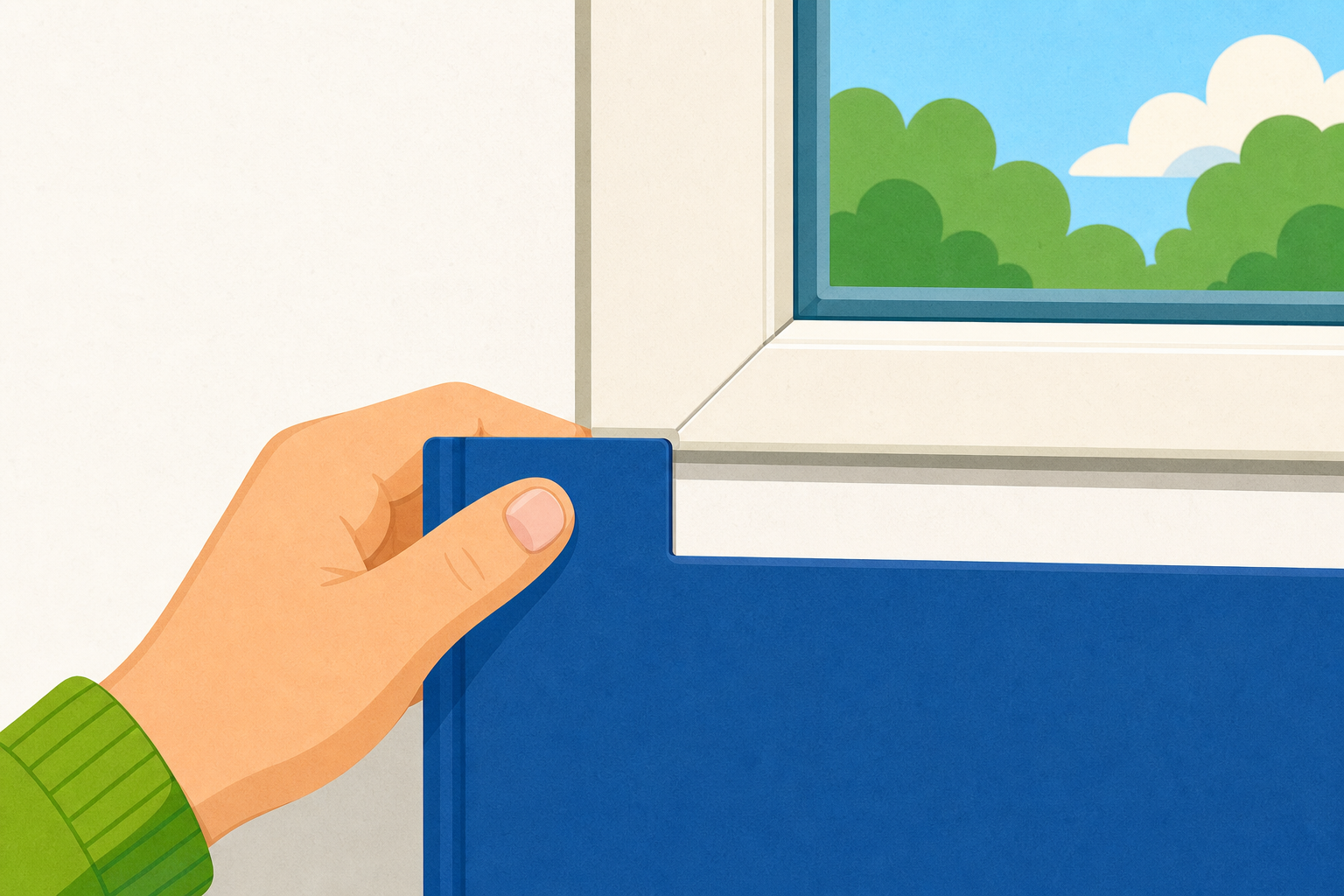
Look at the corner of your copybook. Now look at the corner of the window, and the corner of the door.
Some corners are square and neat. Some are wide open or pinched shut. A square corner has a special name in maths. What do you think we call it?
Take three hands-up answers, not open call-outs. Some pupils will already know the words right angle or square corner — accept both. Give five seconds of quiet think-time before hands go up.
A right angle is a square corner. Watch me make a checker for it: I fold a piece of paper in half, then in half again the other way. The folded corner is a perfect right angle, and I hold it against any corner to test it. You will make your own checker later on.
Watch me test four corners on the board. For each one, decide before I confirm: does the square corner fit exactly, is the corner too small, or is it too big?
Make a folded checker in front of the class first — fold once, fold again the other way, hold it up, then test it against a known right angle like your book corner.
Ask each time: does the square corner fit exactly? Hold out for a prediction before you confirm.
Picture the square-corner test each time.
Now we test corners together on the board. Sort each corner card into the right group: Right angle or Not a right angle.
Today we work through these together: the corner of a book, the corner of a party hat, the corner of a picture frame, and the corner of an open fan. For each one, decide if it is a right angle or not before you drop the card.
Talk this one through together — pupils take turns at the board and the class agrees or corrects out loud.
Hold out for the reasoning, not just the sort: ask would the paper checker fit that corner exactly? before each drop. The party-hat point is too small; the open-fan corner is too big. Revoice a good answer: so a right angle is neither pinched nor wide open — it is exactly a square corner.
In your maths copy, use the corner of your copybook as a guide to draw two right angles. Line the copybook corner up, trace along both edges, then lift it away.
Mark each one with a small square in the corner to show it is a right angle.
Walk the room glancing for the small square mark in each corner and for edges that meet cleanly — this is whole-class copybook practice, not marking. Watch for pupils tracing too fast so the lines do not quite meet.
Time to be right-angle hunters. First, fold a scrap of paper in half, then in half again the other way — that folded corner is your own checker. Then, working at your own desk, use it to find:
count how many right angles are in a rectangle, and check each one with your checker.
Every pupil folds a checker and hunts at their own desk — this is independent practice, not a turn-by-turn board loop. Circulate and prompt: does it fit exactly? Watch for pupils calling a slightly-off corner a right angle because it looks square — send them back to the checker. In the last minute, take two or three pupils holding up a find for the class to confirm. For the stretch, a rectangle has four right angles; a strong pupil should check all four, not assume from one.
You're previewing this lesson. Get full access to this lesson and hundreds more — each one ready to teach, with interactive activities, printable resources and pupil progress tracking built in.