1 - Start ~4 mins
Today you run the democracy action you planned. Something should be different afterwards, and somebody outside this class should notice. Your job is also to catch the evidence while it happens: what you asked for, who you asked, what they said, and what changed. Waiting until later never works.
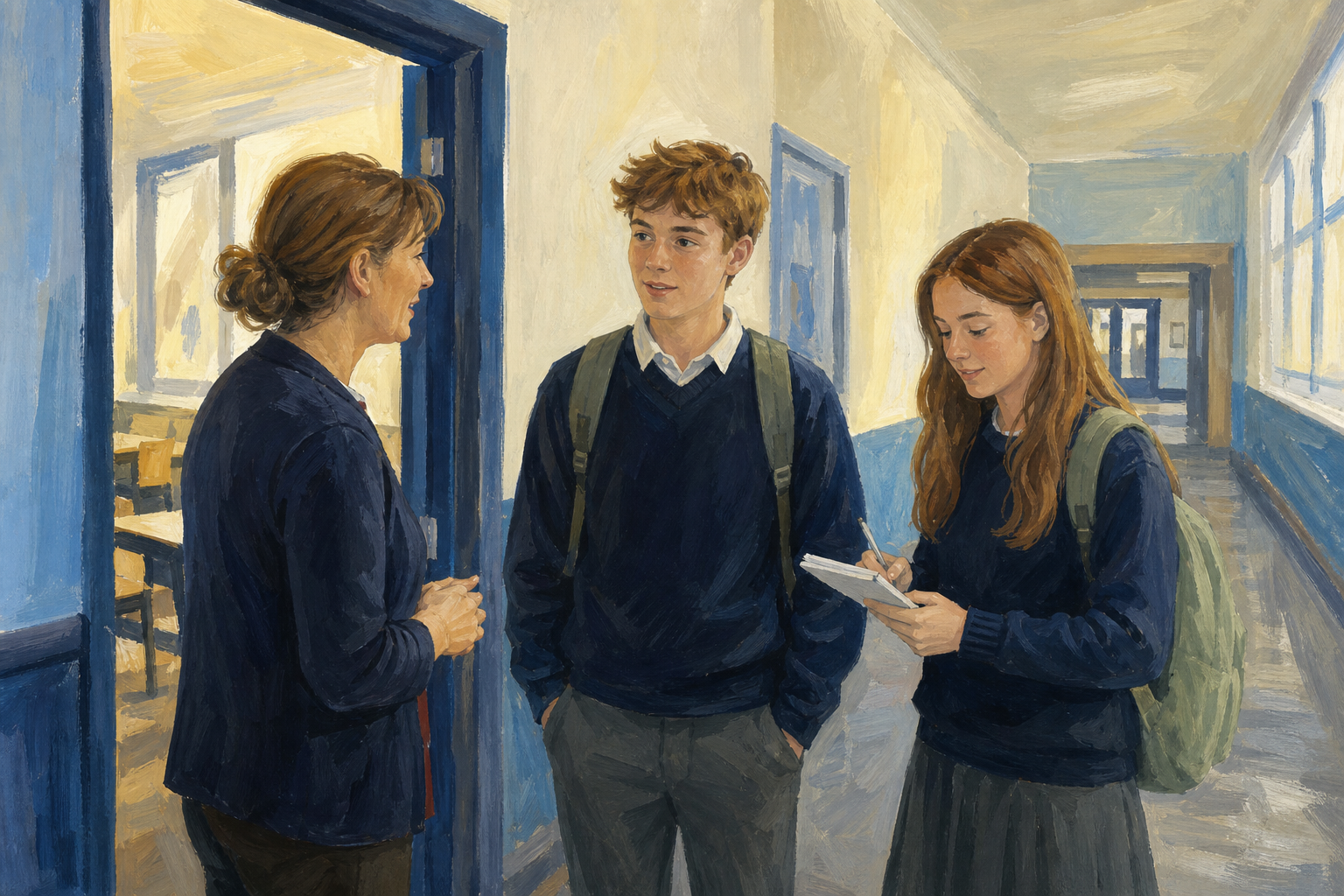 Look at the class plan on the board. It stays up all period and shows three lines every group needs: the ask, the audience, and what counts as done for today.
2 - What Good Evidence Looks Like ~5 mins
For a democracy action, useful evidence is concrete. Write down the question or request you put to someone. Name who you spoke to and the role they hold. Note what they answered, even if the answer was no, not yet, or nothing. Record what changed today and what did not.
A photo of a blank corridor proves little. A dated note that says "asked the year head about a suggestion box; she said bring it to the student council meeting on Thursday" is evidence you can use later. The awkward bits count too: a door you could not get through, a reply that never came, a plan you had to change mid-way.
The four headings stay on the board while you work: what we asked, who we asked, what they said, what changed.
3 - Run the Action ~23 mins
Before you leave your seats, each group reads aloud in thirty seconds: your one-line ask, your audience, and who does which role today. Stay with that plan.
Today you only go to people inside the school: someone nearby, or someone who has already agreed to see you, and the walk there and back must take under fifteen minutes. Anyone outside the school is contacted later, for homework or in the next lesson. If the person you planned to ask is not there, go to the back-up contact your teacher has agreed with your group. Your teacher will ask at least one group to stay in the room and write the ask as an email or letter, so the class still has evidence if a door is closed.
In your roles, carry out today's part of the action. Capture evidence under the four headings as you go. One short dated note per contact is enough. If something stalls, write what stopped it and what you tried next. Do not invent a smoother version later.
Return to the room when called, with your notes ready to share.
4 - Make Sense of It ~5 mins
As a class, say out loud:
- one thing that went as planned
- one thing that did not
- one piece of evidence worth keeping
- one thing still unfinished
Keep each answer short and factual. The unfinished work becomes the next step, not a reason to pretend today was complete.
5 - What You Covered ~3 mins
You carried out part of a real citizenship action on democracy, power or the law. You practised catching evidence while the work happened: the ask, the person, the reply, and the change. That record is what lets you explain the action later, including the parts that did not go to plan.
Before you pack up, the group's note-taker files today's dated notes in the class evidence folder (or the shared class document your teacher names). One person per group holds the original until it is filed. Do not leave notes in four different bags.
Unlock the full learning experience
You're previewing this lesson. Get full access to this lesson and hundreds more — each one ready to teach, with interactive activities, printable resources and pupil progress tracking built in.
This lesson is copyright of Coding Ireland 2017 - 2026. Unauthorised use, copying or distribution is not allowed.